
Each week, our analysts track the developments reshaping organic visibility and AI discovery. Brands building search programs can partner with vetted SEO agencies for strategic implementation.
Microsoft launched Web IQ, a search API built exclusively for AI agents, not human searchers.
The same week, Google began testing a Search Console toggle that lets UK publishers opt their sites out of AI Search features, even as reporting on those experiences remains limited.
The May 2026 core update completed after nearly 12 days, with practitioners describing it as heavier than March.
Here is what search news looked like this week.
Microsoft Builds a Search Engine for AI Agents
Web IQ is a suite of AI-native grounding APIs powered by the Bing index, built specifically for how AI agents search rather than how humans browse search results.
Where Bing prioritizes ranking, the API prioritizes extracting the right information quickly and at low token cost.
The system runs roughly 2.5 times faster than the next-best alternative, summarized as "fewer tokens in, better answers out, lower cost per call," Bing Search Blog reports.
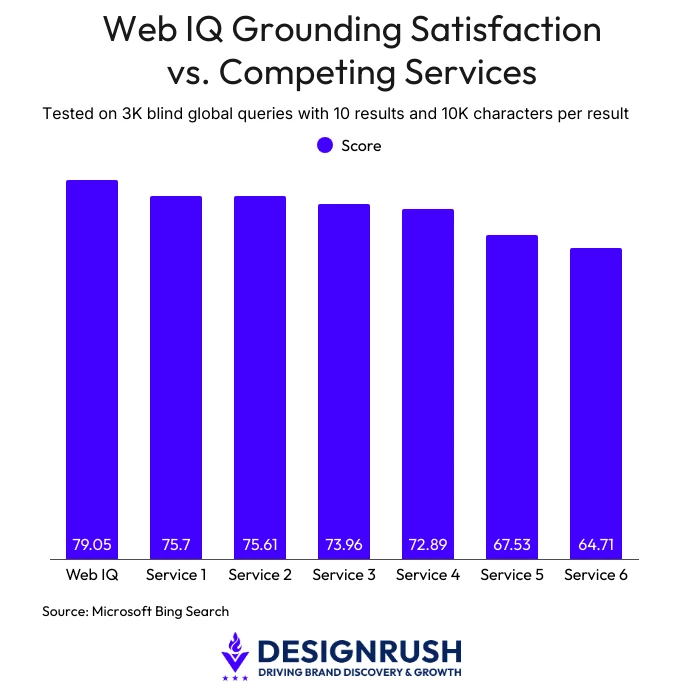
Microsoft's benchmarks across a 3,000-query global test set show Web IQ achieved a grounding satisfaction score of 79.1, compared with 75.7 for the closest competitor.
Grounding satisfaction refers to Microsoft's measure of how well retrieved information satisfies user intent based on completeness, freshness, and authority.
Microsoft is positioning Web IQ as infrastructure for AI systems that require real-time grounding and retrieval from the web.
The agentic web now has two major infrastructure players: Bing and Google.
Google Gives Publishers a Toggle on AI Search
Two new Search Console features are now being tested with UK publishers as part of commitments tied to requirements from the UK Competition and Markets Authority.
The first is a Search generative AI control that, according to Google, lets publishers opt their sites out of AI Overviews, AI Mode, and generative AI features in Google Discover.
Sites that opt out will not receive traffic or impressions from those features.
The initial Search Console reports focus on impression and visibility data, with Google indicating that additional metrics may be added over time.
Click data and query-level metrics are not yet included.
The enforcement date for the opt-out control in the current UK test cohort is June 17, 2026. Google plans to expand both features beyond the initial testing phase following the rollout.
May Core Update Hits Harder Than March
The May 2026 core update was completed on June 2, with volatility spiking multiple times during the 12-day window rather than settling after launch.
The SEO community's reaction landed somewhere between gallows humor and resignation.
Several practitioners noted that after months of AI Overviews compressing organic clicks, a core update feels like a secondary concern.
Others highlighted the six-week gap between March and May as the tightest update cadence in recent memory, leaving sites with less recovery time between disruptions.
Lily Ray, VP of SEO Strategy at Amsive, confirmed significant movement, with a handful of sites seeing major surges during the rollout.
A handful of sites started seeing big surges over the weekend with the core update pic.twitter.com/5lrFM2ayBI
— Lily Ray 😏 (@lilyraynyc) June 1, 2026
Google's guidance is to wait at least one full week after completion before reviewing Search Console data, then compare that week with the week before the rollout began.
The earliest clean comparison window opens around June 9.
SEO Industry Insights
Lily Ray flagged that many practitioners either forgot or never knew that site-wide schema pointing to Trustpilot brand reviews violates Google's structured data guidelines.
I think a lot of people forget this (or maybe never knew in the first place) pic.twitter.com/LAfQWqeaDt
— Lily Ray 😏 (@lilyraynyc) June 2, 2026
The Review Snippet documentation states explicitly: "Don't aggregate reviews or ratings from other websites."
Implementing it site-wide can trigger a Spammy Structured Data manual action, which typically requires correcting the markup and submitting a reconsideration request.
Responses in the thread noted that enforcement at scale is as hard as it is with paid links, but the manual action risk for sites caught doing it remains real.
Marie Haynes discovered that Lighthouse now includes an Agentic Browsing audit and published a walkthrough on how to run it.
Chris Long amplified the finding as one of the more significant technical SEO developments of the week because practitioners can run it directly in Chrome without any third-party software.
The audit runs in Chrome Canary and checks WebMCP implementation, CLS score, and LLMs.txt presence.
Haynes notes that LLMs.txt here serves agents navigating your site, not search ranking, the same file that sent conflicting signals across Google's own teams two weeks ago.
Common high-priority findings include:
- Missing LLMs.txt at the root level, a single Markdown file that tells AI crawlers how to index and use the site.
- ARIA role mismatches in navigation that affect how AI agents parse page structure.
- Missing aria-labels on search buttons site-wide.
- Subdomains need their own LLMs.txt files.
WebMCP is currently informational within the audit, though practitioners expect agent-facing protocols to become more important as AI browsing evolves.
Three priorities from this week:
- Do not analyze core update data before June 9. Any comparison window, including the rollout period, is unreliable.
- Audit site-wide structured data for third-party review schema. AggregateRating markup pointing to Trustpilot across multiple URLs risks a manual action penalty.
- Run the Lighthouse audit on subdomains separately. Each subdomain needs its own LLMs.txt file and accessibility check.
Our Take: Who's Running Your Site When No One's Watching?
Publishers opting out of Google's AI features are making a decision that applies to a single system.
The toggle has no jurisdiction over agent infrastructure that operates outside Google's index.
We think the more uncomfortable reality is that neither side is measuring agent traffic for publishers.
Google reports impressions without clicks. Microsoft reports grounding satisfaction without publisher consent.
Nobody is building the dashboard that shows what both systems combined are doing to visibility, content reach, and the business model.
UK publishers who opt out on the enforcement date will be the first data point the industry has on what that decision costs inside Google's system.
What it costs in Microsoft, nobody is counting yet.
For analysis on the SERP behavioral study, Preferred Sources expansion, and Pichai's agent convergence announcement, check out last week's SEO roundup.
Is your Search Console data clean enough to make the AI toggle decision right now?
These leading SEO agencies help brands stay visible as AI systems change which content gets cited and which gets filtered out.