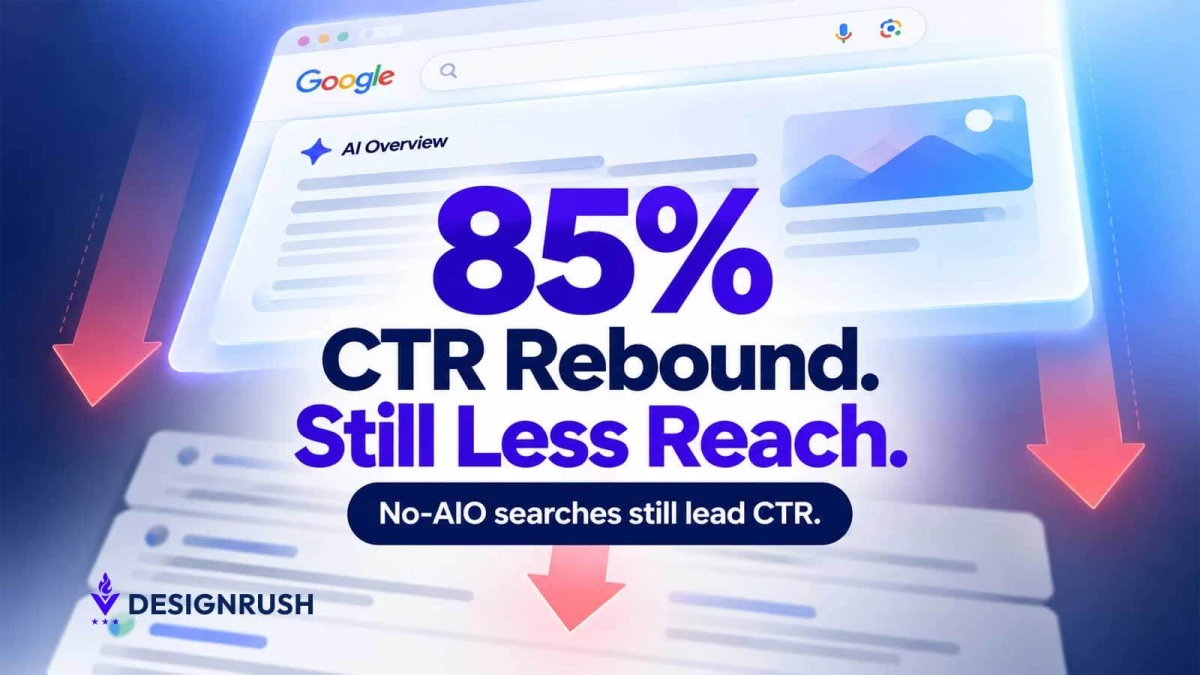

AI Overview-driven organic click-through rates rose 85% between December 2025 and February 2026, but Seer Interactive describes the trend as leveling off, not a recovery, and cautions against forecasting from just two months of data.
Seer Interactive tracked 5.47 million queries and 2.43 billion organic impressions across 53 brands from January 2025 through February 2026.
For searches with an AI-generated summary, organic CTR rose from 1.3% in December to 2.4% in February. Searches without an AI Overview reached 3.82% in February.
Seer also found that being cited inside an AI Overview generated 120% more organic clicks per impression than appearing in an AIO without a citation, yet cited results still received 38% fewer clicks (full-year effective CTR) than queries with no AIO.
The 85% rebound is less a return to normal than evidence that search is settling into a different set of rules.
The question is where those rules apply.
Where Do AI Overviews Appear Most Often?
AI Overviews appeared on 36% of informational queries in Seer’s February 2026 snapshot, compared with 8% of commercial queries and 5% of transactional queries.
That spread changes how an SEO program should be assessed from one page type to another.
"It tracks closely. The clients built heavily on informational content, blog posts, guides, and comparisons are dealing with a much bigger AIO footprint than clients whose traffic comes from product or category pages," says Chad de Lisle, Head of Marketing at Disruptive Advertising.
A company whose traffic comes largely from educational content may see much more AIO exposure than one whose organic program is weighted toward product, category, or service pages.
Seer found an even higher AIO rate on comparison searches.
Queries in an "X vs. Y" format triggered an AI Overview 95.4% of the time in its informational sample. Question-format queries triggered one 85.9% of the time.
De Lisle says Disruptive Advertising is increasingly looking at the questions Google isn’t summarizing yet.
"We’re spending more time identifying the specific questions Google isn’t summarizing yet, since that’s where the clicks still are, and pointing content budget there first."
The point isn’t simply how often AI Overviews appear. It’s which searches still send a visitor to a site and which ones are increasingly answered before the click.
Where Are Consumers Using AI to Research?
Twenty-five percent of consumers now say AI platforms such as ChatGPT are their top research tool, according to Adobe’s 2026 AI and Digital Trends research.
Adobe found AI platforms ranked ahead of brand websites, online reviews, and traditional media for this research activity.
That gives marketers another reason to separate awareness, consideration, and conversion work instead of treating organic traffic as one pool.
A consumer can use an AI assistant to research a category, return to Google for a comparison, and then visit a product or service page directly.
The click still has value, but the path is harder to read in a single search report.
Paid search has held steadier than organic in Seer’s data.
In February, paid CTR was 21.85% when no AIO was shown and 16.21% when one was present, compared with 3.82% and 2.36% for organic search.
"It reinforces something we’ve been saying for a while: paid is the predictable lever right now. When organic gets volatile, that predictability becomes more valuable, not less," de Lisle says.
Paid search gives marketing teams a more stable channel as organic performance varies by query type and AIO exposure.
Traffic quality is becoming harder to assess from click volume alone as AI enters more of the search journey.
Adobe found AI-referred visitors to retail sites converted at 42% higher rates than visitors from non-AI sources in March 2026, reversing the relationship Adobe had observed a year earlier.
That finding doesn’t show that Google AIO clicks convert at the same rate, but it does show why traffic volume alone can become a weak way to judge AI-related visibility.
"We tell clients a citation is a real win relative to the competition on that same page, but it’s not a replacement for owning the click outright. Both goals matter, just not equally everywhere," de Lisle says.
Seer’s data shows that a citation inside an AIO gives a brand a substantial click advantage over another result that appears in the same AIO but isn’t cited.
Yet the cited result still trails a search page with no AIO.
That changes the question from "How do we get cited?" to "Which searches justify fighting for a citation?"
De Lisle says intent comes first.
"We start with intent. A page with no real path to a buying decision usually isn’t worth chasing a citation on, no matter how often an AIO shows up for that query."
An AI Overview report needs to connect visibility data with the page type, query, remaining clicks, and what those visitors do afterward.
An 85% rebound is significant, but it doesn’t erase the 3.82% CTR still available when Google leaves the result page without an AI Overview.
Want to know how AI Overviews are affecting your organic search performance? Request a free audit to assess your search visibility, identify opportunities to recover lost clicks, and determine where your SEO efforts can have the greatest impact.