
Search marketing spent decades hooked on the click metric.
Brands built entire content strategies, analytics dashboards, and revenue models around a simple pipeline where a user typed a query, scanned a page of blue links, and landed on a website to find an answer.
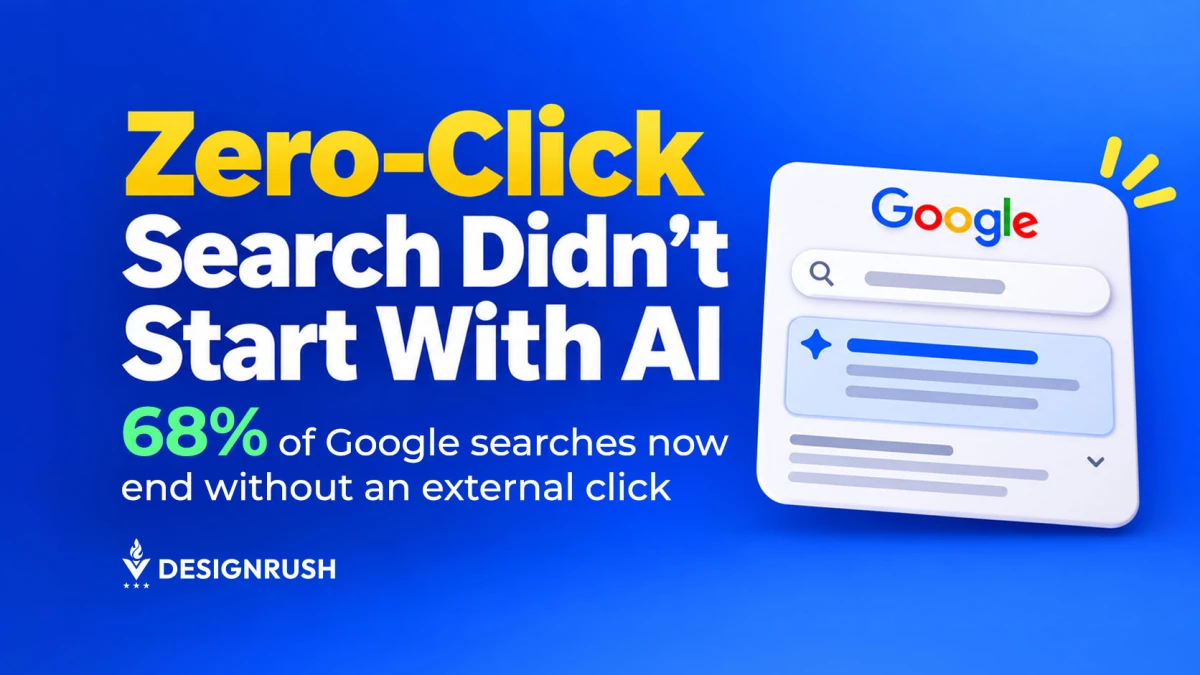
Data from SparkToro shows that around 68% of all Google searches now end without a click to an external site.
When an AI Overview pops up, that number jumps highest for definitional/what-is queries, reaching up to 85%, according to DigitalApplied.
People are getting their answers, evaluating products, and forming opinions right on the search results page, all before your analytics pixel even knows they exist.
While generative AI takes the blame for taking away web traffic, zero-click behavior isn't an AI invention. Generative tools just poured gasoline on a fire that's been burning for a decade.
How Google Became the Answer
The idea that Google suddenly stopped sending traffic to websites when it launched AI Overviews ignores a decade of SERP engineering.
Google's transition from a portal of external links into a direct answer engine happened in phases.
SERP Feature Maturation
Long before Large Language Models entered the consumer landscape, Google was actively scraping web answers directly onto the results page.
Featured snippets, Knowledge Panels, instant conversion tools (like flight lookups and currency calculators), and "People Also Ask" accordions were engineered specifically to resolve user queries without sending them elsewhere.
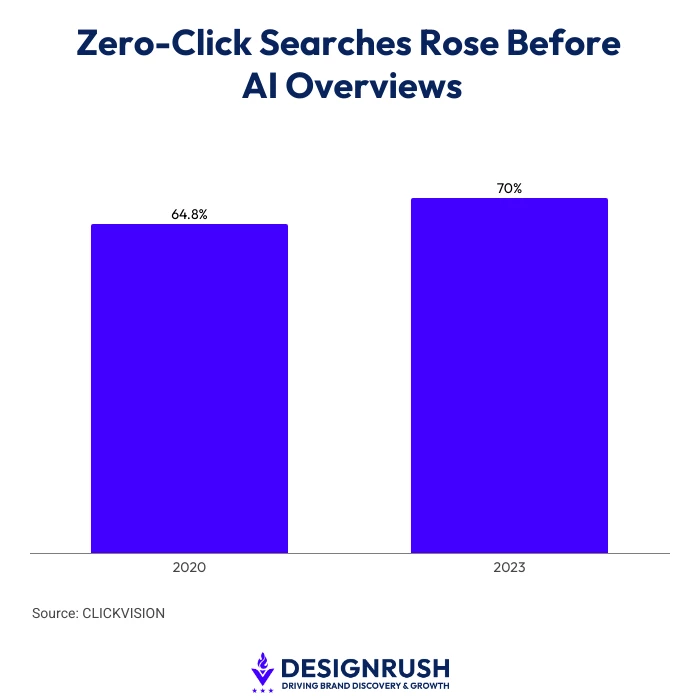
Even on searches without an AI Overview present, baseline Google queries from 2020 through 2023 (a year before the AI Overview rollout) rose from 64.8% to a 70% zero-click rate, according to CLICKVISION.
This as features like voice search, mobile SERPs, Local Packs, and Rich Snippets became the norm.
The Mobile and Voice Precedent
As mobile queries surpassed desktop traffic, zero-click rates naturally expanded.
Mobile users (working on smaller screens with immediate intent) exhibit a 77% zero-click rate, per ABMA.
At the same time, the growth of voice search created a winner-take-all environment where smart assistants read a single extracted snippet aloud rather than presenting a list of website choices.
Why This Is an Infrastructure Problem, and Not a Content Problem
When organic web sessions drop, the standard reaction in most marketing departments is to demand a content refresh, including writing longer articles, targeting lower-density keywords, or producing more blog posts.
However, tweaking content tactics fails to address the root issue that most SEO measurement and monitoring systems were engineered for a system that no longer exists.
Industry surveys from Goodfirms indicate that only 14% of enterprise marketing teams actively track AI and LLM citation visibility, despite AI-generated summaries becoming the fastest-growing surface for first-touch discovery.
Standard analytics setups and search console tools are blind to zero-click impressions:
- They measure clicks and web sessions, not how often your brand is cited as an authoritative source in an AI summary.
- They report average organic rankings, but fail to track whether a competitor's inaccurate product description was extracted into a featured snippet.
- They track on-site conversion rates, while missing downstream branded search lifts caused by zero-click exposure.
Adapting to zero-click discovery requires connecting four functions that enterprise organizations usually run in complete isolation:
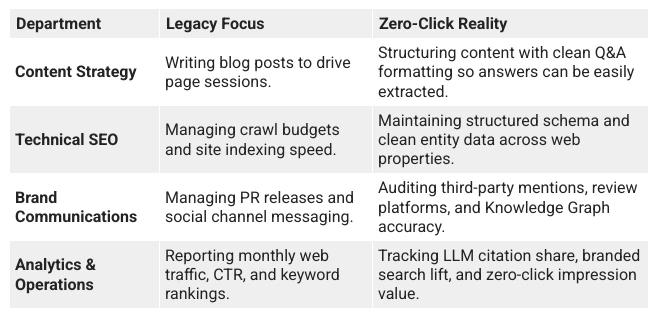
Measuring Influence Over Ownership
When users get what they need directly on the search results page, your goal should now be to shape the answer itself.
Consider if someone just read a clear, accurate summary of your product inside an AI Overview or featured snippet.
That meaningful experience with your brand forms a touchpoint that influences their decision, even if your analytics team never sees a visitor session.
For an agency or in-house team reporting on search performance, that means looking beyond traffic alone.
To track what actually works in a zero-click world, swap out traditional traffic metrics for these presence-focused KPIs:
Branded Search Trends
This is your clearest window into zero-click impact. If someone discovers your business inside an AI response or snippet, they usually don't click the link right then and there.
Like most of us, they digest the info, move on with their day, and type your brand name into Google a few days later when they're ready to take action.
Citation Share of Voice
It’s easy to obsess over where you rank on a list of blue links.
The better strategy, however, is to start tracking how frequently AI summaries, answer boxes, and LLMs mention your brand versus your direct competitors on high-intent search terms.
Downstream Conversion Quality
The traffic that actually makes it to your site today looks different than it did a few years ago.
Simple questions get resolved on Google, so those who do click through are usually much further along in their decision-making process.
You may notice that total site visits will drop, but the percentage of those visitors who turn into leads or buyers should increase.
Entity & Knowledge Graph Accuracy
We now understand that AI tools scan review platforms, structured web markup, and external mentions to build a profile of your company.
If your pricing, product features, or positioning are messy across the web, AI answers will reflect that mess.
Routinely auditing how your brand is represented on third-party sites keeps automated summaries accurate.
Earning Authority on the Modern Web
Search no longer has to end in a website visit for a brand to influence the decision.
AI Overviews and other answer formats have made that easier to see, but the problem is older than generative AI. Search has been resolving more questions on the results page for years.
That changes what marketers need to measure.
Traffic still matters, but so does whether a brand is being mentioned accurately, cited in the right places, and remembered well enough to drive a later search, lead, or sale.
If more of the decision happens before the click, then visibility can no longer be judged by sessions alone.