
Each week, our analysts track the developments reshaping organic visibility and AI discovery. Brands building search programs can partner with vetted SEO agencies for strategic implementation.
Google quietly started rewriting search result links into tracking URLs.
Search Console can now show how your Instagram, TikTok, X, and YouTube content performs on Google Search.
And new research cracked open ChatGPT's citation black box, revealing four hidden retrieval pipelines that decide what sources you get.
This was the week that measurement became the story, as AI visibility tracking emerged as its own discipline alongside traditional rank tracking.
Here's the SEO news you need to know in more detail.
Google's Hidden Tracking URLs
Google is testing passthrough tracking URLs that hide the plaintext destination link in search results, per SERP Alert on X.
Search results now route through a link formatted as google.com/goto?url=.
The destination page is encoded inside this URL parameter, instead of linking directly to a page.
The search engine still redirects the click to the right destination, but the plaintext URL disappears from the results page.
Our own testing across desktop and mobile did not surface the rewritten format, suggesting the rollout is limited rather than universal.
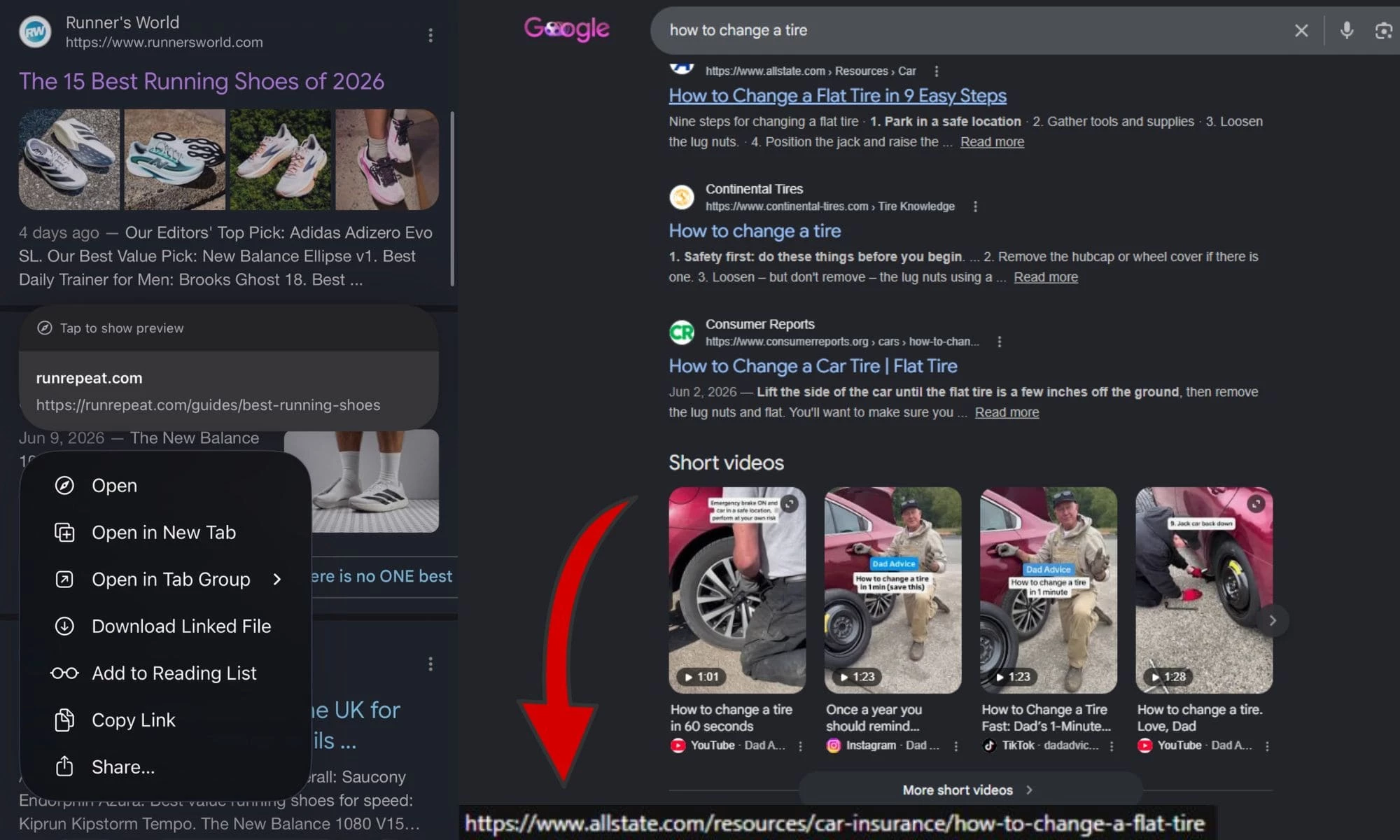
Here's the catch. Tools that scrape search result URLs may need an extra redirect before they can identify the correct domain.
This could affect how some rank trackers and SEO tools report results.
Searchers also lose the ability to preview where a link goes before clicking.
Google has not said whether this is a permanent change or a limited test.
Until it does, treat any mismatch between your rank tracker's reported URLs and what you see in a manual search as an early warning sign.
GSC’s 2 New Features
Search Console can now show how your Instagram, TikTok, X, and YouTube content performs in Google Search.
The update lets creators verify social media accounts the same way they verify websites.
Once verified, creators can view clicks, impressions, top posts, and growth milestones in the same reports used for websites.
Verification requires proving account ownership, and Google says the rollout will continue over the coming weeks.
Google is also expanding Generative AI controls beyond the U.K., according to Jamie Indigo on LinkedIn.
The setting launched a month ago for U.K. sites to meet a Competition and Markets Authority requirement.
It's now appearing on some U.S. and international properties, though the rollout remains inconsistent.
Social performance reports and access to Generative AI controls give publishers more insight into how their content appears in Search.
But whether you can use them still depends on Google's rollout schedule.
ChatGPT's Search Pipeline
ChatGPT uses one of four hidden retrieval pipelines when it searches the web.
Which one handles your prompt can change the sources it cites.
Technical SEO specialist Chris Green tested 1,000 prompts 10 times each.
Nearly 11.6% returned a different primary source between runs, while the overlap in cited URLs fell by 45%.
In other words, the same prompt didn't always produce the same sources.
Meanwhile, SEO consultant Suganthan Mohanadasan analyzed raw network traffic from his own account and identified four retrieval systems:
- Labrador uses licensed publisher content and trusted reference sources.
- Bright pulls information from the open web for commercial searches.
- Oxylabs retrieves open-web content, often from regional publishers.
- SERP uses search engine results, mainly for news.
His findings point to the important distinction that most brands can't access Labrador's licensed publisher network.
However, clean and crawlable HTML still has a strong chance of being retrieved through the open-web systems.
Every SEO/GEO has the same advice for showing up in ChatGPT. Good content, listicles, post on Reddit.
— Suganthan Mohanadasan (@suganthan) June 25, 2026
I wanted to know if any of it actually works, so I spent a few days reading ChatGPT's raw network traffic instead of taking it on trust.
It tags every source as 1 of 4… pic.twitter.com/RKUAuDStV8
Retrieval isn't guaranteed, either. ChatGPT sometimes skips web search and answers from its training data, even for questions that appear current.
Previsible's AI Traffic Study found that ChatGPT drives 92.4% of trackable LLM referral traffic.
Yet 28.8% of these visits land on internal search pages because the model identifies the right domain but not the right URL.
This fact leaves three ways visibility can break down: the wrong retrieval pipeline, no search at all, or the wrong destination page.
Plain, crawlable HTML remains one of the few factors that brands can really control. If ChatGPT can't parse a page, it won't cite it.
SEO Industry Insights
A year of running AEO audits led Chloe Ridley, a partner at a regulatory audit firm, to a blunt conclusion.
Most AEO advice, she argues, is simply traditional SEO under a new name.
Her reasoning comes down to measurement. Traditional search has a stable unit in the query, while AI conversations don't.
People ask the same question in different ways, and AI models don't always return the same sources.
This fact means that AI visibility tools have to invent their own test prompts, baking assumptions into the results from the start.
The clearest takeaway from Ridley's work is simpler.
Third-party mentions consistently improve visibility, and this is PR, not a new discipline.
SEO consultant David McSweeney points to a related mistake. Brands keep publishing "best of" lists that include their competitors.
AI systems built on consensus can treat these lists as endorsements, regardless of where a brand ranks.
A visibility tool recommending more competitor listicles may improve one metric while strengthening the rivals it's meant to outrank.
Both warnings lead to the same conclusion. Don't mistake more AI activity for better SEO outcomes.
PSA (and I'm going to use all caps for this one):
— David McSweeney (@top5seo) July 5, 2026
STOP CREATING LISTICLES ON YOUR WEBSITE THAT INCLUDE YOUR COMPETITORS. NOW.
YOU ARE REINFORCING THEIR POSITION. YOU ARE DOING THEIR MARKETING FOR THEM. YOU ARE ENDORSING THEM.
IF YOU HAVE A LISTICLE ON YOUR WEBSITE AND ARE NOT…
This week's developments point to three checks worth running now:
- Double-check your rankings. Compare tracked URLs with a manual search to catch Google's new redirect format.
- Claim your social profiles now. Early verification means more time to collect performance data as the rollout expands.
- Make key content crawlable. If pricing or specs aren't in your HTML, AI tools may never see them.
None of these search updates alter SEO fundamentals, but they do change how brands measure and monitor performance.
Our Take: Is AI Visibility a Real Metric Now?
AI visibility shows whether your brand appears in AI answers, but not how often, how many people saw it, or what happened next.
The same prompt can produce different answers, and AI platforms still don't disclose impression or engagement data.
You can use AI visibility as an early warning for discoverability, not proof that a strategy is working.
It becomes a true performance metric only when platforms connect citations to audience reach and business outcomes.
For a breakdown of Google's €4.1 billion Android fine, the fake Reddit page exploit, and search's DMCA problem, check out last week's SEO roundup.
If your AI visibility score moved this month, do you know whether your content changed or the pipeline did?
These leading SEO agencies help brands stay visible as AI systems change which content gets cited and which gets filtered out.