
When marketing teams audit their digital footprints, they look for predictable metrics like indexed pages, keyword rankings, backlink profiles, and organic traffic curves.
If page rankings dip, the immediate tactical response is to publish more volume, tweak the meta tags, or build more links.
But this approach ignores the compounding cost of market confusion, which is becoming a massive hidden leak in modern growth strategies.
Companies routinely spend enormous resources creating content while allowing deep fragmentation about their products, positioning, target audience, and primary expertise to persist across the web.
For humans, this fragmentation creates friction. In the purview of a next-generation AI search engine attempting to parse, index, and retrieve your business, confusion equals immediate invisibility.
This makes messaging clarity one of the most undervalued growth assets in the era of AI-driven answer engines.
Market Confusion Is a Technical Visibility Problem
To understand why inconsistency destroys your search footprint, we have to look under the hood of how modern search engines operate.
Legacy SEO treated a website like a catalog of standalone pages.
But Large Language Models (LLMs) and advanced Information Retrieval (IR) systems do not evaluate your brand in fragments.
They analyze your entire digital footprint to build a cohesive mathematical model of who you are and what you do.
Every inconsistency across your website, PR distributions, social channels, and third-party reviews introduces "noise" into the algorithm.
The catastrophic impact of this noise was explicitly targeted in the recent May 2026 Google Core Update, which functioned as a massive "intent-destination" reset.
Google recalibrated its core algorithm to punish sites that attempt to bridge too many disconnected or confusing topics, shifting focus toward deep semantic alignment.
Today we released the May 2026 core update. We'll update our ranking release history page when the rollout is complete: https://t.co/ZfiT6txJk5
— Google Search Central (@googlesearchc) May 21, 2026
This algorithmic shift exposes two critical barriers to AI retrieval:
1. Vector Displacement and Your "Brand Centroid"
Modern AI search models understand your content by converting text chunks into dense vector embeddings, mathematical coordinates of meaning plotted in a multi-dimensional semantic space.
When these coordinates are mapped together, they form your Brand Centroid, a cluster that establishes your true, underlying theme.
Think of your Brand Centroid as your business's definitive GPS coordinate for topical authority. When your content is clear and tightly structured, your vectors group closely together.
However, when market confusion, such as a product page claiming you are an Enterprise SaaS platform while your blog positions you as an SMB service provider, slips in, your vectors scatter.
Your Brand Centroid becomes displaced and mathematically weak.
Following the May 2026 update, if the "mathematical distance" between a fragmented domain's centroid and the user's intent is too wide, the engine quietly ignores the brand.
2. Cluster Collision and the "Information Gain" Penalty
This is the silent killer of modern visibility, and it was a primary focus of the March 2026 Core Update, which integrated "Information Gain" as a core ranking signal.
When companies rely on automated, generic templates or inconsistent messaging, their content looks mathematically interchangeable to an AI engine.
Their centroids collide in the embedding space with hundreds of competitors. Google’s algorithm is now actively suppressing these colliding clusters because they offer zero unique value to the index.
To be retrieved, your Centroid must be distinct, and it must offer unique, human-verified insight.
Reclaiming Visibility by Eliminating Semantic Friction
The real-world cost of market confusion was vividly illustrated in a recent technical audit we conducted for a leading B2B enterprise client.
The Problem
The company had aggressively scaled its content production over an 18-month period, publishing hundreds of keyword-targeted pages.
However, their positioning was deeply fragmented.
Their product documentation targeted technical buyers using complex architecture language, their sales collateral targeted C-suite executives with abstract value statements, and their legacy blog posts targeted entry-level users with basic tactical advice.
While they were generating arbitrary organic traffic, they hit a hard invisible ceiling in AI search retrieval, failing to secure premium AI citations or direct brand recommendations.
The Strategy
Applying our Be Found Framework, we didn't add more content. Instead, our team at Boostability treated the entire digital ecosystem as a single semantic unit.
We executed a comprehensive semantic alignment strategy:
- Eliminated contradictory topic definitions across legacy pages.
- Harmonized schema markup to clearly define the brand’s primary entities, relationships, and target audience.
- Restructured core content chunks to align directly with a single, clear mathematical identity.
The Results
By ruthlessly eliminating market confusion and stabilizing their Brand Centroid, the brand saw a massive lift in modern search health without a single piece of automated content spam:
- Mathematical Distance Reduction: The brand’s semantic coordinates achieved tight clustering, moving them directly into the target retrieval zone for high-value enterprise queries.
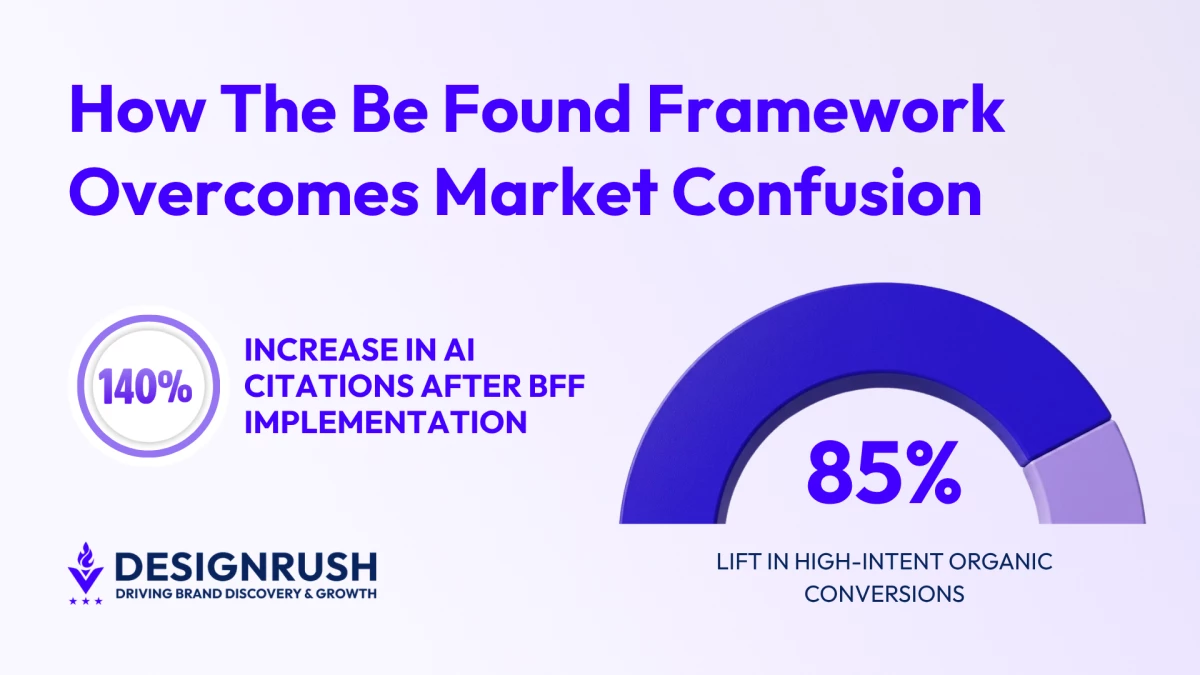
- 140% Increase in AI Citations: Conversational engines rapidly shifted from ignoring the brand to dynamically utilizing their data as verified sources of truth.
- 85% Lift in High-Intent Organic Conversions: By removing the friction of mixed messaging, human buyers who landed on the site moved through the funnel significantly faster, proving that clarity for algorithms is inherently clarity for humans.
Uncompromising Clarity Is The Ultimate Growth Asset
Ultimately, the strategic reality for growth-minded organizations remains unchanged: volume cannot compensate for a fractured identity.
If an internal leadership team cannot agree on a singular, crisp definition of a product’s positioning, audience, and core value proposition, it is impossible to expect a search algorithm to decipher it for them.
And in an environment where AI engines actively filter for definitive truth to serve directly to users, ambiguity becomes an immediate liability.
To win in this next generation of search, organizations must stop treating visibility as a game of mere content volume. True authority requires an uncompromising commitment to structural clarity.
When a brand's footprint is human-led, technically aligned, and completely unified across the web, it removes the friction that causes algorithmic invisibility and unlocks a profound, sustainable competitive advantage.