
Each week, our analysts track the developments reshaping organic visibility and AI discovery. Brands building search programs can partner with vetted SEO agencies for strategic implementation.
New clickstream data across 846,000 sessions is changing what SEO teams thought they knew about how users read search results.
The findings land in the same week Google confirmed Search, Gemini, and agent tools will eventually become one product.
Preferred Sources labels entered AI Overviews and AI Mode as user selections crossed 345,000, while Search Console logged another Discover data gap, the third in three weeks.
This is what search looked like this week in more detail.
AI Overviews Turn the SERP Into a Comparison Loop
A clickstream study of 846,000 U.S. Google sessions, commissioned and provided by Surfer SEO, found that AI Overviews and AI Mode create opposite user behaviors.
Clickstream Solutions collected the data from anonymized sessions in February and March 2026.
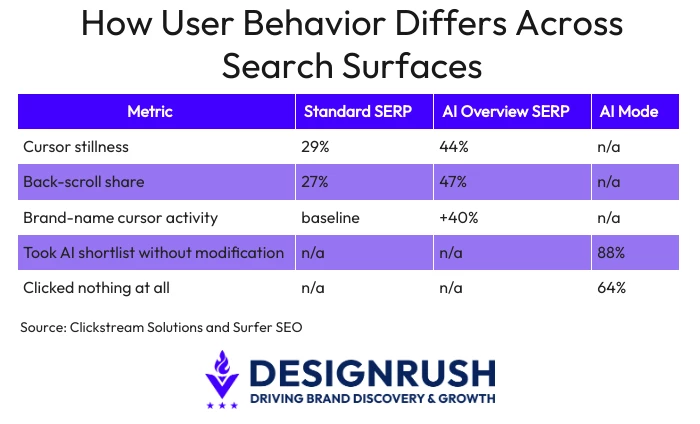 A separate April 2026 study of 185 high-stakes purchase tasks found that 88% of AI Mode users accepted the AI shortlist without modification, and 64% clicked nothing at all.
AI Overview SERPs work differently:
- Cursors stayed still 44% of the time, versus 29% on standard results.
- Nearly half of all scroll movement went back up the page, versus 27% on standard results.
- Cursor activity for brand-name searches increased 40% when an AI Overview was present.
People who already knew where they wanted to go still stopped to evaluate what the AI surfaced around them.
Brand recall gets searchers to the SERP. The AI Overview now decides whether they click through.
AI Overviews also collapse behavioral differences between search intents.
On a standard SERP, navigational searchers leave quickly while informational ones stay longer. That gap has shaped SEO strategy for two decades.
With an AI Overview present, all five intent types cluster within six points of each other at the 21-second mark.
Intent no longer predicts how long someone stays on the results page, so intent-based optimization alone is no longer enough to predict engagement.
Listings on AI Overview SERPs are getting two or three impressions, and the second is when comparison happens.
Title tags and meta descriptions are doing more work than they were six months ago.
One Product, Deeper Content
Google CEO Sundar Pichai confirmed in an interview with The Verge that Search, Gemini, and standalone agent tools will converge into a single interface.
AI will decide how much of the work to complete before returning anything to the person searching.
Pichai said "It will" when asked directly whether those products should become one, adding that the infrastructure required for agents to operate end-to-end is still being built.
He described agents as "the next evolution of the web" and said they should work in the background when people plan trips, build things, or complete tasks.
On publisher concerns, Pichai rejected the Google Zero idea but acknowledged the product already filters out what he called low-quality clicks.
"As the technology improves, low-quality clicks get filtered out. That's a natural evolution we see. We see it in our metrics. Bounce clicks are going down," he said.
Pichai said nothing about the broader trend of publishers moving away from search dependency altogether.
Condé Nast CEO Roger Lynch publicly described the same shift as planning for zero search traffic.
After several years of declining search traffic, Condé Nast CEO @rogerlynch has directed all the company's brands to operate as if search traffic to their properties will be zero.
— TBPN (@tbpn) May 12, 2026
He says the era of turning search and social media traffic into profitable businesses is gone.
And… pic.twitter.com/wMto7V7wVf
Lynch described a board meeting where the same search from seven years ago returned ten blue links. Today, it returns an AI overview, rows of commerce links, and sponsored results.
The same week, SVP Nick Fox addressed the flood of GEO consultants and AI optimization pitches directly at Google Marketing Live 2026.
"The way to optimize for AI search is the same way to optimize for search. Create great content," he said.
Fox's additional advice was to go further than what AI already handles. Fox said AI summaries cover the first layer on most queries, and content that stops there will struggle to earn a click.
"The best content that will do the best within AI is one that goes one level deeper, two levels deeper," he added.
He described the pages most likely to perform as work built around firsthand human experience: what someone used, what went wrong, what details no summary would include.
Preferred Sources Now Inside AI Responses
Preferred Sources labels have expanded beyond Top Stories and now appear on links inside AI Overviews and AI Mode responses.
Selections have grown from 200,000 in late April to 345,000 this week.
A reader who selects your site as a preferred source now carries that preference into AI-generated answers, not just editorial carousels.
Click-through rates on preferred sources run at twice the rate of other links, though Google has not disclosed how that figure was measured.
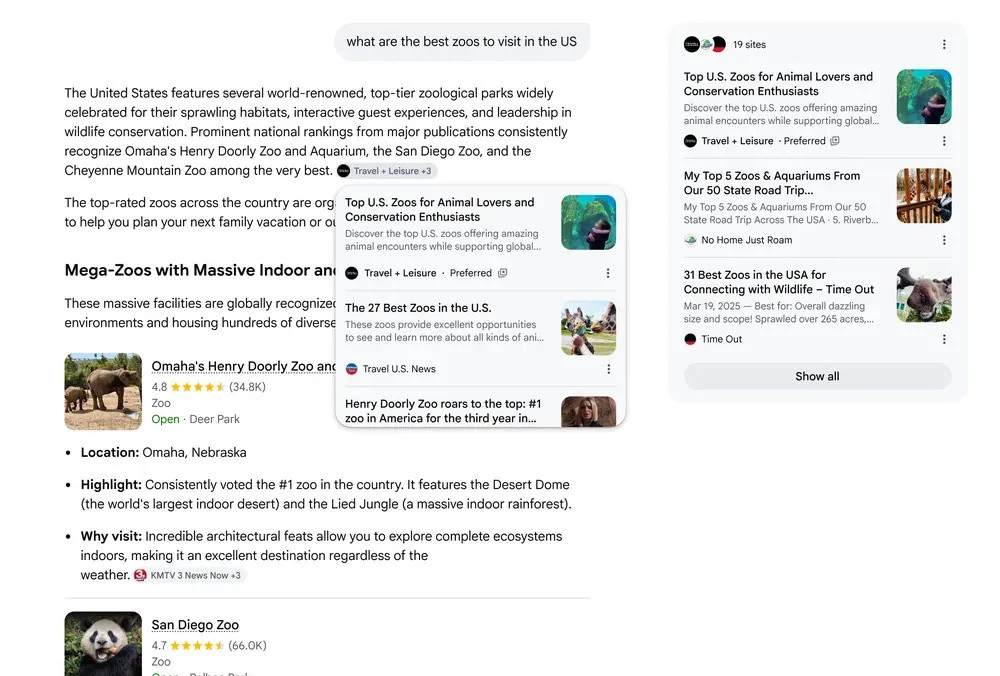
New article carousels are rolling out for developing topics, flagging any Preferred Sources in the mix.
A perspectives carousel, pulling from forums and social media, is coming but has not fully launched yet.
The Highly Cited label is expanding to standard results, now flagging articles that reference a primary source and making citation chains visible across the full SERP for the first time.
Audience loyalty has always mattered for editorial credibility. The feature now has a direct line into AI-generated search results.
The expansion of Preferred Sources into AI responses is the clearest signal yet that Google designed the feature to give publishers something back.
Search Console Logs Another Discover Data Gap
A logging error affected clicks and impressions in the Search Console Discover performance report for May 21, 2026. Actual site performance in Discover was not affected.
The error is the third Discover reporting failure in three weeks. The May 7 and May 8 data are also permanently lost.
Google previously admitted to losing 50 weeks of Search Console impression data.
Teams using Discover data for year-over-year comparisons should treat any window from the past few weeks as a gap rather than a baseline.
SEO Industry Insights
SEO expert Lily Ray flagged recent language around inauthentic mentions as a direct warning for brands using third-party tools to manufacture AI visibility.
She noted that AI Overviews and AI Mode are rooted in the same core ranking systems that govern backlinks, meaning the same enforcement logic applies to mentions.
"The fact that Google literally just put out a statement about 'inauthentic mentions' is a major warning that companies need to be REALLY careful in this space," she wrote on X.
Key points being:
— Lily Ray 😏 (@lilyraynyc) May 27, 2026
- Google also has LLMs and AI Overviews and AI Mode are rooted in Google's ranking systems (plus other LLMs use their results)
- the fact that Google *literally* just put out a statement about "inauthentic mentions," at least to me, is a major warning that…
Responses in the thread compared the situation to paid links, not necessarily illegal, but against Google's terms of service.
SEO specialist Peter Rota wrote on LinkedIn that "SEO may not be dead, but it's halfway in the ground," advising brands to build real audiences, invest in CRO, and diversify referral sources.
That advice aligns with what the Google AI optimization guide states explicitly. AI Overviews and AI Mode are rooted in core ranking systems.
Brands that spent the past year optimizing for shortcuts now face the same enforcement logic they thought only applied to links.
Three things worth acting on before next week:
- Promote Preferred Source selections to your audience. Every reader who selects you carries that preference directly into AI-generated answers.
- Flag May 21 Discover data as a recording gap. Comparisons including that date will be skewed.
- Revisit title tags and meta descriptions on your highest-traffic pages. Write for someone who has already scrolled past you once.
SEO has always been trial and error. This week added new variables to the same game.
Our Take: Is Google Quietly Shrinking the Web?
Google is sending less traffic to the web while calling it progress.
We think the behavioral data is the part most teams will underestimate. A user who typed your brand name and still spent time evaluating what the AI put around you is not confused.
They are doing exactly what the SERP now asks them to do. That is a trust problem, and title tags are now where it shows up first.
The inauthentic mentions warning is the most immediate risk for brands building AI visibility through third-party tools.
Google enforces the same rule for the same reason it enforces paid links: self-interest, not altruism.
The difference between optimizing for how Google worked and how it works now is showing up in this quarter's analytics reports.
For analysis on Google's FAQ deprecation, the Ahrefs schema study, and the Condé Nast warning on publisher strategy, check out last week's SEO roundup.
If AI Overviews are changing how readers evaluate your listings, what does your metadata optimization schedule look like for Q3?
These leading SEO agencies help brands stay visible as AI systems change which content gets cited and which gets filtered out.