
Each week, our analysts track the developments reshaping organic visibility and AI discovery. Brands building search programs can partner with vetted SEO agencies for strategic implementation.
Google I/O 2026 brought the biggest search box redesign in 25 years alongside the first official data on AI Mode usage after one year.
Google also published its first consolidated guide on optimizing for generative AI search, treating AEO and GEO as part of SEO rather than separate strategies.
A six-month study confirmed infographics as the strongest driver of organic traffic growth among the visual asset types tested.
Here is what moved in search this week.
Google Launches the Intelligent Search Box
Google released the first major update to its search box in over 25 years at Google I/O 2026, calling it the Intelligent Search Box. Google VP of Search Liz Reid announced the update on the Google blog.
Yesterday at #GoogleIO, we introduced the biggest upgrade to our iconic Search box in over 25 years. Here’s what to know about the new, intelligent Search box:
— Google (@Google) May 20, 2026
🔎 More intuitive than ever, the new Search box will dynamically expand to give you space to ask whatever’s on your… pic.twitter.com/yUP3Oi0N7y
The box expands as users type, making room for longer queries and conversational prompts. It also supports multimodal inputs including images, files, documents, videos, and Chrome tabs.
Reid said the update is "more intuitive than ever, dynamically expanding to give you space to describe exactly what you need."
It is also designed to anticipate user intent with AI-powered suggestions that go beyond standard autocomplete.
SEO expert Lily Ray noted that the Intelligent Search Box may have a longer-term goal.
"Google is trying to slowly train its users to type longer, more conversational prompts so it can ultimately push them toward a default AI Mode," she wrote on X.
I think that’s the point - Google is trying to slowly train its users to type longer more conversational prompts so it can ultimately push them toward a default AI Mode https://t.co/snO23lyoUr
— Lily Ray 😏 (@lilyraynyc) May 20, 2026
The update is rolling out globally in all countries and languages where AI Mode is available.
Google also confirmed that the AI Overview to AI Mode transition feature is now live across desktop and mobile search worldwide.
Search ranking volatility spiked on the day of Google I/O, partly driven by the May 2026 core update that launched the same day. It is the second core update this year.
The rollout may take up to two weeks to complete, and Google has not shared specific guidance beyond its standard advice to focus on helpful, people-first content.
AI Mode Hits 1 Billion Monthly Users
AI Mode has surpassed 1 billion monthly active users globally one year after launch, with queries more than doubling every quarter since launch, according to Google.
The average AI Mode search is three times longer than a traditional search. In the U.S., follow-up queries rose over 40% month over month, and more than one in six AI Mode searches are multimodal.
Google reported several fast growing query types:
- Planning-related queries grew 80% faster over six months.
- Decision questions starting with "which" increased 40%.
- Brainstorming queries grew 30% faster than overall AI Mode queries since launch.
The intent behind AI Mode queries maps to existing search behavior. Users are not searching differently. They are searching more.
The data also shows that shoppers start with traditional search, then move to AI Mode for deeper product research, particularly in electronics, books, apparel, health and beauty, and automotive.
Infographics Drive 110% Organic Traffic Increase
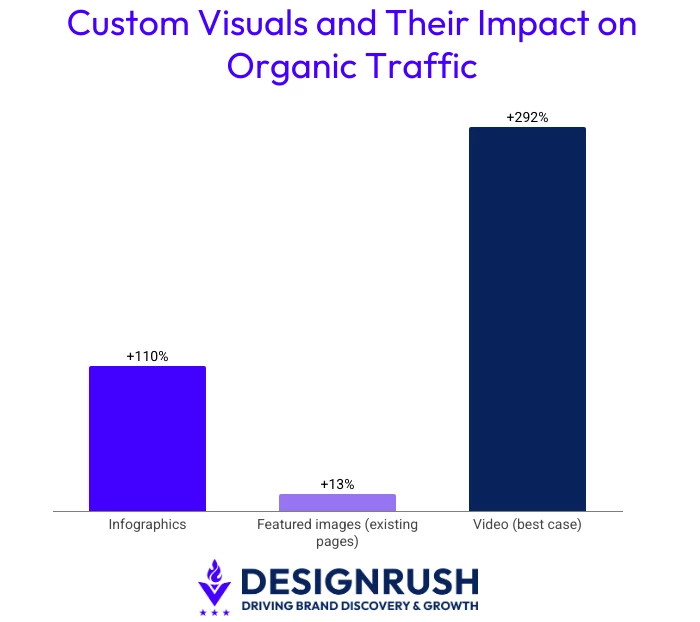
A six-month experiment across 47 articles found that adding infographics produced an average 110% increase in organic traffic, according to Search Engine Land.
Custom featured images on existing pages resulted in a 13% average increase in traffic.
Video results were mixed. An AI financial modeling video ranked on the first page of YouTube and drove a 292% increase in page visits, but two other videos had minimal on-site impact despite generating around 500 YouTube views each.
The study's main finding was that custom visuals work best on pages that already have search demand.
Design amplified strong content but did not revive declining pages or create interest where none existed.
Google's llms.txt Contradiction
Google Search and Chrome's Lighthouse now send conflicting signals on llms.txt, and the SEO community has noticed.
Google's official guidance states that llms.txt is unnecessary for generative AI search visibility.
At the same time, Chrome's Lighthouse now checks for the presence of an llms.txt file as part of its experimental Agentic Browsing audit category.
If the file returns a server error, Lighthouse flags it. If it is missing and returns a 404, the audit is marked not applicable.
SEOs are debating why Google added something to Lighthouse that it says is unnecessary for search.
The distinction is between search ranking and agent readiness.
The file serves AI coding tools and browser agents operating outside the search index, not Google Search visibility.
For most business websites and eCommerce stores, llms.txt remains a low-priority experiment.
For developer portals, SaaS platforms, and documentation-heavy sites, it may be worth adding before agent traffic scales.
SEO Industry Insights
John Mueller published Google's first official AI optimization guide on the Google Search Central Blog, consolidating positions the company has shared at conferences over the past year.
Lily Ray shared Mueller's Bluesky response to the llms.txt debate, in which he clarified that Google's own use of the file serves AI coding tools, not search ranking.
"The short answer is that it's not done for search. There's more to websites than just SEO," Mueller wrote.
Got some good answers from John Mueller (on Bluesky) about why Google’s site uses llms.txt and markdown files: pic.twitter.com/87ysg7R2y0
— Lily Ray 😏 (@lilyraynyc) May 20, 2026
Crystal Carter, head of AI search at Wix, confirmed the company has been preparing for this shift and is rolling out global implementation of agentic llms.txt files.
SEO expert Chris Long announced that Screaming Frog 24.0 now includes an official Model Context Protocol (MCP).
For agencies managing large-scale audits, this removes the manual export step and lets Claude analyze crawl data end-to-end inside a single workflow.
This week's announcements narrow down to three actions worth taking now:
- Audit content for depth and follow-up potential, not just keyword coverage. Planning and decision queries are the fastest-growing category in AI Mode.
- Run Google's new guide against your current roadmap and cut what it calls unnecessary. The guide names specific tactics to drop.
- Audit your highest-traffic pages first for custom visual investment. Infographics work best where demand already exists, so prioritize those pages before creating new content.
For brands and agencies managing SEO in 2026, the clearest takeaway is that Google's own documentation now makes the case against panic-driven pivots to GEO and AEO tooling.
Our Take: Was the AI Search Panic Premature?
The panic was premature, but the industry that profited from it isn't going anywhere.
We think the more uncomfortable question is how many content budgets were reallocated to tactics that Google just publicly called unnecessary.
Google's mythbusting section exists because the confusion was real and widespread. That confusion had a market, and it still does.
If your current SEO roadmap is built around tactics Google explicitly says you don't need, that is where the reallocation should start.
The fundamentals earned citations before AI Mode existed, and they will earn them after the next interface update too. What changes is the vocabulary used to sell them.
For analysis on schema markup, Google's Discover profiles pilot, and what the Ahrefs data says about GEO signals, check out last week's SEO roundup.
Which SEO tactic are you reconsidering after Google's new AI optimization guide?
These leading SEO agencies help brands stay visible as AI systems change which content gets cited and which gets filtered out.