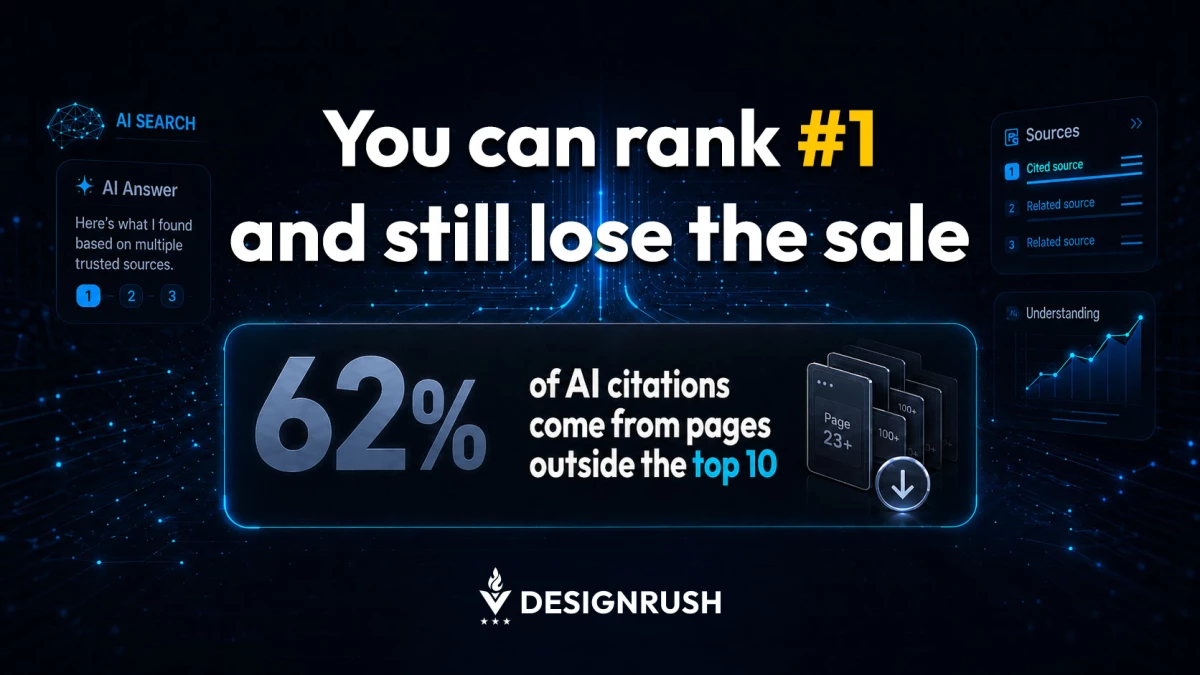

Google has switched on its information agents in Search for paying subscribers. The broader industry knows them as search agents.
Ask AI Mode to track a topic, and an information agent works in the background, scanning blogs, news sites, and social posts, then sending back a synthesized update with links.
The buyer gets an answer. The sources that fed that answer get the visit.
The feature is live for AI Ultra subscribers, with broader access rolling out to more users this summer. Information agents are the newest layer of a larger shift.
Across AI Overviews, AI Mode, and now background agents, Google is building a system that reads, selects, and summarizes sources before a user makes a single click.
Which sources get selected is the question every brand should sit with.
Ranking and Getting Cited Have Come Apart
Only 38% of pages cited in Google's AI Overviews also rank in the top 10 for that query, per an Ahrefs study of 863,000 keywords. Seven months earlier, it was 76%.
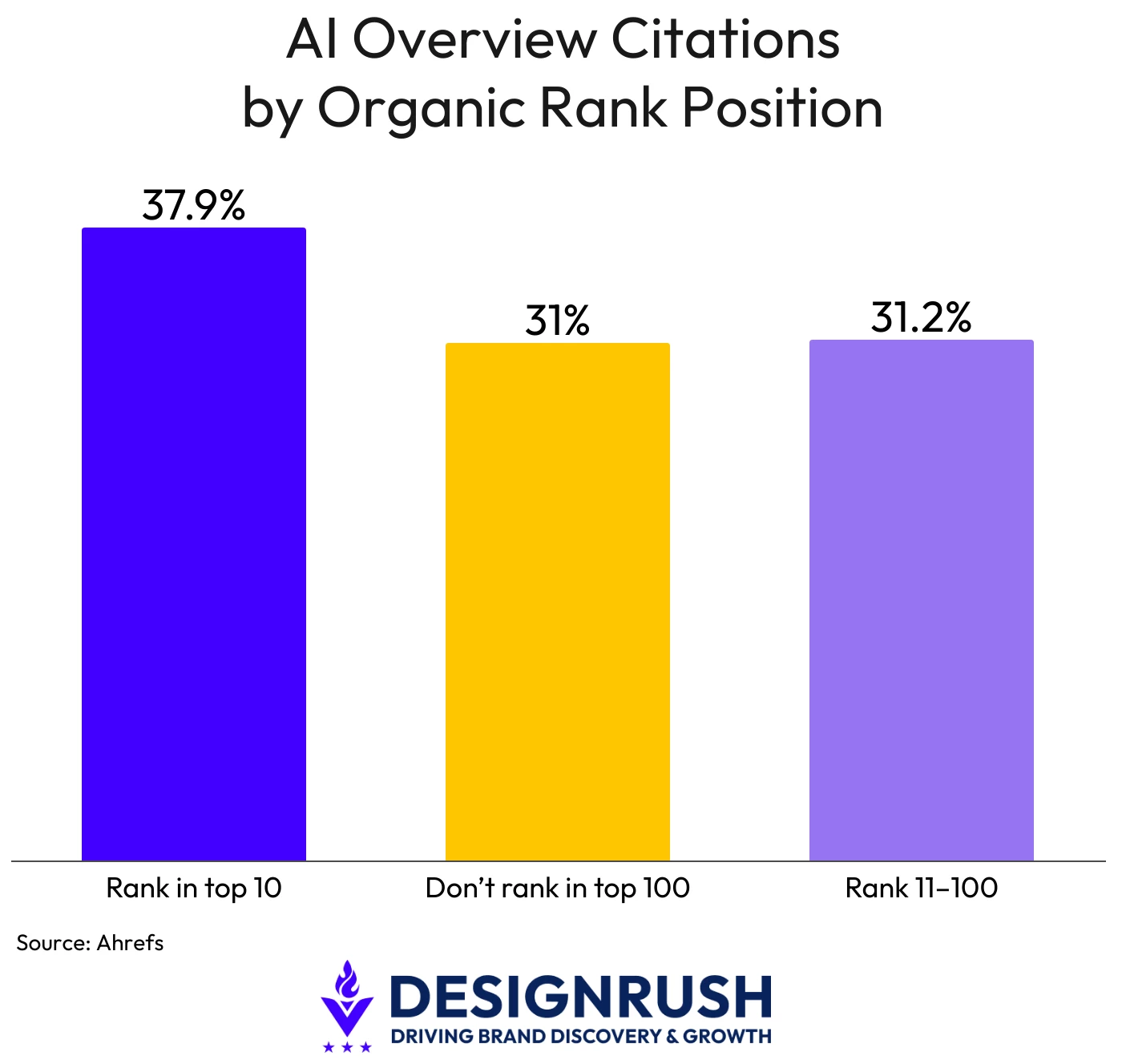 That fall flips the old order. The page at position one is now the underdog for the citation, beaten by pages ranked well below it, or by pages that do not rank at all.
Here is why that matters. A brand can hold every ranking it has, watch its traffic stay steady, and still disappear from the answer now sitting above those rankings.
eSEOspace, an agency specializing in generative engine optimization (GEO), analyzed what the drop means for brands when the data landed.
Its founder, Irina Shvaya, says ranking and citation now run on separate logic.
"A page can satisfy everything that drives a ranking and never clear the bar for a citation, because the retrieval system is reading for whether it can extract a clean, self-contained answer, not for how well the page ranks," she says.
Why Cited Pages Win and the Rest Quietly Lose
Two pages rank in the same spot for the same query. One is cited in the AI Overview, the other is not. Same position, different outcome.
The cited page earns 120% more organic clicks per impression than an uncited page on the same AIO-present SERP, per Seer Interactive research across 5.47 million tracked queries.
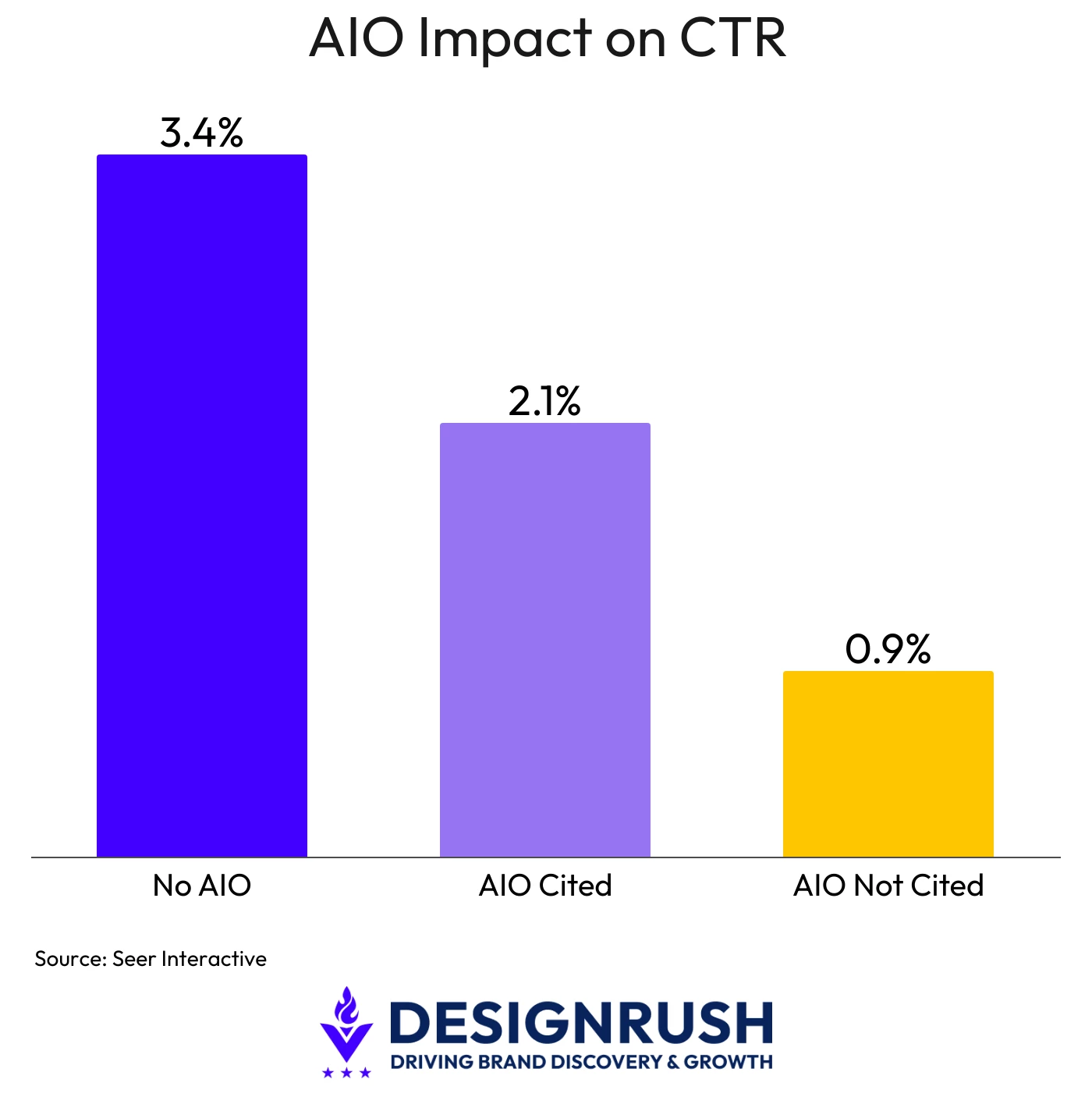 What makes that dangerous is how well it hides. The uncited page still ranks, so the dashboard stays calm.
Impressions can even climb because Google logs the AI Overview and the organic listing as two separate views of the same query.
The clicks slip away while the numbers above them look healthy.
So why does one page get pulled into the answer while another, ranked just as well, gets skipped?
Shvaya says it comes down to how AI reads a page now.
"These systems read a page in pieces, not as a whole. If a single section can't be lifted out and still make sense on its own, it rarely makes it into the answer, no matter how strong the full page is," she says.
In other words, the AI takes one block at a time and asks whether it answers the question alone. A page can read beautifully top to bottom for a human and fail that test in every section.
The Brands Getting Cited Build for Extraction
The work that earns a citation is writing each section to answer its own question completely, so a block still holds up when the AI pulls it out and drops it into an answer.
That extraction bar is where eSEOspace has gathered hard numbers.
The agency says fixing a site's full technical stack, from theme and hosting to schema and content structure, drove an average 75% to 85% increase in AI citations within 90 days.
That finding comes from their work across more than 1,284 WordPress sites.
The result shows that the same page, rewritten so that an AI can lift it cleanly, nearly doubles the number of times it gets cited.
The content does not change what it says. It changes whether the AI can use it.
"The brands that win here pair clean technical structure with content written to be quoted. When the markup is right and the writing is clear, a page gives the AI every reason to cite it," Shvaya says.
Start by auditing your highest-traffic pages. Check whether each section stands alone as an answer, and whether the markup gives the AI a clean signal to pull it.
And the reward for doing this compounds, because the surface keeps growing.
Around half of Google searches already return an AI summary, a share McKinsey expects to pass 75% by 2028.
This means the retrieval logic deciding who gets cited today will govern the majority of search results within two years.
Citation Is Now a Revenue Metric
Google's AI Ultra now starts at $100 a month, and its top tier dropped from $250 to $200. Both moves push these agent features toward wider adoption.
Every subscriber who uses information agents to research a purchase is a buyer your brand cannot reach through rankings alone.
Therefore, it is more of a revenue problem than a traffic one.
Here is the harder part for any brand watching rankings.
A high rank now confirms one thing, that you rank. Whether you get seen is settled a layer above it, inside the answer.
Most Google updates shift which pages rank. This one shifts where the decision happens.
Because by the time a buyer reaches a website, the retrieval system has already built the shortlist. A brand the retrieval system leaves out loses the sale before the visit ever happens.
What is more, that dynamic is only going to intensify. As AI Mode handles more of the search page, citation becomes the condition for staying in the conversation at all.
In the end, citation is how brands stay in the conversation before the conversation ever reaches them.