
SaaS User Retention: Key Findings
- Retention gaps often start in early development, where misaligned priorities and untested features lead to churn before the product even launches.
- Designli builds retention through early validation, helping non-technical founders prioritize features that match real user behavior and drive long-term engagement.
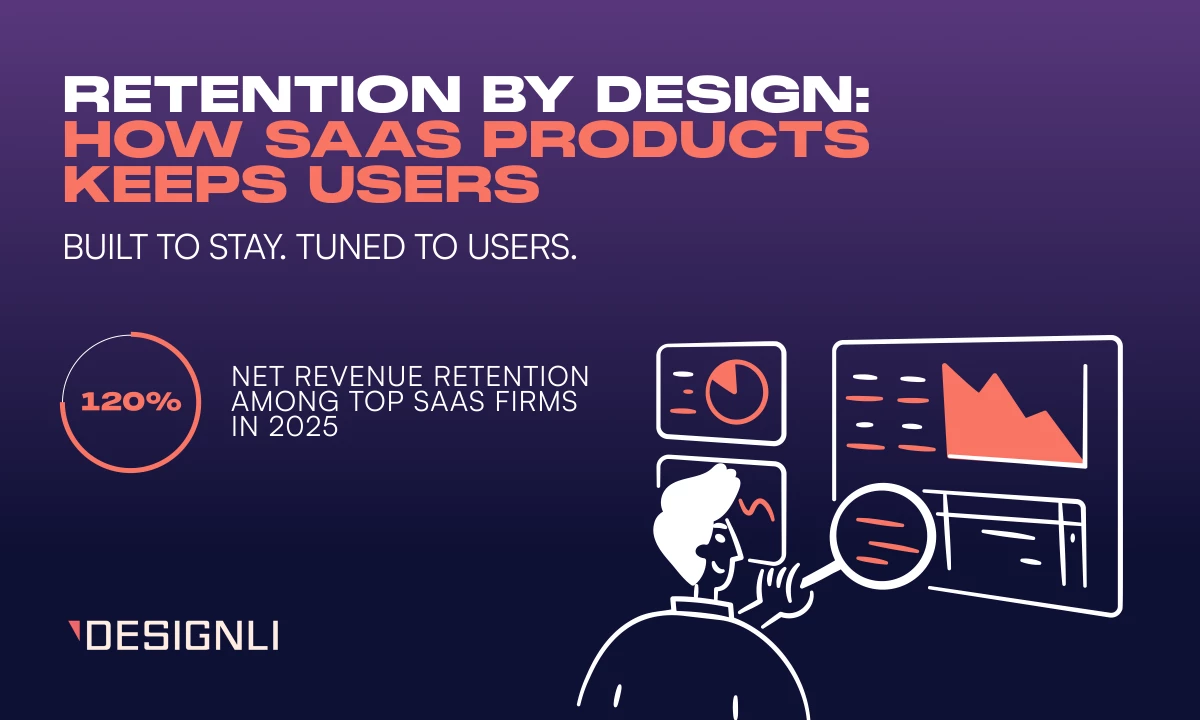
- Top-performing SaaS companies exceeded 120% NRR in 2025, showing that strong retention strategies can generate more revenue from existing users.
Some Software as a Service (SaaS) companies don’t realize they have a churn problem until it’s too late.
Users leave quietly, and by the time leadership sees the numbers, the product has already fallen behind.
This just goes to show why user retention has to be part of the conversation early.
Designli makes this rule the center of its product development process.
Editor's Note: This is a sponsored article created in partnership with Designli.
The software development agency treats retention as a core product decision, not just a metric to monitor after launch.
Its framework is built on understanding how users behave, why they stay, and how to adapt before engagement starts to slip.
This approach is built on the idea that products that are built around user behavior stay relevant longer, evolve more effectively, and earn stronger brand loyalty.
“Retention only occurs when a product keeps solving the right problems for users,” Designli Co-Founder Keith Shields told DesignRush.
“The earlier you understand what your users actually need, the easier it is to build something they keep coming back to.”
Effective retention is all about building steady value that becomes part of the user’s routine.
Build for Retention Before the First Line of Code
It costs five to seven times more to acquire a new user than to keep an existing one, which means every churned customer drains resources that could have gone toward growth.
Designli’s SolutionLab sprint gives founders a chance to validate product assumptions early to avoid this kind of expensive mistake.
You should first ask the following questions to make sure you’re not designing something that won’t work:
- Which user problems are worth solving?
- What behaviors signal long-term success?
- What moments build trust or cause confusion?
This kind of discovery work helps SaaS founders avoid feature bloat and build leaner Minimum Viable Products (MVPs).
When feedback loops are in place early, product teams can actually prevent the churn.
“Too many businesses treat MVPs like a smaller version of everything they want to build,” Shields said.
“But the goal isn’t to cram in features. It’s to figure out what actually helps users succeed, then build around it.”
Most users don’t leave because of frustration. They leave because the product stops feeling relevant.
Designli builds against this outcome by embedding retention thinking into the product design process:
- Onboarding that builds confidence fast. Users are guided with contextual steps that show them how to win early.
- Feature planning tied to actual usage. The roadmap prioritizes what users rely on, not just what looks good in a demo.
- Interfaces tested with real users. UX decisions are backed by usability feedback, not assumptions.
- A feedback loop that never stops. Complaints, drop-offs, and behavior shifts inform every release.
The easiest way to lose a user is to ignore their signals. When teams build around real behavior, loyalty happens more naturally.
What Happens After Launch Still Matters
Higher retention lifts customer lifetime value (LTV), giving SaaS companies more predictable revenue and a stronger footing when it’s time to forecast growth or pitch to investors.
In fact, top-performing SaaS companies exceeded 120% net revenue retention in 2025.
Meanwhile, the median sat at 106%, reinforcing how strong retention strategies directly increase revenue from existing users.
These numbers depend on continuous learning and iteration long after the product is released.
Teams must track how users interact, where they lose interest, and what keeps them engaged.
Important metrics include customer retention rate (CRR), monthly recurring revenue (MRR) churn, and net promoter score (NPS).
Designli’s approach bakes retention into the product from the start.
It begins with validation, making sure teams aren’t building features no one needs, then continues with feedback loops that track behavior and flag early signs of churn.
After launch, product planning stays focused on what users actually use, not what looks good on a roadmap.
“Every product will hit moments where the user needs to shift,” Shields shared.
“If you’re not set up to catch this early, you’ll end up solving the wrong problems while users quietly move on.”
This is why staying responsive to behavior keeps a product relevant and trusted over time.
Smart Teams Stay Close to the User
Retention depends on attention; this is the basics. But knowing when to reconnect also matters.
A simple reactivation campaign, like a “We Miss You” email or a feature update reminder, can bring users who might have drifted away back.
Remember that these small moments of outreach can still spark renewed engagement from dormant users.
Combining ongoing feedback, user-aligned updates, and smart reactivation strategies enables you to make retention part of every stage of development.
The products that grow best are the ones that keep proving their value, release after release.