
AI Ad Automation for Franchise Brands: Key Findings
- Meta confirmed $115–$135B in 2026 AI ad tool spend, showing automated ad execution will handle most campaign decisions.
- Franchise brands risk poor lead quality if they don’t define what counts as a qualified lead and set clear creative rules for AI.
- Brands that audit local performance, standardize inputs, and train operators ensure AI-driven campaigns produce reliable business outcomes.
$115 billion to $135 billion in projected capital expenditures for 2026 is not subtle.
That’s the range Meta confirmed in its Q4 and full-year 2025 earnings release, published earlier this year.
A large part of that spending went toward tools that handle ad delivery, targeting, creative production, and campaign optimization.
Put simply, the platform moved toward a setup where the system itself takes on more of the decision-making.
For franchise and multi-location brands, this move signals an operational change.
The Platform Is Moving Toward “Goals In, Execution Out”
According to Meta, most marketers use its self-service ad platform to launch and manage campaigns.
That suggests self-service is becoming the standard, with automated tools handling much of the work behind the scenes.
The company wants brands to use AI tools for ad creation and targeting by end-2026.
Editor's Note: This is a sponsored article created in partnership with Rock Salt Marketing.
Reuters reported that the process starts when an advertiser shares a product image and sets a budget.
From there, the system creates the visuals, writes the text, and even suggests targeting options on its own.
In other words, set the goal, set the budget, and voila. The platform handles the logistics.
That convenience comes with a tradeoff, though, especially for brands that operate across dozens or hundreds of locations.
Ridge Anderson, co-founder of digital marketing agency Rock Salt Marketing, puts it plainly:
“When the platform decides targeting and creative combinations, the only durable control left is how you define success. If a franchise brand does not standardize what qualifies as a lead, the algorithm will optimize to whatever is easiest to generate.”
That tradeoff is amplified when external factors, like evolving user data rules, limit how precisely the platform can target audiences.
According to Meta in its Form 10-K filed January 28, 2026:
“We have implemented, and we will continue to implement, changes to our user data practices. Some of these changes reduce our ability to effectively target ads, which has, to some extent, adversely affected, and will continue to adversely affect, our advertising business.”
This matters most for location marketers because they depend on narrow geography, intent signals, and short conversion windows.
When those signals weaken, lead quality suffers, and franchisees feel the impact first.
Creative at Scale Means Governance at Scale
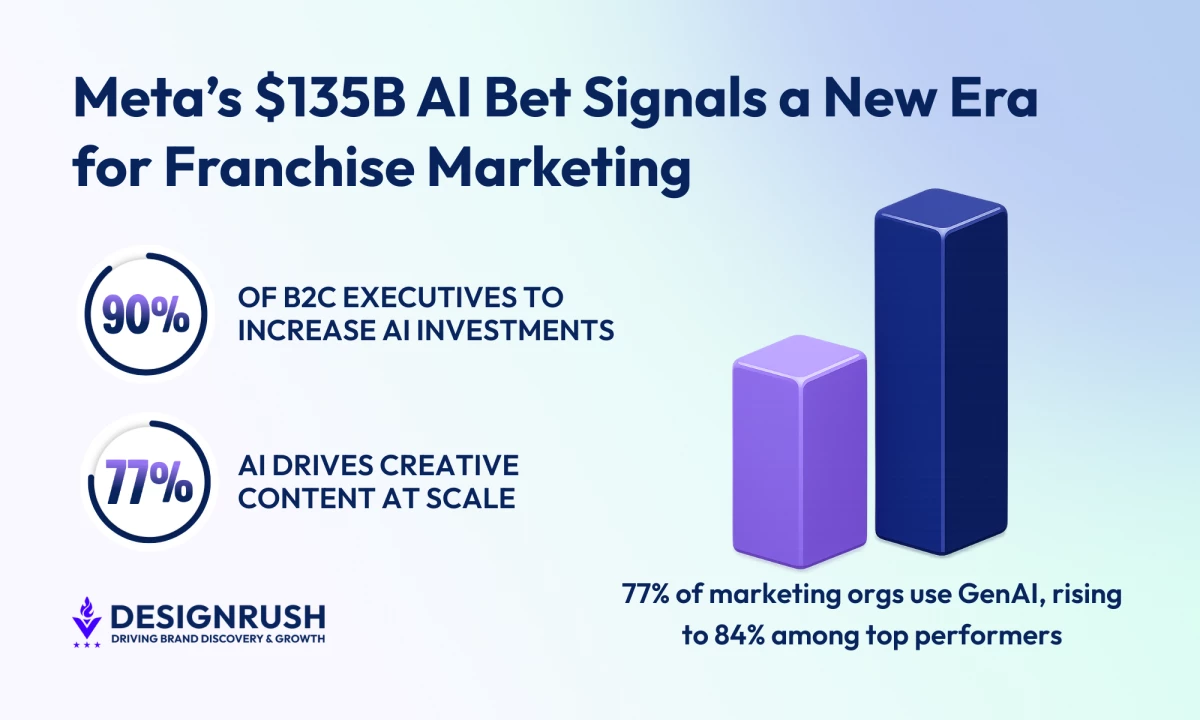
About 77% of marketing organizations that have adopted GenAI use it for creative development tasks, according to Gartner’s February 18, 2025, press release.
Among high performers, that share rises to 84%.
Which means AI is doing most of the heavy lifting on creative.
Franchise and local teams still need to set the rules, or risk getting a jumble of outputs that don’t fit the brand.
With AI taking over much of the creative work, cost savings also come with strings attached.
For example, Mondelez reported 30% to 50% reductions in marketing content costs using a generative AI tool, which also produced targeted variants for different consumers.
It looks good on paper, but in franchise systems, every variant raises compliance issues, and every offer affects margins.
And that is the structural friction.
Central teams push assets, local operators need relevance, and AI now speeds up work for both.
Rock Salt Marketing used AI to spot a 17.6% jump in healthcare LLM prompts over three months, showing AI’s speed:
“AI can localize creative in seconds. But that doesn’t mean it understands your franchise agreement, your regional pricing, or your compliance constraints,” Anderson said.
“Brands need approved offer libraries and clear guardrails before automation scales.”
Without clear rules, automation delivers fast but inconsistent results.
This performance instability is already widespread.
Gartner’s survey showed that marketing teams are facing persistent performance headaches:
- 44.5% of total marketing budgets are spent on campaigns and media plans
- 87% of CMOs reported campaign performance issues in the past 12 months
- 45% reported terminating campaigns early due to poor performance
These issues carry over into measurement and optimization.
Most marketing tools still prioritize short-term clicks and conversion metrics, but franchise brands care about booked appointments, qualified consultations, and repeat visits.
And those outcomes live beyond a click.
Last year, 79% of B2C marketing leaders felt confident measuring marketing’s business impact using AI.
But Forrester predicts that confidence will drop 7% in 2026, citing concerns over AI-driven data transparency.
While franchise systems depend on trust in measurement, co-op funding, revenue sharing, and local reinvestment hinge on who gets credit.
“When measurement confidence drops, franchisees question central campaigns,” Anderson explained.
“If the platform optimizes in a black box, the franchisor has to supply the clarity. That means validating leads at the CRM level, reconciling store data, and reporting outcomes in terms operators actually care about.”
Without that clarity, even the most advanced AI tools cannot reliably drive business outcomes.
Brands need systems that connect automation, measurement, and accountability, or the gains AI promises will remain theoretical.
The Operating Model Is the Bottleneck
Franchise brands are cross-functional by design.
Corporate marketing, local operators, finance, and agency partners all intersect.
Boston Consulting Group’s “How AI Will Transform Marketing” report found that 15% of AI initiatives operate cross-functionally at scale to deliver enterprise value.
And now, more AI investment is coming, as 90% of B2C marketing executives plan to increase investment in AI over the next year, Forrester reported.
The question now is whether the operating model can keep up.
For franchise and multi-location brands, Meta’s AI investment signals the need to formalize how decisions are made.
That starts with a few key steps:
- Define what a qualified lead is at the system level.
- Standardize which inputs AI is allowed to use.
- Audit store-level performance beyond platform dashboards.
- Train local operators on how automated campaigns function.
Are your processes ready to make AI work for your business?
Platforms will continue absorbing execution.
Brands that clarify governance, measurement, and local validation will keep control of outcomes.
Agencies like Rock Salt Marketing help franchise brands build these systems, connecting AI, measurement, and local execution to real results.
Meta is building the engine. Franchise brands still choose the destination.