
AI x Human Collaboration: Key Findings
- Claude Sonnet 4.5 runs autonomously for 30 hours coding a chat app, showing AI agents now handle end-to-end software tasks.
- Newo.ai argues that human oversight remains essential for escalation, value exceptions, and strategy, highlighting that AI receptionists and sales systems still need humans in the loop.
- Businesses that deploy networks of AI agents at scale while keeping humans in critical roles win productivity gains without job cuts proves how smart firms redirect talent rather than replace it.
AI just crossed another milestone.
Anthropic’s latest model, Claude Sonnet 4.5, generated 11,000 lines of code and ran autonomously for 30 hours with little human input.
This achievement signals how quickly AI agents are stepping into tasks once handled entirely by people.
But for Newo.ai, this leap doesn’t mean people should step aside.
Instead, it signals how businesses using AI agents need to change their strategies to make sure they’re overseen by real people.
The San Francisco-based company says its AI receptionists and AI sales employees can now handle real customer-facing work, and this applies to first contact, booking, and even lead qualification and nurturing.
What makes them different is how they reason through each step instead of following preprogrammed paths.
In one case, an AI receptionist built a new skill on its own to finish a restaurant table booking, showing how the system can adapt to reach a goal while staying within monitored limits.
Editor’s Note: This is a sponsored article created in partnership with Newo.ai.
But when situations get complicated, humans should still provide the judgment and nuance that technology can’t match.
"Traditional bots are too rigid, while untamed LLM agents hallucinate and fail at business tasks. Newo.ai takes a different approach," Dr. David Yang, co-founder of Newo.ai, told DesignRush.
"Our AI employees reason freely within built-in workflows that keep them aligned with business intent. We keep humans in the loop alongside AI-based evaluation to provide feedback for continuous improvement and tasks requiring a true human touch.
This hybrid model, according to Newo.ai, is how businesses win now.
Where Automation Peaks and Human Skill Takes Over
Advances in agentic AI mean tools like Claude Sonnet 4.5 can run long, multistep processes and build working apps without interruption.
These tools excel in routine automation, repetitive tasks and structured workflows.
But these systems are most effective when structure and reasoning work together. At Newo.ai, this is the balance that defines the design.
Each AI employee follows a clear workflow but can still make contextual choices, using monitored reasoning to adapt when real situations fall outside the script.
Still, humans are irreplaceable in several key areas:
- Exception handling and escalation: When a case falls outside scripts, human judgment prevents breakdowns.
- Strategic alignment and brand voice: People still need to steer tone, values, and client relationship in the right direction.
- Reflective oversight: AI can act quickly, but it takes a person to reflect on outcomes, provide continuous feedback and improvement, and adjust the system accordingly.
Companies using AI, whether for automation or customer support, need to remember to design agents that work fast, but keep people in charge of key decisions.
The Human-in-the-Loop Workflow
When companies move from testing AI receptionists and sales agents to deploying them at scale, structure becomes crucial.
Newo.ai follows what it calls a Human-in-the-Loop workflow, an approach that lets automation handle speed and scale while humans stay responsible for direction and judgment.
- Routine flow. AI agents manage bookings, FAQs, and lead capture to keep day-to-day operations running smoothly.
- Hybrid hand-off. When tasks become complex or context-sensitive, the system immediately escalates to a human operator.
- Human strategy node. Specialists oversee results, refine prompts, and design escalation rules that align with business goals.
This framework expands capacity without cutting staff.
Teams just need to shift into higher-value roles, guiding and supervising digital coworkers through the loop.
“True intelligence is about building systems that learn from the new process,” Luba, Ovtsinnikova, Newo.ai CEO explains.
“When humans guide the loop, AI becomes a real extension of collective experience. This enables it to improve with every interaction.”
People Should Hold the Reins
AI agent adoption is spreading fast, but not every company is getting it right.
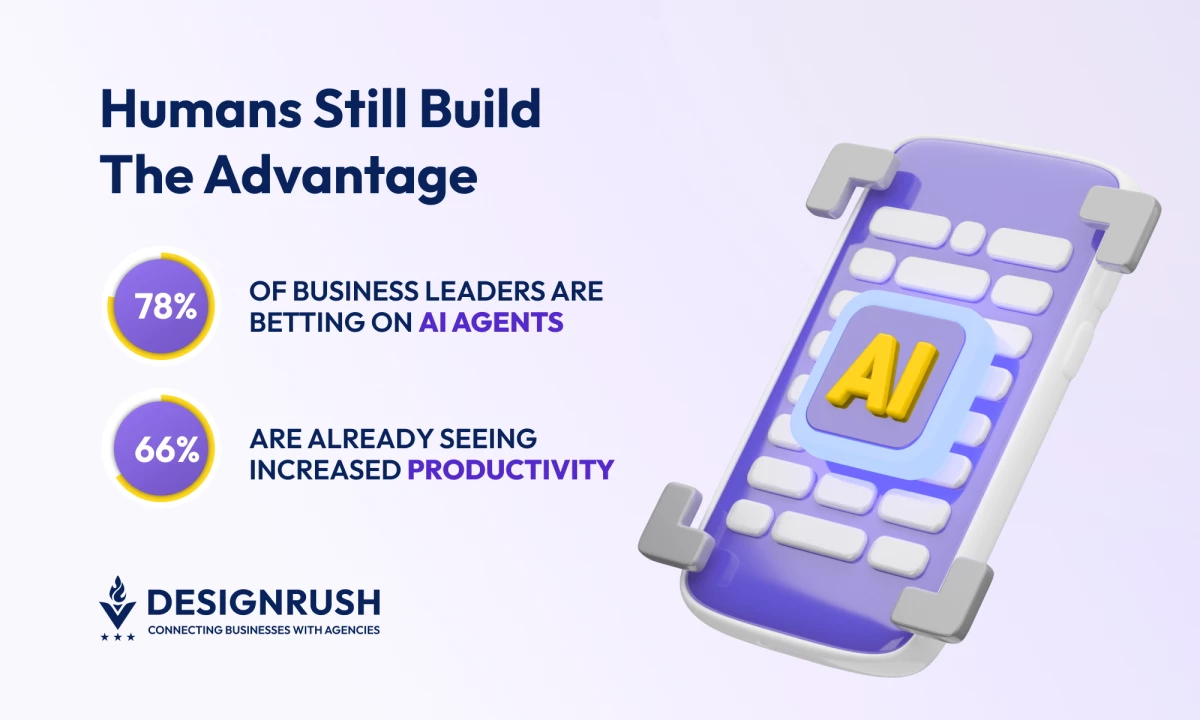
A May 2025 PwC survey found that 79% of senior executives say their businesses are already using AI agents in some capacity.
Meanwhile, 88% are intending to increase their budgets within the next year to integrate agentic AI.
And most companies are seeing early wins from AI agents, but these gains are still incremental.
Productivity is improving, decisions are faster, and customers are getting better experiences, yet the biggest advantage will come to organizations that push further.
The next wave will belong to businesses willing to adjust their workflows around coordinated networks of agents.
This is where automation and human strategy work together to create real benefits.
The Real Edge Is Coordination
AI agents can now execute tasks by itself that were once reserved for specialists.
However, this doesn’t equate to better outcomes on its own.
The real advantage comes from how organizations structure the work around them, connecting automated precision with human perspective.
Companies that treat agents as teammates can see stronger strategic alignment and faster adaptation across teams.
The next competitive edge certainly won’t come from replacing human employees, but from teaching systems how to work with them.
Looking to integrate AI agents into your workflow? Explore how rapid deployment can accelerate real results.