
More than 1 million businesses now use Meta's AI chatbots on WhatsApp and Messenger, per Meta.
In particular, the new Business Agent connects to enterprise systems like Shopify and Zendesk, pushing Meta into direct competition with OpenAI, Anthropic, and Google.
Meta executive Nicola Mendelsohn described the same ambition, discussing a rollout of enterprise agents that handle full customer interactions, from answering a question to completing the sale, in one place.
Meta CEO Mark Zuckerberg said the company's agents will eventually take on enough responsibility to run a business end-to-end as the underlying models improve, per CNBC.
That kind of end-to-end access is exactly where most companies run into trouble.
Meta tested the agent in India, Mexico, and Brazil before rolling it out to businesses everywhere.
The platform now carries over one billion business-to-customer conversations a day across WhatsApp, Messenger, and Instagram.
One Million Users Is Just the Beginning
So what does Meta reaching this number of business AI users reveal about the maturity of the agentic AI market?
Marcello Gracietti, CEO of Cheesecake Labs, an AI implementation and modernization company, points to two things, and the first is comfort with the initial wave of AI, chat itself.
Users have spent a couple of years talking to ChatGPT. Therefore, a conversational interface no longer feels novel or intimidating.
"That comfort is what's letting agents scale. Users already trust talking to a machine, and now the machine is going beyond chat," Gracietti says.
MCP connectors allow an agent to access multiple data sources at once. That access changes what AI does day-to-day.
It moves from answering a question to deciding what to do and acting toward a goal.
The second is what the number actually represents at Meta's scale.
"One million is nothing for Meta. They operate at billions of users. So, this number isn't a ceiling, in fact, it's just the beginning," Gracietti says.
For a platform at that scale, this number just shows how much growth is still ahead as Meta pushes agents past its current user base.
The Failure Point Is Rarely the Model
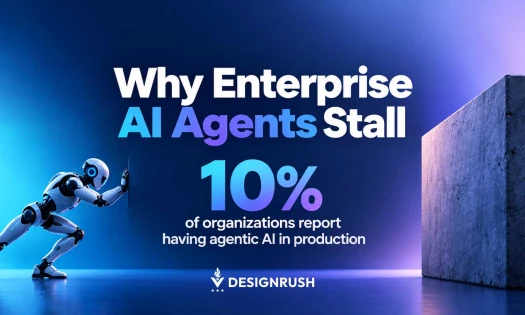
Most agent initiatives never make it past the chatbot stage into anything business-critical.
Gracietti says the model is rarely the reason they stall and identifies education as the biggest obstacle.
More often, teams simply do not know how to give an agent the right context or how to govern what it can access.
"The mental model that works is to treat an agent as a digital employee. It should have a defined role, a clear purpose, and explicit boundaries on what it can and cannot access based on that role," he says.
Companies that skip this step end up with agents that are either useless because they lack context or unsafe because they lack boundaries.
Security compounds the problem. An agent has to communicate with other systems to be useful, which raises a direct question about data exposure.
Until a company can confirm an agent can talk to its other systems without exposing data, it should not move that agent into anything business-critical.
That distinction is what separates a chatbot pilot from a system a company can actually depend on for real work.
The Infrastructure Question Comes First
Where an agent runs and how it handles data matters before any model gets chosen.
Running an agent locally with a tool like ChatGPT or Manus is simple.
But an agent needs a company's own content to be useful. That means most businesses should run on an enterprise account, so that data is not used for training.
Enterprise tiers also carry compliance certifications like HIPAA and SOC 2.
Gracietti says that is what makes running agents on real business data safe. Major cloud providers, including Google, Microsoft, and AWS, already offer that foundation.
Beyond identifying context and governance, he flags three things that matter before scaling an agent.
- The agent works as intended, end to end.
- Governance and security are confirmed, not assumed.
- Observability with identity shows which agent did what, so a failure can be traced and fixed.
Discoverability matters too. Agents increasingly call other agents in production, and each one needs to know when calling another is appropriate.
"In short, treat this as a data, platform, and operations problem, not just a model choice," Gracietti adds.
Who Presses the Button
Agents perform well at open-ended, probabilistic tasks like researching options, comparing information across sites, or drafting a message.
"Let them run freely there. That's what they'll always do well," Gracietti says.
The moment an action carries real consequences, the rules change.
A payment, a signed transaction, an emailed message actually going out all need to stay deterministic, not left to an agent's discretion.
That raises a practical question. How do businesses balance automation with governance as agents take on real customer-facing work?
The Cheesecake Labs CEO suggests that the answer is to stage it.
- In stage one, build the full process from start to finish, but hold back the agent's permission to execute the final action.
- In stage two, once the agent's output holds up consistently, hand over that final step and let it complete the action itself.
Governance, in this framing, is the discipline of moving that boundary outward slowly, only as the agent earns it.
APIs Now Answer to AI Agents
Companies have designed their systems for human users and for application-to-application API calls. Meta's platform connections force a third category into that list.
"The big shift is that companies need to start seeing their platforms and systems as serving a new kind of customer, an agent," Gracietti says.
That shift changes what a system needs to handle well. APIs, data access, and guardrails have to work for a caller that decides things on its own, not just one that follows a fixed script.
That means building them clear, well-structured, permissioned, and predictable, so an agent can call them correctly and safely.
The same data consistency, latency, permissions, and orchestration issues that come with connecting Shopify and Zendesk get harder once the caller is autonomous.
And companies designing for that now, rather than retrofitting later, are the ones positioned to scale.