
For over two decades, digital marketing operated on the assumption that if you published content, optimized for keywords, and earned backlinks, search engines would place your page on an open ranking gradient.
But that approach no longer works the way it once did. In fact, it’s become fairly ineffective for brands chasing a place within the top three search results.
As user discovery shifts to generative answer engines and autonomous AI assistants, search now functions more like an automated gatekeeper.
When a buyer asks an AI engine to answer a complex research question, the model does not return ten blue links. It synthesizes a single, structured answer and cites a small selection of verified entities.
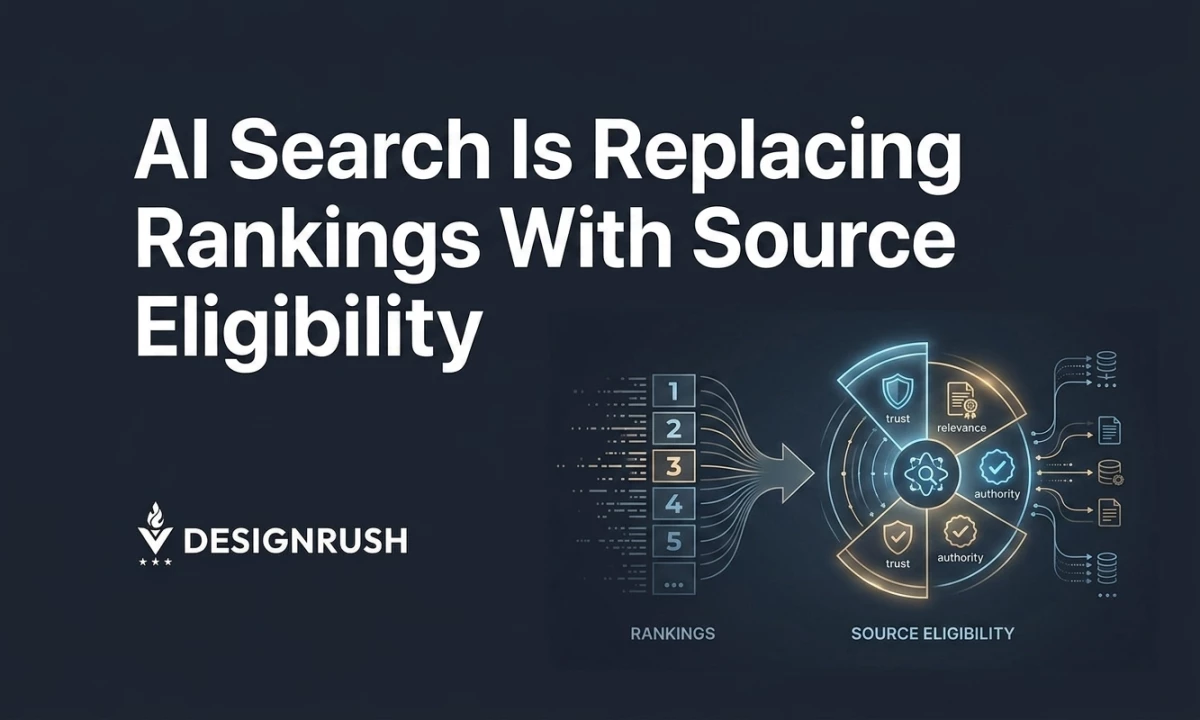
As such, the primary battle in digital marketing is no longer about winning ranking positions. It is about establishing source eligibility.
- Traditional Search: Indexing, Keyword Relevance, Backlink Authority, Ranking Gradient (#1 - #100)
- GenAI Search: Entity Extraction, Source Eligibility Gate, RAG Context Ingestion, Binary Synthesis
Why AI Engines Disqualify Brands From Answer Summaries
When an LLM processes a high-intent commercial prompt, such as "What are the top white-label digital marketing platforms for scaling agencies?", it runs an automated eligibility check.
This is the model’s way of deciding which brands qualify to appear in commercial answers, filtering out low‑quality or unverified names so only credible, recognized brands are included.
Brands are routinely disqualified for three structural reasons:
1. Synthetic Echo Chambers (Zero Information Gain)
If your content simply rephrases facts that are already widespread across the web, AI retrieval models filter it out as redundant noise.
Generative engines prioritize original proof, proprietary datasets, case study metrics, and direct expert commentary.
2. Unverified Off-Site Entity Signals
LLMs cross-reference your brand’s claims against distributed third-party web footprints.
If your official website claims a specific specialization, but third-party review platforms, directories, and industry publications lack corroborating data, the reasoning model assigns a low confidence score to your brand entity.
3. Machine Friction & Opaque Schemas (AXO Deficit)
Autonomous AI agents require explicit, structured metadata to interpret core services, pricing logic, service regions, and suitability.
If this information is buried inside unformatted PDFs or complex JavaScript without clean Schema.org (JSON-LD) markup, machines bypass the source entirely.
Navigating The Be Found Framework (BFF)
To help organizations stay visible across both human searchers and machine engines, Boostability developed the Be Found Framework (BFF).
BFF structures digital strategy across four core operational pillars:
1. Search Engine Optimization (SEO)
Search Engine Optimization (SEO) is the bedrock of digital visibility, primarily targeting traditional search engine crawlers and indexers like Googlebot and Bingbot.
Its core focus centers on technical crawlability, site health, and indexation to ensure that web engines can efficiently discover, parse, and catalog your digital properties.
Core verification signals include a clean, logical site architecture, strong domain trust, fast page load speeds, secure HTTPS protocols, and authoritative backlink profiles.
- Real-World Example: A regional commercial law firm restructures its website architecture, fixes broken canonical tags, compresses high-resolution assets to pass Google's Core Web Vitals, and earns backlinks from state bar associations.
As a result, Googlebot seamlessly crawls the site, indexing its practice area pages and surfacing them in top organic positions for local business law searches.
2. Generative Engine Optimization (GEO)
Generative Engine Optimization (GEO) focuses on positioning brand entities to be cited, summarized, and recommended by Large Language Models (LLMs) and conversational AI answer engines such as ChatGPT, Perplexity, Gemini, and Google AI Overviews.
Rather than optimizing for specific keywords, GEO centers on information gain and citation authority, ensuring your brand's unique data is ingested into model outputs.
Core verification signals include publishing proprietary research, using clear direct-answer syntax, structuring data with explicit facts, and building off-site entity consensus across authoritative third-party platforms.
- Real-World Example: A B2B SaaS company conducts an original industry study on enterprise cloud migration costs and publishes the raw benchmark data alongside concise summary tables.
When a CTO asks ChatGPT or Perplexity, "What is the average cost of cloud migration for mid-market manufacturing?", the AI model synthesizes the answer directly from the company's study and explicitly cites the brand as its primary source.
3. Search Experience Optimization (SXO)
Search Experience Optimization (SXO) merges traditional SEO principles with user experience (UX) and conversion rate optimization (CRO) to serve human visitors. Its main objective is to drive on-site engagement that matches the intent of the searcher’s needs.
Conversions are more than new leads. They are consumers turning into believers in the content you are providing.
Once a real person lands on your page, their search intent is fulfilled instantly and without friction.
Core verification signals include intent-driven page layouts that display key information above the fold, fast visual loading, intuitive navigation, clear calls to action (CTAs), and authentic trust elements such as customer reviews and badges.
- Real-World Example: A residential plumbing service ranks high for emergency repairs and directs traffic to a streamlined, mobile-optimized landing page.
Instead of burying visitors in dense text, the page features a prominent "Book Emergency Repair" button, upfront pricing ranges, and live customer star ratings, allowing the homeowner to schedule a technician in two clicks.
4. Agent Experience Optimization (AXO)
Agent Experience Optimization (AXO) prepares a business's digital infrastructure for autonomous AI agents and digital personal assistants that perform research, evaluate options, and execute transactions on behalf of users.
Its primary focus is machine actionability and suitability, allowing autonomous bots to parse business rules, pricing logic, and service criteria without human intervention.
Core verification signals include rich Schema.org (JSON-LD) metadata, machine-readable suitability statements, consistent cross-platform directory data, and open API endpoints or clean booking paths.
- Real-World Example: A boutique hotel implements detailed JSON-LD markup (HotelRoom, priceSpecification, amenityFeature) explicitly outlining business desk availability, high-speed Wi-Fi attributes, and real-time room rates.
When an executive assistant's AI agent is instructed to "Book a hotel downtown under $200/night with a dedicated workstation for next Tuesday," the agent instantly verifies the hotel's structured criteria and completes the reservation without requiring human browsing.
How to Build a Source Eligibility Moat
Securing your brand's eligibility in AI search requires an intentional pivot toward machine readability and verified authority across three concrete execution steps:
- Unify Entity Signals Across Knowledge Graphs: Ensure absolute consistency for your brand name, address, core service taxonomies, and executive leadership across Google Business Profile, Wikidata, Crunchbase, and primary vertical review platforms.
- Publish High-Information-Gain Knowledge Assets: Replace generic 101-level articles with original research, benchmark reports, proprietary survey results, and direct-answer comparison tables. Follow the E-E-A-T playbooks and push beyond the basics.
- Deploy Full-Stack AXO Schema: Implement structured JSON-LD (Organization, SoftwareApplication, Service, FAQPage) with explicit audience and offer fields so autonomous AI agents can validate your product suitability without ambiguity.
- Industry Tip: Forward-thinking agencies are replacing traditional keyword rank trackers with Prompt Citation Audits.
By sampling 50 to 100 buyer-intent prompts across ChatGPT, Perplexity, Gemini, and Claude monthly, brands can track true citation share, recommendation placement, and contextual sentiment.
The shift to AI search is not just a user interface update; it is a fundamental restructuring of how online authority is awarded.
Brands that continue to focus solely on keyword density and legacy backlink tactics will find themselves increasingly invisible in AI-generated answers.
By operationalizing the Be Found Framework and defending Source Eligibility across SEO, GEO, SXO, and AXO, businesses can ensure they remain the trusted, cited, and recommended choice for both human buyers and machine agents.