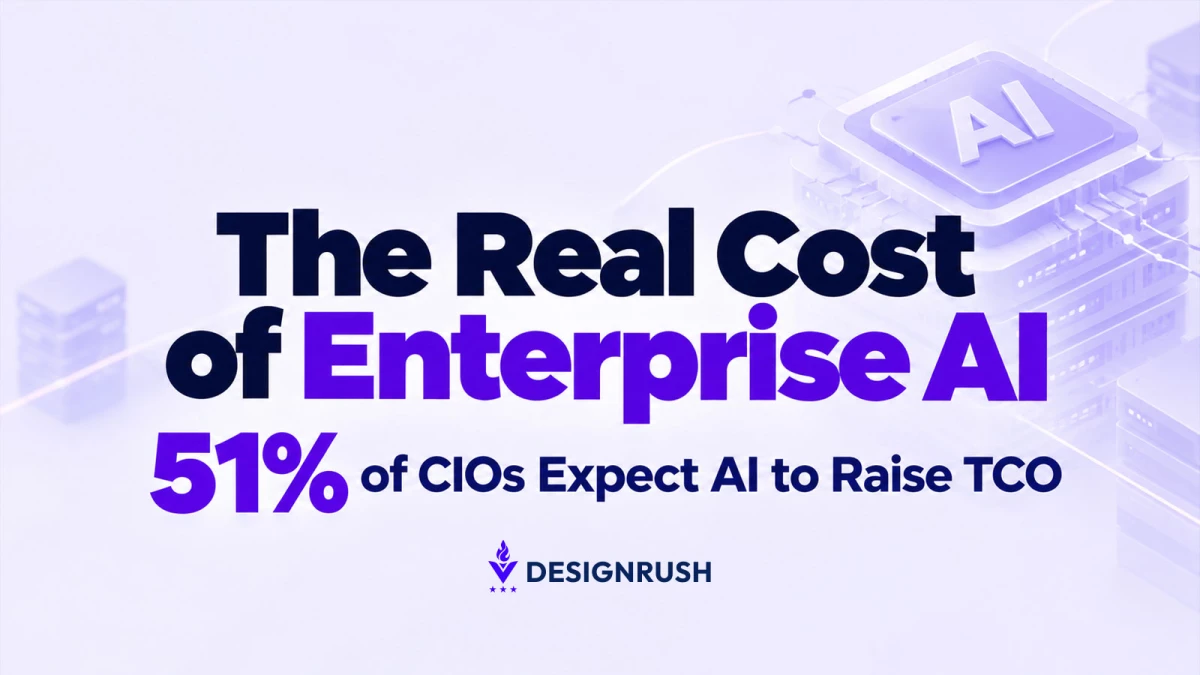

As many as 51% of CIOs expect AI to increase the total cost of ownership of technology solutions over their life cycle, according to Gartner’s 2027 CIO and Technology Executive Survey.
Gartner claims AI costs are determined at run time, leaving part of the spend unknown until the product is actually being used.
The development or licensing price is one part of the budget. But even once the product is live, model usage and data processing keep generating costs.
This results in companies still paying for infrastructure and integrations, while monitoring, security work, and ongoing development continue around the product.
Goji Labs works on AI features and data infrastructure for existing products, including the systems that connect models to company data and keep them working in production.
The company’s CEO and Co-Founder, David Barlev, explains that enterprise buyers need to understand the assumptions behind the operating number as closely as the build estimate.
"An enterprise can get a very clear build estimate and still have a fuzzy run-cost number," he says.
"I want to know what usage that estimate assumes and what still needs people once the product is live. If nobody can answer that, the budget isn’t finished."
AI Run Costs Continue After Launch
Goji Labs' AI prototype guidance treats model usage as one part of operating cost.
And even though retrieval and processing keep running after launch, human review may still be needed when the system hits an exception, and third-party services add another recurring cost.
Once the product is live, Goji Labs tracks token use and which model is doing the work. Both can change the run cost as usage picks up.
Its enterprise software guidance puts annual maintenance at 15% to 25% of build cost. And while infrastructure, security patching, and third-party licensing sit inside that figure, new feature development, however, sits outside that estimate.
"I’d want to know what a completed task costs once the product is being used normally, including any human review around it," Barlev says.
"That gives you a much better basis for deciding whether the economics still work when the product scales."
Enterprise AI Runs on Existing Data and Systems
Enterprise AI often has to reach into systems the company already uses.
That can require retrieval pipelines, vector databases, and model orchestration, along with integrations to the places where the underlying data is stored.
Goji Labs' enterprise software cost guidance identifies integration depth, compliance requirements, and data migration as factors that can change an estimate before development is finished.
As a result, regulated and high-availability systems can carry more ongoing work as audits, monitoring, and redundancy become part of the operating requirement.
"Connecting the model to the business is where a lot of the engineering sits," Barlev says.
"Company data has permissions, old integrations, and systems that change over time, and somebody has to keep all of that working after launch."
Goji Labs' AI optimization work tracks real-world performance after release, including accuracy, latency, and usage patterns. New edge cases can lead to changes in prompts, workflows, system logic, or model choice.
Enterprise Buyers Need a Multi-Year AI Cost View
Barlev recommends evaluating enterprise software against a three-year total cost of ownership.
That calculation includes the initial build, annual maintenance, infrastructure, third-party licensing, internal support, and the next release cycle.
Gartner is seeing pressure from the other side of the budget too, with the report suggesting that 58% of CIOs say that they face increased pressure to deliver cost improvement from AI.
Goji Labs' AI prototype guidance also measures cost against completed work, including the cost of a resolved request or an hour of manual work avoided.
For buyers comparing AI products over several years, the pricing model also needs to show how operating costs can change as the product scales.
"By the time an AI product reaches a board, I’d want the operating assumptions on the same page as the build number," Barlev says.
"Show me what happens if usage doubles. Show me the cost of adding another data source or keeping human review in the workflow. Leadership can then judge the investment against the value it is expected to create."