
Consistency in AI Content: Key Findings
- AI can speed up content creation, but that gain disappears when teams still need to fix and review every asset.
- Generic image tools often break under real identity standards, especially across formats, languages, and approvals.
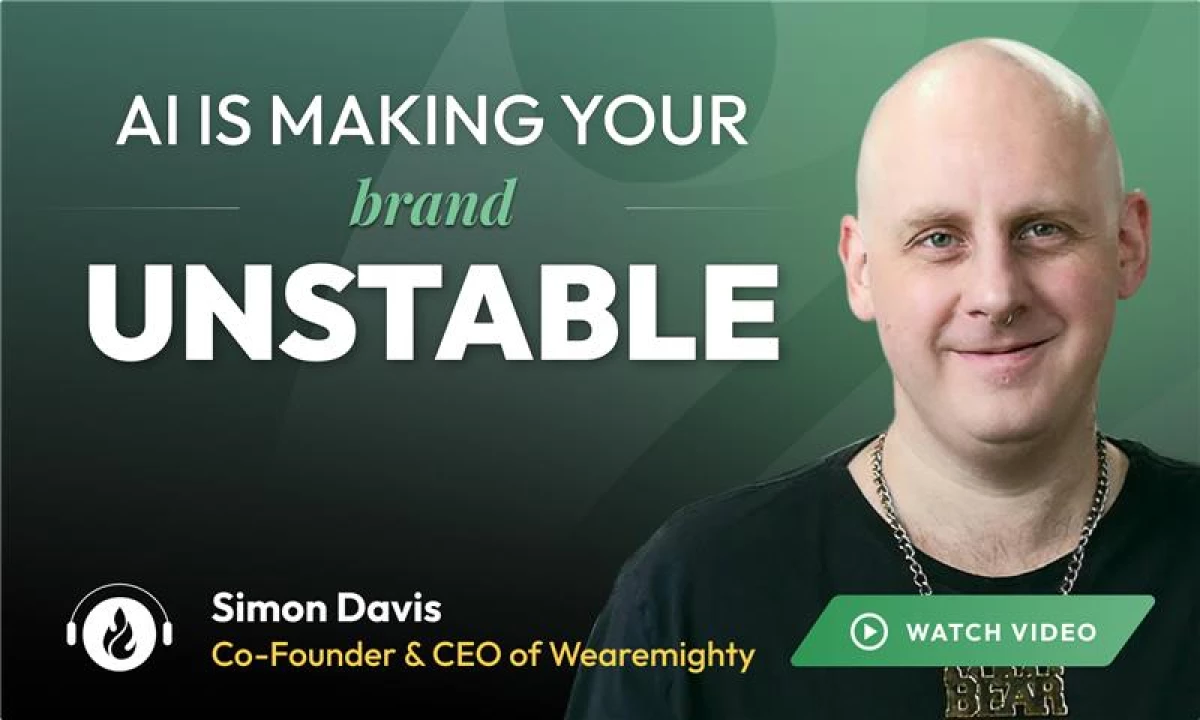
- Simon Davis of wearemighty argues that brands need clear rules and human review before they trust AI at scale.
AI and marketing teams are under pressure to produce more content at a faster rate and across more channels than ever.
HubSpot’s 2026 State of Marketing report found that 80% of marketers use AI for content creation, while 75% use it for media production to keep up with those expectations.
But scale on its own does not solve the harder problem of keeping work usable, accurate, and on-brand.
That’s the problem Simon Davis, Co-Founder and CEO of wearemighty, aims to resolve through his company and its development of SecretSauce, a creative tool for producing on-brand content at scale.
According to Davis, speed becomes harder to trust once a brand has to manage formats, languages, approvals, and creative rules at scale.
“[...] AI has made content generation very fast and very cheap. So you can create almost an infinite amount of content. But it's an ROI negative situation because you're creating loads of content that you can't use.”
“And I see people talking about how AI gets some 70% or 80 % of the way there, but then they have to redo it manually. And so there's only really a marginal improvement.”
Davis refers to this as drift, when AI-generated assets slowly move away from the brand they are meant to represent through small visual and verbal inconsistencies that become harder to control over time.
When this happens, the value of AI breaks down.
In episode No. 135 of the DesignRush Podcast, Davis explains why speed alone is not enough in AI-powered content production and why the real challenge for brands is creating content they can actually use consistently.
Watch the full episode on YouTube or listen on Spotify.

Who Is Simon Davis?
Simon Davis is the Co-Founder and CEO of wearemighty, an AI studio helping brands and studios create and scale ideas through production systems built for real-world use.
Davis previously held roles at King, Ubisoft, Bigpoint, and AKQA, and now leads SecretSauce, wearemighty’s tool for on-brand content at scale.
Why Faster AI Output Still Creates More Work
Speed still dominates a lot of AI discussions. Yet, Simon is more interested in what happens after the asset is made.
After all, faster output means very little if teams still have to spend time fixing every AI-generated asset before it goes live.
Although it may not sound like a big deal on an individual level, it becomes a major headache when it has to be done repeatedly and at scale.
“Thinking about my time at King, for example, King makes Candy Crush. Candy Crush has
a massive audience, but they create lots and lots of ads,” Davis says.“But these ads are in dozens of languages and they're served in multiple formats so that you have one size for Instagram, a different size for TikTok."
"That's essentially thousands of variations for each campaign. And so they have to be right.”
And the consequences go beyond time inefficiencies.
An Adobe Express survey of 1,000 U.S. business owners and professionals found that one in three companies had at least doubled content production in the past year.
But to achieve that result, 36% of respondents said they sacrificed creativity or originality to keep up with output goals.
Meanwhile, 21% of them said they frequently feel burned out due to content production demands.
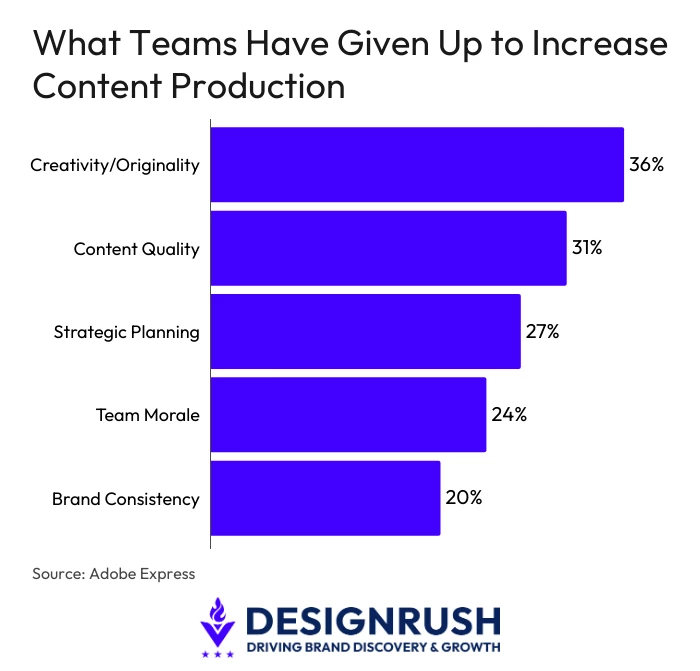
These all point to the fact that content velocity on its own is a weak measure of success once teams have to manage approvals, formats, and brand control at scale.
This is why Davis says leaders need to judge AI by how quickly the work can be approved, adapted, and published without extra rounds of repair, rather than just how quickly it can produce content.
Generic AI Breaks Down Under Brand Rules
Davis describes standard image generation as unreliable by design.
“[...] it's essentially what we call prompt lottery, where you prompt and you hit the button, and you pray that you get an output you can use.
"And maybe you redo that like 50 or 100 times, and then eventually you win the lottery, right?”
Sometimes the output is close enough to use. But more often than not, it falls short of usable.
The trouble starts when a company needs consistency, not just a nice visual. This is especially true when the work has to hold across a full visual identity.
“Generic artists are very good at creating images, but they don't know your brand. And they'll do things like put logos in the wrong position, or the text will break, or it will drift.”
This is the reason why Davis and his team built SecretSauce, a creative tool for producing on-brand content at scale.
“It wasn't built to be sold. It was built out of necessity,” he says.
“We had a bunch of content we were building. We had a game that required 25 million unique characters, because the vision was that every player would have a completely unique character.”
That forced the team to think less about flashy demos and more about systems that could hold up under extreme production pressure.
That thinking led to what he describes as a “brand brain,” a system built around a company’s product information, creative rules, and current campaign inputs.
As those inputs changed, the system can update with them, while humans still review the output.
Davis’ point here is practical.
“You know, the best output is not fully human-generated or fully AI-generated. For me, it's like when you mix the two,” he says.
What Commercializing the Tool Taught Him
Davis is just as candid about what happened once the internal tool started attracting outside interest.
Commercializing the tool brought a different challenge.
“We were a game studio for nine years. And so we have a completely different skill set to building like a technical tool that serves multiple different industries,” Davis says.
Moving into a technical B2B product meant new roles, a new operating focus, and a different kind of team.
He describes it as a real cultural change inside the business, even though user response to the product was strong.
He also draws a useful lesson for founders trying to judge whether an internal tool deserves a wider market.
“Everyone's very nice to you. And people don't often tell you what you don't want to hear, right? They won't tell you if it sucks. They're your friends.”
Friendly feedback is not enough. Real product-market fit starts when people with no personal investment try the product and tell you where it fails.
Brand Teams Need a Definition Before Generation
For leaders who want to use AI without weakening the brand, Davis’ advice starts earlier than most teams expect.
Do not rush to generation. Start with creating definition.
“Spend the time with a tool that understands your brand, and spend the time speaking to it and discussing what your brand is.”
He adds that teams should make the AI repeat the rules back, so they can see whether the system actually understands the company before they scale output.
Companies need to spend time teaching the tool what the business actually is, what standards matter, and where the boundaries sit.
Teams that skip that stage often get poor output and blame the technology when the real issue is weak input.
That usually points back to a weak or unclear brand identity.
As Davis puts it, “They just go straight to image generation. They're like, oh, it doesn't look like my brand. It's like, well, you didn't explain what your brand is.”
That advice is easy to underestimate. It also gets at the real cost of AI in marketing.
What usually fails first is not access to AI tools. It is the discipline required to teach them what the brand stands for.
Teams can buy tools quickly. Building a system that protects identity across channels, markets, and campaign cycles takes more care.
This is also where outside support can help. Before a company asks AI to produce at volume, it needs visual rules, message discipline, and approval logic that can hold under pressure.
That is also where the right branding agency or creative partner can help.
Before a company asks AI to produce at volume, it needs clear visual rules, message discipline, and approval logic that can hold under pressure.
Why Consistency Has Become a Growth Issue
Consistency now affects far more than visual polish. It affects revenue, trust, and how efficiently teams can publish at scale.
“Consistency is a huge issue for all brands all the time. But when you're using AI to produce things on like an industrial scale becomes very important,” Davis says.
When output falls apart across languages, sizes, channels, and reviews, speed only adds more pressure.
Brands that set clear rules early are in a much stronger position to use AI without losing control of how they show up.
Want to take a closer look at how brand teams can scale AI content without losing control?