
The luxury SUV market surpassed $239 billion in 2025 and is on track to surpass $313 billion by 2030.
That's according to a Mordor Intelligence growth forecast report, which shows crossover SUVs held over 52% of the market in 2024. And coupe SUVs are set to grow at an 11.82% CAGR through 2030.
Clearly, luxury SUVs sit in one of the busiest parts of the car market.
The Kelley Blue Book 2025 Brand Watch study supports these predictions. In 2025, interest in luxury SUVs reached an all-time high. And the BMW 3 Series dropped out of the top 10 most-considered luxury vehicles as buyers moved toward SUVs and crossovers.
Why are buyers opting for luxury SUVs? This premium crossover is now the go-to for buyers, but the popularity comes with a cost for brands:
The more buyers flock to a format, the harder it becomes for any one brand to own it.
INFINITI Motor Company is using the QX65 to put emotion back at the center of its crossover design.
Its all-new 2027 QX65 brings back a more emotional fastback shape.
It has a roofline inspired by the INFINITI FX, a bamboo-inspired grille, Sunfire Red paint with real gold-coated glass flecks, and a cabin built around Japanese hospitality and personalized technology.
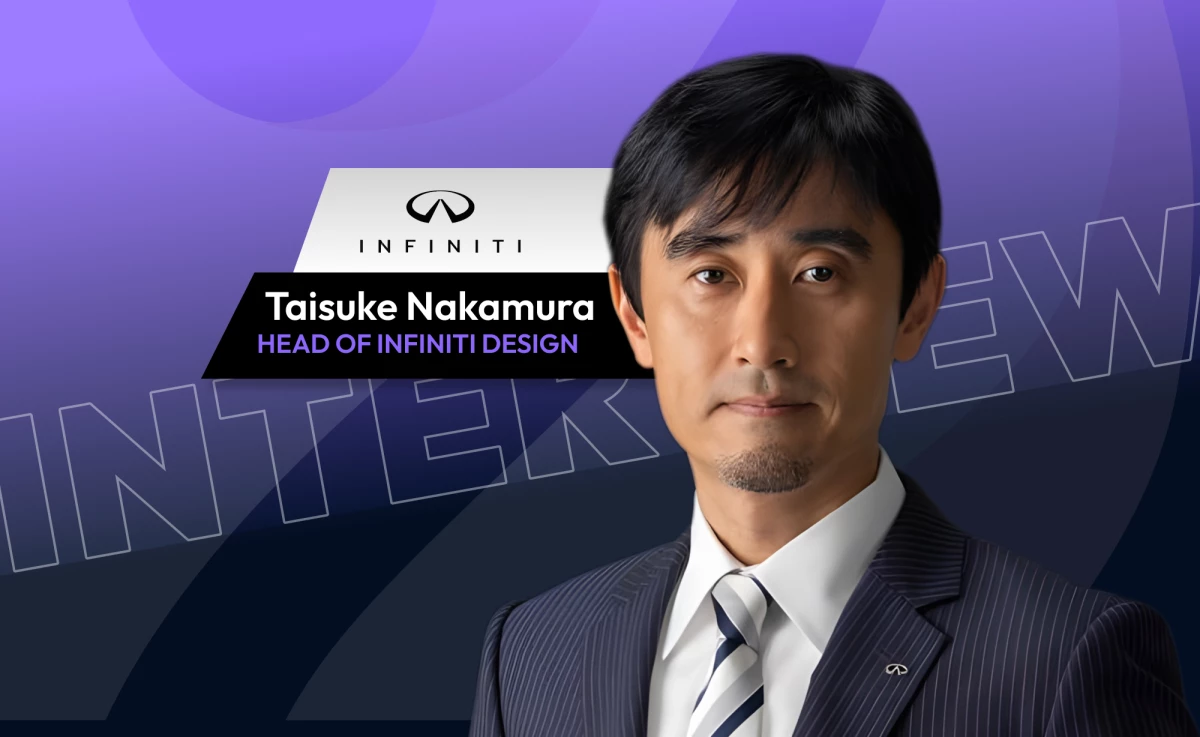
"The INFINITI brand is for drivers who want to set themselves apart in the luxury segment," Taisuke Nakamura, head of INFINITI Design, tells DesignRush.
In this DesignRush interview, Nakamura shares why QX65 needed more emotion.
He also explains how INFINITI decides what to bring forward from its past, and why cabin technology has to feel thoughtful rather than loud.

Who Is Taisuke Nakamura?
Taisuke Nakamura is head of INFINITI Design, leading the global team from Kanagawa, Japan. He joined Nissan Motor Co. in 1993 with a degree in product design from Kyoto City University of Arts.
He has since worked across exterior design, advanced design, and UX/UI for both Nissan and INFINITI, including a stint at Nissan Design Europe in London. His concepts include QX Inspiration, Prototype 10, and Qs Inspiration.
A Popular Shape Needs a Sharper Idea
The luxury crossover has become a default choice for many premium buyers.
The sales opportunity comes with a brand identity problem.
Raised profiles, large screens, sculpted bodywork, and premium materials have become standard cues in the category.
QX65 starts with a more specific design job.
"Artful design and performance are essential to providing this uniqueness and stirring people’s emotions," Nakamura says.
The emotion comes first from the silhouette.
QX65 has a pronounced arching roofline, a wide stance, and a fastback profile.
The color draws from a limited-edition Regal Red on the Nissan GT-R, another link to the brand's performance heritage, according to the QX65 press kit.
For Nakamura, the aim was to make the vehicle feel instantly different.
"QX65 does just that; from the first look, it’s clear this SUV is different from the rest," he says.
This sameness makes the silhouette more important.
Deloitte’s 2025 Global Automotive Consumer Study found that 54% of U.S. respondents plan to switch brands for their next vehicle.
In that kind of market, brands cannot rely on loyalty alone. Product and experience have to give buyers a reason to stay interested.
For QX65, that reason starts with shape.
Heritage Has to Do Real Work
The QX65 references the INFINITI FX, but this is not a retro move. This matters because it gives the new model a recognizable emotional base.
Nakamura says designers prioritized an arching roofline to create a sleek upper cabin silhouette, while keeping the lower body powerful and planted.
This balance is harder than it sounds.
Fastback SUVs often face the same criticism: they look sharper, but lose some daily usefulness.
INFINITI tried to avoid that trade-off. Per INFINITI's specs, the QX65 offers 35.8 cubic feet of luggage space behind the second row and 67.7 cubic feet behind the first row.
The brand says it places its luggage area among the most spacious in the segment.
"Designers and engineers worked closely to achieve this so INFINITI clients don’t need to sacrifice style for utility," Nakamura says.
This is where the FX reference earns its place. The FX reference gives the QX65 a familiar emotional starting point.
The roofline creates the emotional pull. The cargo space protects the practical reason to buy.
For brands, this is the lesson: heritage works best when it solves a current problem.
Japanese Detail Gives the Design Its Logic
QX65 has a lot of visible detail.
The grille takes inspiration from Japanese bamboo forests. The front lighting uses INFINITI’s Digital Piano Key design.
The rear has a three-dimensional, full-width LED taillight with vertical elements inspired by aircraft fins.
The Sunfire Red paint is another strong cue.
It uses genuine gold-coated glass flecks and a three-layer coating process. INFINITI says the color was inspired by a similar Regal Red used on the Nissan GT-R.
On paper, those details could easily feel like a long feature list.
Nakamura says the design team kept them tied to one idea.
"The 2027 QX65 was designed under INFINITI’s design philosophy, Artistry in Motion," he says.
This philosophy matters because the design is doing more than decorating the vehicle.
The bamboo grille connects the product to Japanese craft. The aircraft-inspired lighting gives the rear a cleaner, more technical feel.
The red paint adds drama without breaking from the brand’s performance heritage.
"Whether it’s the new Sunfire Red paint or the aircraft-inspired taillights, the result is a vehicle with gorgeous details that harmoniously blend together," Nakamura says.
For marketers, the brand logic is easy to see here.
A premium detail is stronger when it has a reason to exist. Otherwise, it is just another line in a spec sheet.
Cabin Technology Has to Stay Human
Luxury car technology has become a strange balancing act.
Buyers expect more screens, personalization, and connected services, while still wanting basic cabin functions to feel easy.
J.D. Power’s 2025 U.S. Initial Quality Study found infotainment remains the most problematic vehicle category, with 42.6 problems per 100 vehicles.
The study also found more touchscreen-related complaints as automakers move more functions, including climate settings and garage door controls, into screens.
This makes QX65’s cabin design more important.
Nakamura says INFINITI wanted the technology to feel integrated from the start.
"From the start, our design team aimed to seamlessly integrate technology into the cabin," he says.
The QX65 includes:
- standard dual 12.3-inch displays
- Google built-in
- wireless Apple CarPlay
- wireless Android Auto
- available 64-color ambient lighting
- Klipsch audio
- Individual Audio
- and INFINITI Personalized Sound, which adjusts the audio profile to the driver’s hearing.
The cabin also uses ambient lighting inspired by the four seasons in Japan. This detail is easy to overlook, but it fits the wider brand idea.
INFINITI talks about modern Japanese luxury through minimalism and hospitality.
In the QX65, that shows up in small moments:
- a projected light path as the driver approaches
- lighting that warms the cabin
- audio that can be shaped around the person sitting in the seat,
- and screens that sit cleanly inside the dashboard.
"Once inside, drivers will find the large dual displays fit smoothly into the dashboard, while ambient lighting provides a unique warmth throughout the space," Nakamura says.
Deloitte’s 2026 Global Automotive Consumer Study also found many consumers are open to AI-driven personalization and over-the-air enhancements that extend a vehicle’s usefulness over time.
But the same study says buyers still place weight on product quality, performance, and price when choosing a brand.
Technology helps when it makes the cabin easier, warmer, and more personal.
For QX65, the job is to make tech feel less like a dashboard flex and more like part of the ownership experience.
Brand Lessons From the QX65
QX65 shows how a product can use design to defend brand identity when a category fills up with competitors offering the same thing.
For brands and agencies, there are three useful lessons:
- A popular format still needs a point of view. Luxury SUVs may be in demand, but demand also attracts similarity.
- Heritage needs a present-day role. The FX reference works because it shapes the product, not because it asks buyers to care about the past.
- Technology should support the cabin experience. Screens, lighting, and personalization matter more when they make the product easier and warmer to use.
And according to Nakamura, every feature needs a clear role in the overall experience.
The QX65 uses its roofline, paint, lighting, grille, cabin atmosphere, and audio experience to say the same thing from different angles.
INFINITI frames luxury around personal distinction, with the QX65 carrying that idea through shape, lighting, sound, and cabin atmosphere.
That is a harder story to tell in a segment full of polished crossovers. But it is also the reason the product needs a sharper shape in the first place.
For marketers, the takeaway is straightforward: a product stands apart when its details point back to the same brand truth.