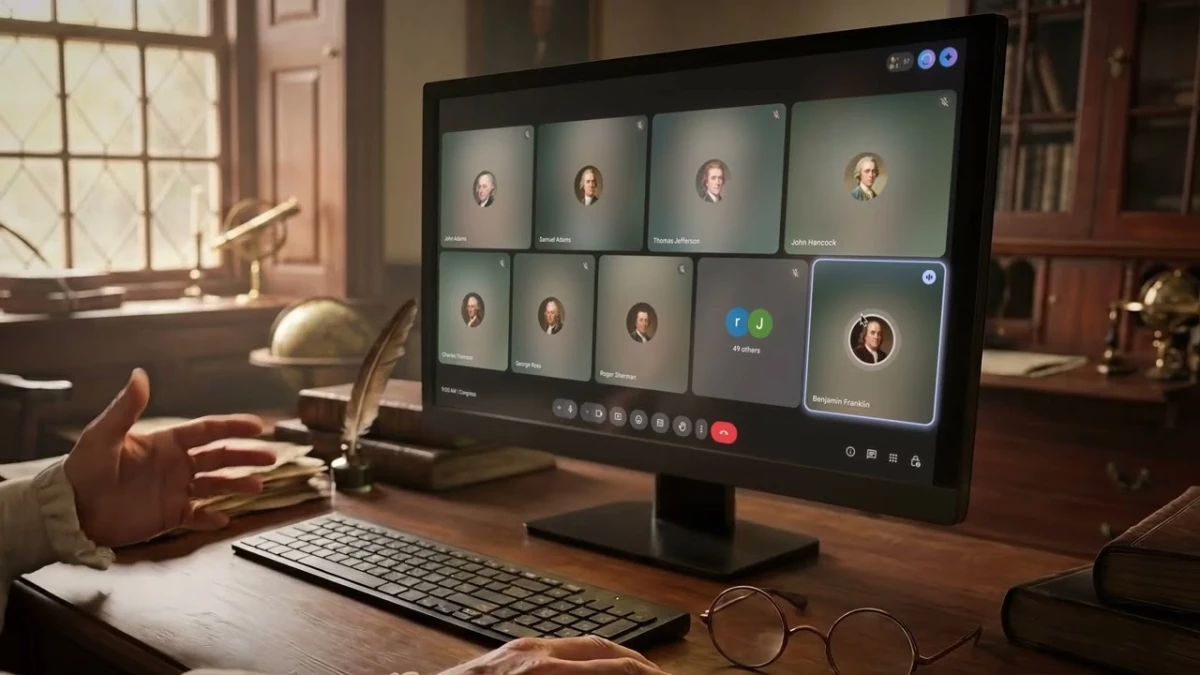

Google just handed America's Founding Fathers a shared drive, and the internet is grading their project harshly.
"Group project, but make it 1776" drops Thomas Jefferson, John and Samuel Adams, and Benjamin Franklin into a modern office routine.
Jefferson drafts by parchment while Franklin nudges him by text.
The document soon lives in a shared file, with edits and comments moving back and forth.
A calendar invite goes out, and a video call gets scheduled.
And every attendee keeps their camera off the whole meeting, a detail viewers love almost as much as the premise.
Sam Adams then asks if the group can settle their disagreements over beers.
The founders debate a national seal design in what plays like a group email thread.
John Hancock signs off with an eSignature before fireworks close the spot, with the sequence playing like a workplace sitcom cosplaying as history class.
Google CEO Sundar Pichai posted the spot himself, calling the pairing of Docs, Gmail, and Calendar a fitting way to mark the anniversary.
He adds that it "really puts the history in version history."
Love this re-imagining of America’s founding using Docs, Gmail, Calendar and more from @GoogleWorkspace. Really puts the history in version history :) pic.twitter.com/eWO4yc22p5
— Sundar Pichai (@sundarpichai) July 2, 2026
Overall, the ad timed to the 250th anniversary of the Declaration of Independence opts for humor over reverence.
But whether this was a good move by Google is still up for discussion.
Behind the Punchlines
Where the ad gets more serious is its use of artificial intelligence, tucked in without much fanfare.
The founders consult a chatbot before denying King George III edit access, and a design tool spins up seal options on the fly.
Google keeps these AI scenes brief and almost incidental, treating the technology as one tool among many.
But this restraint still drew criticism.
Bluesky ran colder than the positive YouTube and Instagram responses, with users calling the spot tone deaf and flagging how thin its AI usage was.
It’s amazing how little of this is actually AI. Even in a corny fantasy joke, it’s impossible to make the case that AI is a useful tool for political organizing, writing, or human collaboration.
— Angus Johnston (@angus.bsky.social) July 5, 2026 at 3:20 AM
[image or embed]
Historian Angus Johnston summed up the skepticism directly:
"[I]t's impossible to make the case that AI is a useful tool for political organizing, writing, or human collaboration."
This isn't the first time an AI cameo cost a brand some goodwill.
Sony ran into similar heat when an AI assistant named E.V. showed up in the opening pages of "Spider-Man: Brand New Day."
Because of this, fans argued that the character replaced the human connection that defines Peter Parker.
Peter has a new A.I. assistant E.V. in ‘SPIDER-MAN: BRAND NEW DAY’.
— DiscussingFilm (@DiscussingFilm) April 29, 2026
“[She is] sadly, the closest thing Peter has to a friend.”
(Source: https://t.co/vVhwpjuKNL) pic.twitter.com/HYWseJxNQR
"Group project, but make it 1776" draws a similar complaint, but from a different angle.
Viewers aren't objecting to AI failing at the task, and are instead objecting to AI showing up at all inside a story built on human ideas.
History Is a Hard Sell for AI
Google timed the ad to an anniversary that already has audiences feeling sentimental.
Occasions like this push people to measure today's institutions against the founding ideal, so any brand in the frame faces stricter judgment.
A recent run of ad backlash shows audiences reading AI placement as a signal of a brand's values.
Keeping its AI use small suggests Google's marketing team saw some of these negative reactions coming.
Showing AI on small logistics while humans write the actual words is becoming the safer creative choice.
Brands attaching themselves to historic or patriotic events should expect their technology to be judged against a higher bar of authenticity.
🪟 Google’s 1776 ad is just a preview of AI-as-staff: rewrite history in Docs, schedule the revolution in Calendar, then “approve” with e-signature vibes. Cool. Creepy.https://t.co/PpTCyHC3x2#GoogleWorkspace#EnterpriseGovernance#AiInProductivity#GeminiAipic.twitter.com/u11pwJWx22
— Windows Forum (@windowsforum) July 4, 2026
Here are some lessons for marketers:
- Match tone to moment. Campaigns tied to historic anniversaries carry more scrutiny, so brands should keep new technology in a supporting role.
- Show the tool doing small and realistic tasks. Marketers should keep AI visibly limited to logistics to avoid signaling a shortcut.
- Expect the counter-narrative. Brands using AI in nostalgic or patriotic campaigns should prepare responses for the platforms where skepticism runs highest.
Ultimately, Google's ad proves that real history and new technology don't automatically mix well, no matter how playful the wrapper.
Our Take: Did Google Pick the Wrong Ad to Show Its AI?
We've watched enough of these product-meets-history mashups to know the formula rarely survives contact with the internet.
The gamble was that a funny Founding Fathers premise would keep viewers from scrutinizing the AI.
how people cannot see how this is disrespectful is beyond me
— furnaces (@furnaces) July 3, 2026
But history is a tricky ingredient. It makes people protective, and a protective audience goes looking for something to resent.
Here, that something was Gemini hovering near the birth of the country's founding document.
We don't think Google set out to provoke anyone.
We just think it misjudged how little goodwill AI has right now, even when it's barely doing anything.
The fix is picking an occasion that can actually survive the technology you attach to it.
Brands introducing new technology often rely on creative partners who can translate technical features into clear, engaging stories.
Explore these top creative agencies to help bring product innovations to life.