
The rise of AI-assisted development has dramatically lowered the barrier to building software.
Today, founders can generate interfaces, create backend logic, automate workflows, and launch MVPs faster than ever before. A growing number of SaaS startups are being built partially, sometimes almost entirely, using AI coding tools and rapid-generation platforms.
In startup circles, this has become known as "vibe coding."
The appeal of these tools is obvious.
A founder with a strong concept can move from idea to product without hiring a full engineering team upfront.
Likewise, teams can prototype faster, validate ideas earlier, and reduce early development costs significantly.
For many SaaS companies, that speed is valuable.
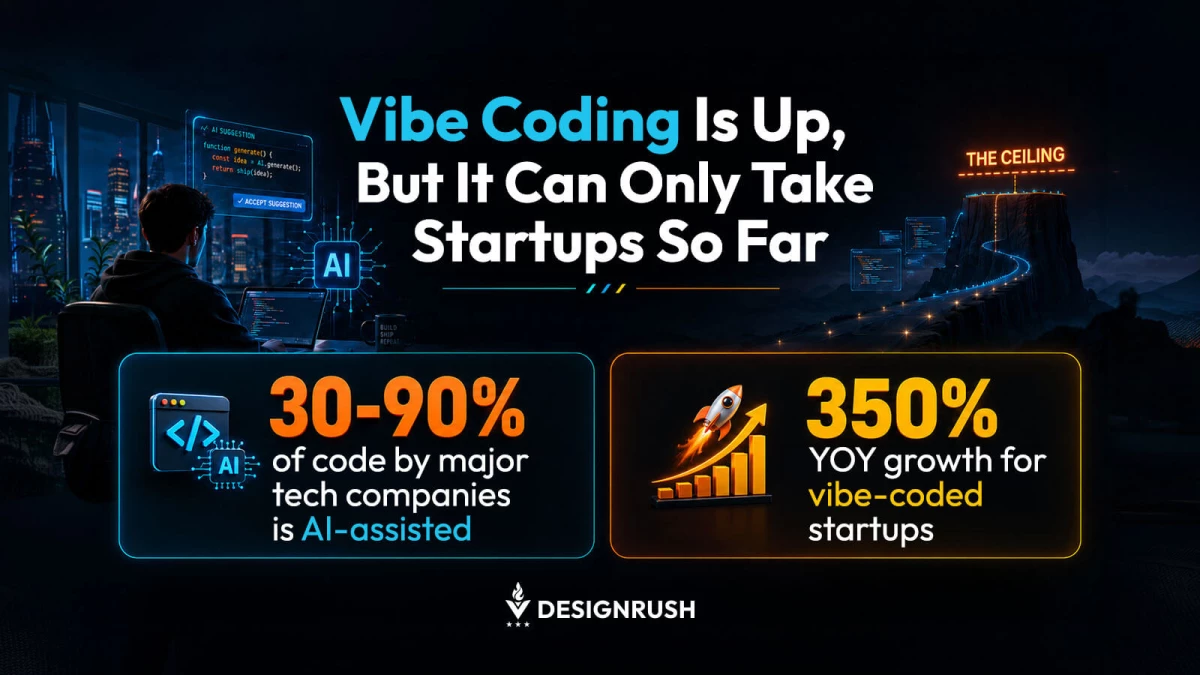
In fact, major tech companies generate 30–90% of their new code using AI tools, according to data from Hostinger.
But speed at launch and long-term scalability are not the same thing.
At Essential Designs, we often work with organizations that reach a turning point after rapid early growth. The MVP worked. Customers adopted the product. Revenue started coming in.
Then new challenges began to emerge:
- Performance bottlenecks as user activity increased
- Technical debt from rapid development decisions
- Disconnected systems and manual workarounds
- Security and compliance concerns
- Features that became increasingly difficult to maintain
Fast MVPs Solve Early Problems
For early-stage SaaS startups, AI-assisted development helps accelerate momentum.
But in many cases, founders do not need enterprise-grade architecture on day one.
What they actually need is to answer a much simpler question: Does anyone actually want this product?
To answer that question, most startups need:
- Proof of concept
- Market validation
- Customer feedback
- Investor tractio
- Faster iteration cycles
AI coding tools are highly effective at helping teams reach these early milestones.
But the issue is not whether these tools work.
The issue lies in using these tools as a shortcut, which leads to missing out on the valuable information the skipped steps provide.
And that’s when issues begin to pop up as founders and teams attempt to scale their products. .
Scaling Creates Different Technical Demands
As SaaS companies grow, software requirements become significantly more complex.
Teams begin dealing with:
- Larger user volumes
- More integrations
- Security and compliance requirements
- Cross-platform consistency
- Performance optimization
- Data architecture decisions
- Long-term maintainability
- Operational reliability
Many architectural weaknesses remain hidden during the MVP stage because user activity is low and functionality is relatively simple.
As adoption increases, however, those weaknesses become more visible.
Systems that worked well for hundreds of users may struggle with thousands. Integrations become harder to maintain. Security requirements become more demanding.
This is where many quickly built products begin to struggle.
A product assembled rapidly through AI-generated code can become difficult to scale because the underlying architecture was never designed for long-term operational complexity.
The problem is rarely visible during the MVP stage.
It becomes visible later, when teams attempt to grow.
Technical Debt Compounds Quickly
One of the biggest risks associated with rapid SaaS development is the accumulation of technical debt.
Technical debt occurs when software is built using shortcuts that help achieve short-term goals but create long-term maintenance challenges.
Vibe coding can introduce technical debt when AI-generated code is implemented without fully understanding how it fits into the app’s broader architecture.
Features may work independently, but the underlying systems are not always designed with long-term scalability, maintainability, or performance in mind.
At first, this may not cause obvious issues. The software works, customers are using it, and the business is growing.
Over time, however, the consequences often become more significant:
- New features take longer to build
- Bugs become more difficult to diagnose and resolve
- Integrations become harder to manage
- Performance issues increase as usage grows
- Security vulnerabilities become more difficult to address
- Development costs rise as complexity increases
That does not mean rapid development is inherently wrong.It just means founders need to understand the tradeoff.
A quickly generated product may help validate an idea, but scaling a software company requires:
- Clear system architecture
- Maintainable codebases
- Reliable infrastructure
- Strategic product planning
- Strong UX decisions
- Long-term scalability planning
Without these foundations, growth often becomes more expensive over time.
Product Strategy Still Matters More Than Speed
One of the biggest misconceptions around AI-assisted development is that technology is now the hardest part of building software.
In reality, the strategic decisions surrounding the product remain far more important.
After all, AI tools cannot replace product strategy, architecture planning, operational thinking, or user experience design.
That’s why the companies that scale successfully are usually the ones that deeply understand:
- Their users
- Their workflows
- Their operational requirements
- Their product roadmap
- Their long-term business model
How Founders Can Use AI Development Successfully
AI-assisted development can be incredibly valuable when used strategically.
For founders considering AI-generated development, we generally recommend:
- Using AI to accelerate validation, not replace architectural planning
- Establishing coding and documentation standards early
- Reviewing AI-generated code before deploying it to production
- Regularly refactoring critical areas of the application
- Planning for scalability before growth becomes a problem
The goal is not to avoid AI-assisted development.
The goal is to ensure that early development decisions do not create unnecessary limitations later.
AI Will Continue To Accelerate SaaS Development
AI-assisted coding is not going away.
In many ways, it is becoming an important part of modern software development workflows. The ability to prototype, iterate, and test ideas faster is a major advantage for startups.
But there is a difference between launching software and building software capable of supporting long-term operational growth.
At Essential Designs, we regularly work with organizations that have successfully validated their product and are preparing for the next stage of growth. In many cases, the challenge is no longer building software quickly.
This ensures the software can continue supporting customers, operations, and new opportunities as the business scales.
The companies that scale most effectively are the ones that know when to transition from rapid experimentation to sustainable software development.