
How much of customer experience should AI control before the brand loses control of the message?
Earlier this year, Adobe launched CX Enterprise, an AI agent platform built to automate customer engagement, marketing workflows, and parts of the digital experience lifecycle.
The launch raises an important question for marketers.
Can a company use AI to speed up customer work without letting the system make decisions that should typically stay with people?
That is where Isadora Agency founder Isadora Marlow-Morgan draws a line.
“Brands should be careful about automating moments that require judgment,” she tells DesignRush.
Should AI Control Customer Engagement and Loyalty?
That point matters most in customer engagement and loyalty, where AI supports delivery and increasingly influences how customers move through brand interactions in real time.
“AI can automate execution, but it shouldn't own the relationship,” Marlow-Morgan adds.
"The role of marketing isn't disappearing. It's shifting from managing campaigns to defining the experiences and values those systems deliver."
However, the risk begins when those automated interactions start shaping how customers perceive the brand.
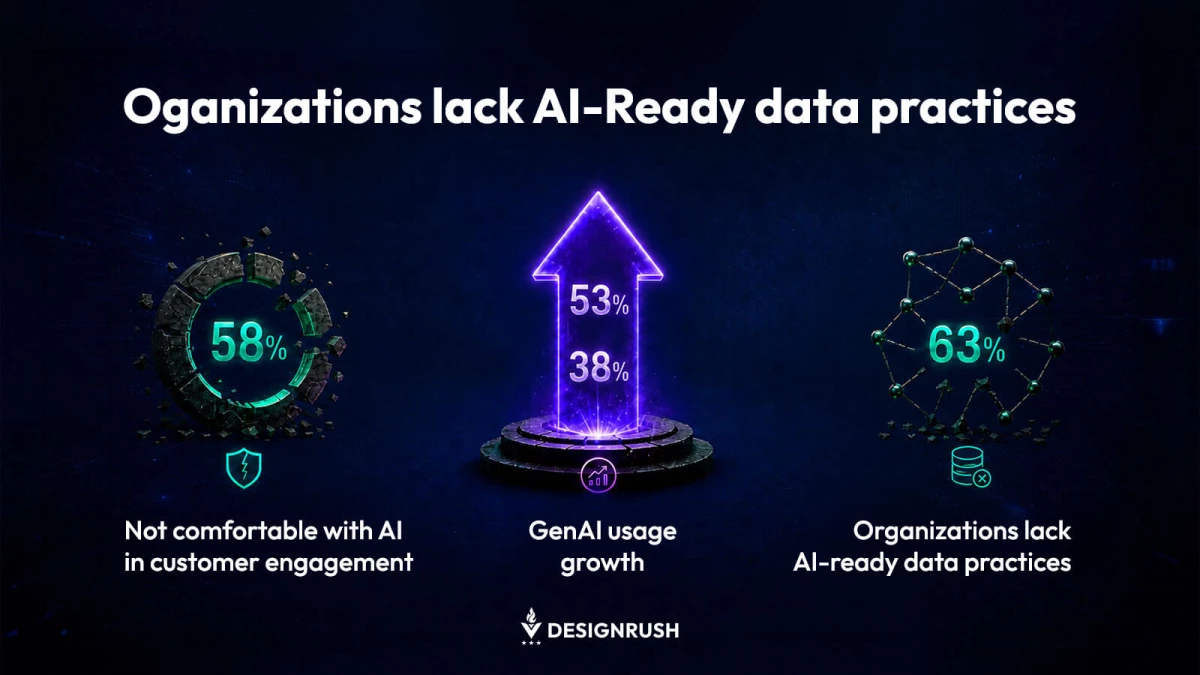
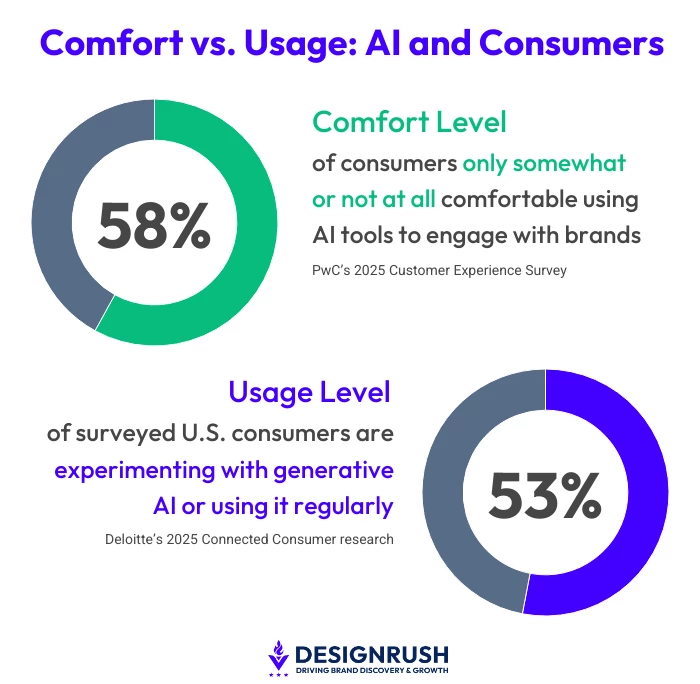
And not all consumers are comfortable with AI-led brand interactions, with 58% of consumers only “somewhat” or “not at all” comfortable using AI tools to engage with brands, according to PwC’s 2025 Customer Experience Survey.
Usage tells a different story.
Fifty-three percent of surveyed U.S. consumers are now either experimenting with generative AI or using it regularly, up from 38% in 2024, according to Deloitte’s 2025 Connected Consumer research.
Marlow-Morgan believes this shows up in how AI systems are designed and presented to customers.
If AI is making recommendations, personalizing experiences, or triggering actions, customers need to understand what's happening and have a way to intervene if needed.
“The best experiences will feel helpful and seamless, not mysterious or confusing,” she says.
But giving customers a way to intervene is only part of the equation. They also want to know how their information is being used.
Only 20% of U.S. consumers say tech companies are very clear about what data they collect, and a further 20% say it is very easy to control that data, according to the same Deloitte report.
Just 27% report high or very high trust in data security. However, nine in 10 consumers say companies should do more to protect data privacy and allow people to view or delete collected data.
Allowing users to view, control, delete, or modify their data is an example of intervention.
If AI recommendations are driven by customer data, users need the ability to change or remove that data to influence future outcomes.
In other words, the levels of trust and control aren’t keeping up with AI adoption.
That lack of clarity and control is tied to how these systems are built in the first place.
“Most organizations don't have an AI problem. They have a systems problem,” Marlow-Morgan says.
That means AI can only deliver accurate recommendations when the content, customer journeys, and underlying data are well organized.
In a project with Texas State Technical College, Isadora Agency helped prepare the digital experience for AI-assisted enrolment by restructuring content, improving audience journeys, and aligning information architecture with an AI-powered assistant connected to the institution's CRM.
The engagement supported improvements including:
- 84% increase in application page traffic
- 30% increase in organic traffic
- 26% increase in total users
What Happens When AI Runs on Broken Customer Data?
That’s where execution exposes the quality of the underlying system.
About 63% of organizations either don’t have or are unsure that they have the right data management practices for AI, Gartner’s 2025 research found.
That’s where execution starts to separate from intent. Some organizations try to layer AI on top of unclear systems; others fix the structure first.
At APS Payroll, Isadora Agency is helping the organization develop an AI visibility strategy focused on how customers discover and evaluate brands through AI-generated answers and search experiences.
The work includes content development, reputation management, social signals, and targeted expertise content designed to help AI systems accurately understand and represent the brand.
Early results show strong performance gains across key engagement and conversion metrics:
- 72% increase in conversion rate across key landing pages
- 50% rise in average session duration
- 35% lift in trust-based conversions among B2B prospects
The same research predicts that 60% of AI projects not supported by AI-ready data will be abandoned throughout 2026.
This means that weak data foundations turn ambitious AI plans into stalled projects and sunk costs.
That’s why connected experiences, where what a customer sees stays consistent across every channel instead of changing from system to system, matter more than another feature drop.
“AI may eventually own much of the journey, but brands still own the relationship. The companies that forget that will optimize themselves into something customers no longer trust.,” Marlow-Morgan says.
And as AI starts to manage more of the customer journey than ever before, leaders should really ask themselves whether it should also control the moments that shape customer trust.