
Human-First Content: Key Findings
- Performance gaps often start with editorial oversight, not keywords or tools. Rock Salt Marketing sees this repeatedly when reviewing client content.
- Human-first content still drives rankings. Clarity, intent, and specificity consistently outperform speed-focused, generic pages.
- Sustainable visibility depends on real user value. Time on page, repeat visits, and conversions signal usefulness and long-term performance.
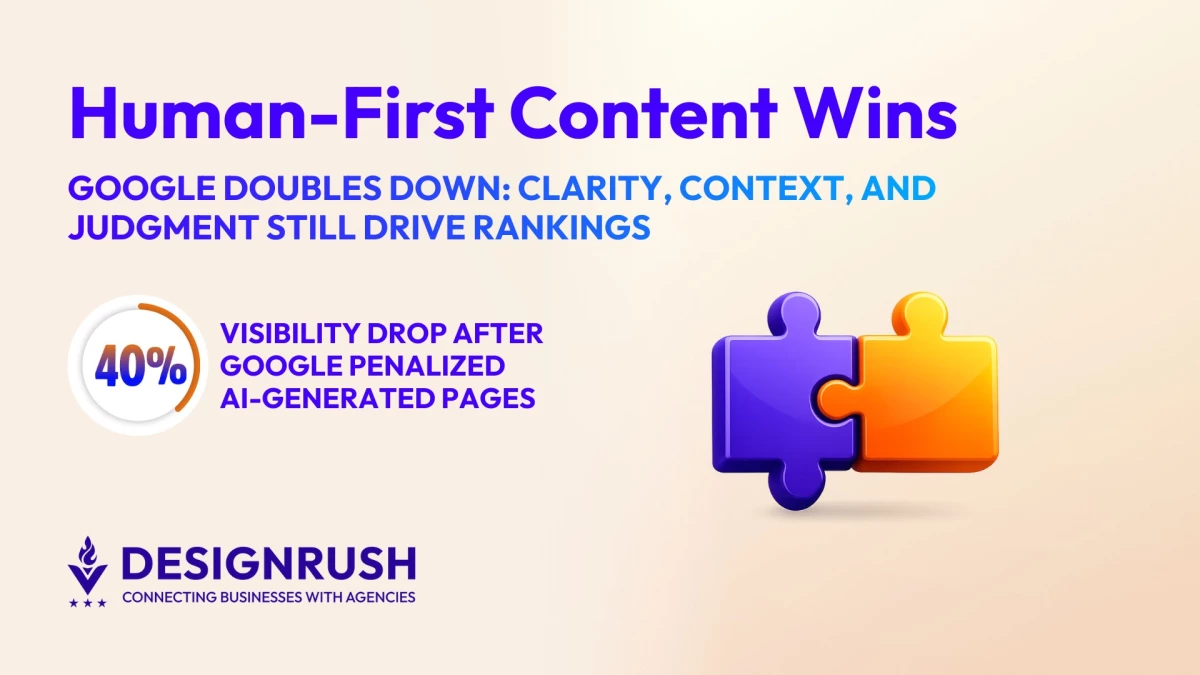
Google recently repeated a point it has been making for years: Its ranking systems reward content created for people, not content built to please search systems.
The timing is what caught attention, as Search Engine Journal reported.
As questions around large-scale, automated content production keep piling up, Google chose to restate its position.
With more brands publishing faster and more often, the company made one thing clear.
How content is produced matters far less than whether it actually helps someone.
That clarification matters because behavior has changed, even if the guidance hasn’t.
Content moves faster now. Pages go live quickly. Updates happen constantly.
In the rush, many teams start chasing the signals they assume machines want, and clarity tends to slip quietly out the door.
“We see this constantly when auditing client content. Pages can be technically sound and still underperform because they never answer the real question behind the search,” said Ridge Anderson, co-founder of Rock Salt Marketing.
“When clarity drops, rankings usually follow.”
Google’s message pushes back on that pattern. Not as a new rule, but as a reminder of what its systems were designed to reward in the first place.
It’s a nudge back toward priorities that many brands have started to overlook.
Editor's Note: This is a sponsored article created in partnership with Rock Salt Marketing.
Why This Matters Right Now
The issue isn’t what Google believes but what marketers are prioritizing.
Large volumes of content now exist that technically answer questions but leave readers unsatisfied.
They look right. They rank briefly. Then they fade. Google has repeatedly said that this outcome is expected.
Content that fails to meet real user needs tends to lose visibility over time, regardless of how efficiently it was produced.
Engagement, relevance, and usefulness still win. They always have. The difference now is that shortcuts are easier to take and easier for Google to recognize.
See Rock Salt Marketing’s breakdown on low-hanging fruit SEO for practical ways to capture high-impact wins without chasing generic content:
Nothing in Google’s message suggests a rejection of modern tools or automation.
The point is simpler than that.
Content still needs judgment. It needs context. It needs a clear understanding of why someone searched in the first place.
Tools can assist with research and structure, but they can’t replace editorial responsibility.
“The strongest results come when tools support the process, but humans own the final call. Editorial judgment is what turns information into something people actually trust,” said Rock Salt Marketing’s Kirk Madsen, Director of Creative Services.
When content goes live without that layer, it tends to sound generic. It covers topics without resolving them.
And over time, rankings reflect that gap.
What Brands Should Do Instead
To turn Google’s guidance into action, here are four key steps brands can take to keep content useful, engaging, and built for real people.
1. Add real editorial oversight
Every piece should be reviewed for clarity, accuracy, and usefulness. Not just for completeness.
Agencies like Rock Salt Marketing often point out that this review step is where most performance gaps start, not at the keyword or tooling level.
2. Focus on intent, not phrasing
Search terms point to problems people are trying to solve.
Content that understands the decision behind the query performs better than content built around wording alone.
3. Use specificity as a differentiator
Examples, experience, and clear points of view matter. Generic explanations are easy to produce and easy to replace.
4. Measure value beyond traffic
Time spent, repeat visits, and conversion behavior show whether content actually helps.
Those signals tend to align with sustainable visibility.
Observations like these come up repeatedly in Rock Salt Marketing’s work with growing brands, especially when speed starts to outrun judgment.
The Cost of Rushing Content
The risk is assuming that speed equals progress.
When production becomes the goal, quality erodes quietly.
Google’s reminder is timely because it reinforces a simple truth: People still decide what is useful, and rankings follow that behavior.
Brands that respect that reality tend to perform well over time.
But brands that chase efficiency without judgment usually learn the lesson later, and at a higher cost.