
For decades, search was a volume game centered around clicks. And the more clicks a brand had, the more chances they had to convert potential customers.
Today, however, AI visibility is quickly becoming a significant factor in business success.
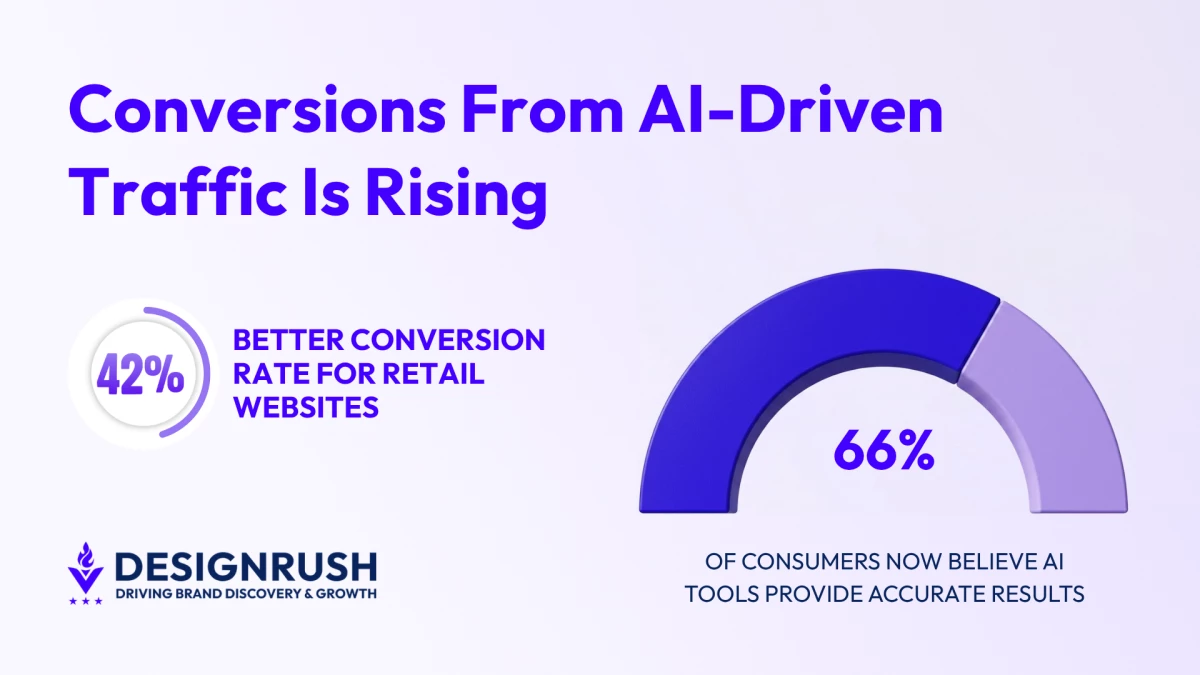
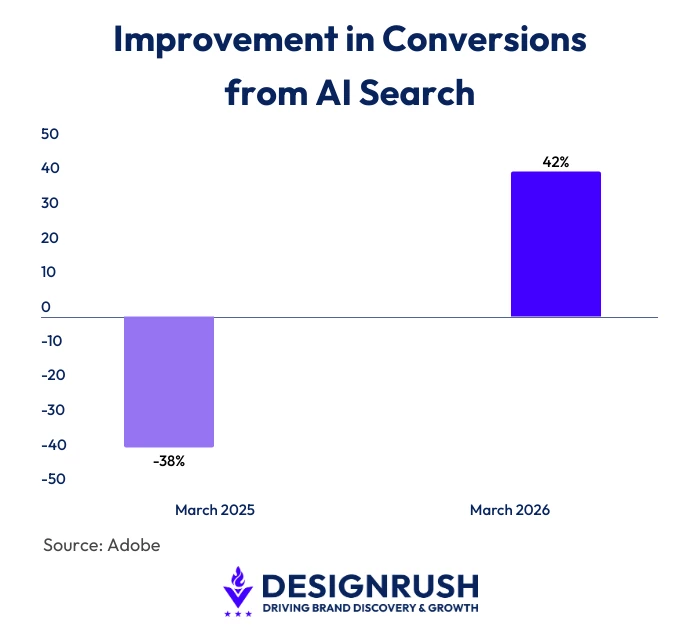
This is one of the biggest takeaways from a recent Adobe report, which found that AI-driven visits to retail sites now convert 42% better than traditional traffic.
The result is eye-catching, especially since AI-driven traffic converted 38% worse than traditional traffic just a year ago.
 This development matters because it was widely accepted that if an AI engine doesn't cite your business, you don’t exist in the user's decision-making process.
Now, experts can point to tangible proof of how AI search and AI visibility impact conversions and bottom lines.
“What makes this shift important is that AI traffic behaves differently from traditional search traffic,” said Gavan Thorpe, CEO at Boostability, a respected AI-powered SEO agency.
“Users arriving from AI platforms have often already compared options, narrowed their choices, and established baseline trust before they ever reach a website."
"That compresses the decision-making journey significantly.”
Trust in AI is Growing
But what exactly caused such a significant turnaround for AI search?
It turns out that trust in AI is also on the rise.
According to the same Adobe report, 66% of consumers believe AI tools provide accurate results, revealing a newfound confidence in the accuracy of AI results and product recommendations.
This isn’t a coincidence. AI models have been trained to produce high-quality results by following three investigative processes:
1. LLM Cross-Referencing: The Fact Check
AI systems compare a brand’s claims against what the wider web says about them. This includes:
- Website copy
- Third-party mentions
- Industry directories
- Reviews
- Social profiles
- Media coverage
Of course, simply having these isn’t enough. To successfully benefit from all these online mentions, brands need to ensure the information from all these sources is consistent.
Thorpe and his team at Boostability refer to this as “Narrative Symmetry,” where messaging, positioning, and operational details align across digital touchpoints.
When information conflicts after these checks, AI systems interpret the inconsistency as uncertainty.
And when that happens, the system hesitates to surface the brand.
2. Sentiment Synthesis: The Vibe Check
Aside from consistency, AI systems also evaluate contextual reputation.
That means they analyze a wide range of verification signals from the brand, including review sentiment, industry authority mentions, community discussion, and the like.
The stronger and more discoverable those signals are, the easier it becomes for AI systems to trust the brand without hesitation.
For example, a business with hundreds of reviews but weak credibility signals elsewhere may still struggle to earn inclusion.
Meanwhile, a company with fewer reviews but stronger authority markers, clearer positioning, and consistent third-party validation can appear more trustworthy to AI systems.
3. Real-Time Validation: The Friction Check
In many ways, AI search now behaves less like a search engine and more like a recommendation engine performing due diligence in real-time.
In most cases, this means checking:
- Inventory availability
- Pricing consistency
- Shipping and return policies
- Business information accuracy
- Product availability across channels
This is why Boostability prioritizes "Agentic-Ready Infrastructure" when helping clients optimize for AI search, providing the high-density structured data to validate business claims.
“Brands with structured data, schema markup, machine-readable product information, and accessible APIs make validation easier for AI systems,” said Thorpe.
“Businesses operating with fragmented data, broken schemas, or inconsistent listings create friction that machines often avoid.”
How to Pass The Checks
Ultimately, the goal for brands now is to ensure they pass the three checks and get themselves included in the list that AI presents to users.
This is why Boostability created its Be Found Framework (BFF), which combines traditional SEO with:
- Answer Engine Optimization: Crafting the factual "nuggets" AI needs to qualify a brand as the primary answer.
- Generative Engine Optimization: Managing a brand’s citation footprint across major LLMs (ChatGPT, Claude, Gemini) to stay citable.
- AI Optimization: Prepping technical infrastructure so AI agents can understand your offers and services instantly.
- Search Experience Optimization: Turning AI mentions into measurable engagement by satisfying user intent the moment they transition from an AI answer to a brand's site.
This offers brands a single framework for visibility, trust, and measurable growth.
When it comes to earning inclusion in the answers AI provides users, the framework identifies three key phases that brands should focus on.
| Phase | Critical Requirement | The Recommended Approach |
| 1. Technical Integrity | Sub-500ms machine indexing. | Server-Side Rendering (SSR) to eliminate the "Execution Gap" where bots skip heavy JavaScript. |
| 2. Knowledge & Intent | Scannable, modular data. | Answer Blocks: 40–60 word declarative content units designed specifically for AI extraction and synthesis. |
| 3. Verification Loop | Distributed authority. | Digital Provenance: Aligning your "Entity Fingerprint" across the web so AI doesn't flag you as a "Hallucination Risk." |
Phase 1: Technical Integrity
Important content is hidden behind heavy JavaScript, slow-loading elements, or inaccessible structures, AI systems may never process it correctly.
That is why many visually polished websites still struggle with AI visibility.
Boostability recommends prioritizing Server-Side Rendering (SSR) because it delivers readable content immediately during the first page load, improving indexing and citation likelihood.
The difference is simple:
- JavaScript-heavy websites can hide important content from AI crawlers, making pages harder to index and cite.
- SSR-optimized websites load readable content immediately, making them easier for AI systems to process, increasing the potential for citation.
Phase 2: Knowledge and Intent
AI systems break content into semantic chunks and evaluate whether those chunks answer a query clearly and efficiently.
This makes scannable, modular data critical to success.
Boostability recommends using Answer Blocks, which are short 40 to 60-word declarative content units specifically structured for AI extraction.
To do this, make sure content is written to be:
- Direct
- Fact-rich
- Front-loaded with value
- Easy to synthesize
Phase 3: Verification Loop
Both AI systems and humans need signals that tell them that the information they’re looking at can be trusted.
One of the best ways to showcase a brand is trustworthy is through “Digital Provenance,” a digital fingerprint or a “birth certificate” of everything you put online.
To boost Digital Provenance, brands must keep a consistent “Entity Fingerprint” across directories, social profiles, reviews, and owned channels. As such, brands should regularly audit:
- NAP information
- Business descriptions
- Review activity
- Social and directory consistency
Compete for Inclusion, Not Just Rankings
SEO may have been the best way to be found online a few decades ago, but today, doing just SEO won’t be enough.
Instead, brands will need to lean on a combination of SEO and AI-focused optimization.
Because as AI search continues to become commonplace, the most important ranking will be whether you make it on an AI model’s trusted sources list.