
Google AI Mode Search Impact: Key Findings
- AI Mode replaces traditional results with synthesized answers, meaning brands must now optimize for machine-readable clarity to secure visibility before a user ever clicks.
- User behavior in AI Mode is 2-3 times longer than classic search, showing that brands must shift from transactional SEO to content that supports deeper, conversational exploration.
- Only 13.7% of AI answers cite source URLs, underscoring the need for structured, authoritative content that earns inclusion in Google’s selective AI-generated summaries.
In late 2025, Google introduced a change that is already reshaping how brands are discovered online.
The rollout of Google’s new AI Mode, powered by its Gemini 3 model, means that search results are no longer just a gateway to websites but a destination in themselves.
Here, users are provided with answers, context, and guidance directly within Google’s interface.
Gemini 3 Flash is starting to roll out as the default model for AI Mode in Search globally.
— Google (@Google) December 17, 2025
AI Mode can now tackle your most complicated questions with greater precision — without compromising speed. ⚡
With this upgrade, AI Mode becomes an all-around more powerful tool, better… pic.twitter.com/u1MsVUI6cb
Editor's Note: This is a sponsored article created in partnership with Customer Paradigm.
Google’s move is already stirring real concern among UX and eCommerce agencies, such as Customer Paradigm, a Colorado-based firm focused on digital strategy and conversion.
To stay visible in Google’s AI-powered search, brands need content that answers real questions, avoids jargon, and signals expertise in a way machines can confidently surface and summarize, explains Jeff Finkelstein, founder of Customer Paradigm.
“Most sites were built to convince humans,” Finkelstein says.
“But now, you also have to convince an AI that your page is the best answer, and that requires a completely different approach to structure, language, and trust signals.”
Apart from altering the long-established patterns of user search behaviors, it has marked a pivotal moment for businesses that rely on organic visibility.
For businesses to show up in modern search engines, attention is no longer just earned. It is filtered and framed by AI long before a website is even visited.
What AI Mode Means for Brand Visibility and Strategy
While search has been evolving for years, the advent of AI Mode marks a more decisive shift in how information is presented.
Instead of acting solely as a platform to direct users, Google now interprets queries and delivers synthesized responses directly on the results page.
Selectively chosen source links support these responses and provide users with context and answers before they engage with any individual website.
This shift is already happening at scale, with insights from Search Engine Journal suggesting that Google AI Mode sees an estimated 75 million active users every day.
According to Finkelstein, websites are still referenced, but now more often as supporting sources rather than primary destinations.
“For brands, this changes the role that their content plays in the user journey and impacts the discoverability of their website,” he says.
This clip previews how Google presents AI summaries in real time, offering a glimpse at how users now receive answers before visiting a website:
Traditional Visibility Signals Are No Longer Enough
Google has long cemented its place as the crown jewel of search engines.
So much so that according to Exploding Topics, as many as 16.4 billion searches occur on Google every day, which translates into the processing of 189,815 searches every second.
Historically, the outcomes of these searches were ranked according to strong rankings, compelling headlines, and optimized metadata.
Discoverability and visibility now depend on whether content can be clearly interpreted, summarized, and trusted by machine systems, before users ever reach the page.
User behavior reinforces this change, with AI Mode queries taking two to three times longer than traditional searches.
This indicates that users are engaging in conversational exploration rather than quick, transactional lookups.
This shift has created a new challenge where a brand’s first impression may now be an AI-generated interpretation of its content and not the site itself.
If that interpretation lacks clarity, authority, or relevance, the opportunity to engage the user may be lost before the visit even begins.
Want to know exactly how AI summaries are replacing traditional search rankings?
This DesignRush Podcast episode breaks it down and explains what it means for brand visibility:
AI Mode User Behavior at Scale
Studies by Search Engine Land shed light on how people interact with AI Mode’s search results.
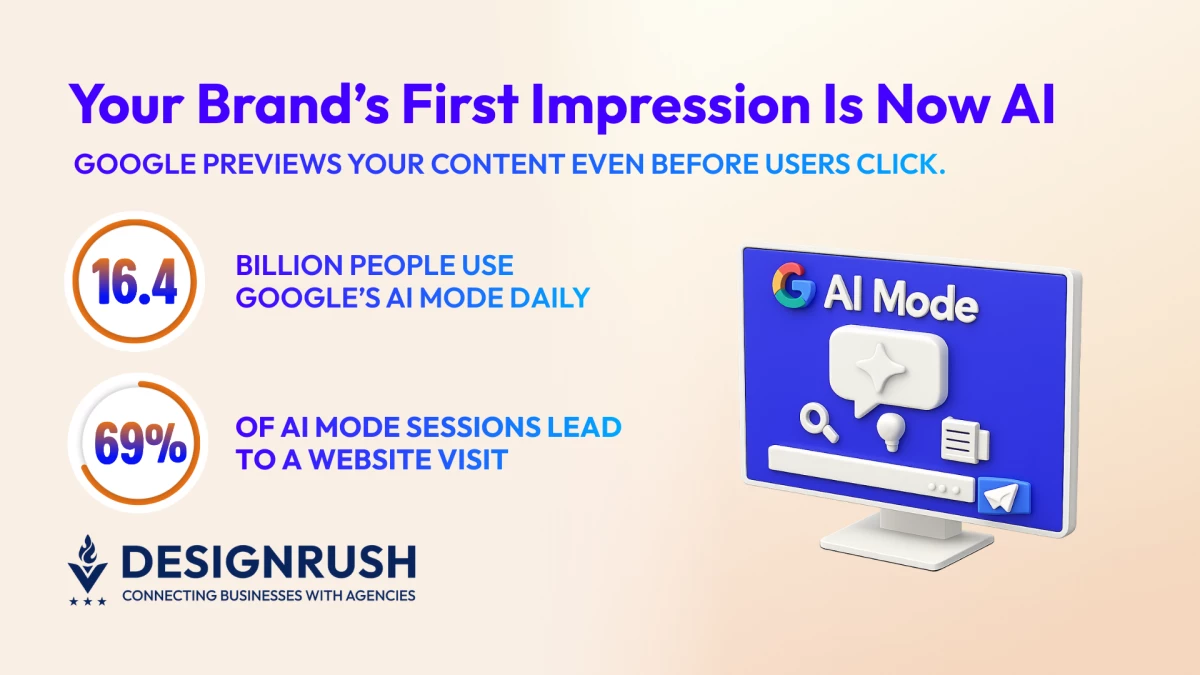
- 69% of AI Mode sessions resulted in users visiting a website, underscoring that the majority of searches still end in a click.
- 27% of users made a decision based on the AI summary, indicating that people still want additional information beyond what AI provides.
- 89% clicked on more than one business, highlighting that users compare options instead of settling on a single recommendation.
- 84% scrolled to see additional options, evidencing that users seek more context beyond the first screen of suggested results.
- 74% read reviews before clicking, suggesting that reviews hold greater influence than images.
These insights prove that AI Mode has shaped how people explore and decide.
Apart from a means to garner visibility, trust, and engagement, the stats reinforce the importance of brands being positioned within the consideration set, and not just ranked first.
For a deeper look at how Google’s AI determines what gets surfaced, this video breaks down the mechanics behind recommendations, brand associations, and the new rules of visibility:
How Brands Should Adapt
Adapting to AI-driven discovery requires a broader mindset than traditional SEO updates.
“Rather than optimizing solely for rankings, brands must now optimize for machine comprehension and human context simultaneously,” Finkelstein says.
“This means that brands must ensure that content is not only discoverable, but also easily distilled into accurate, meaningful summaries.”
This becomes especially important when considering how AI selects sources.
AI Mode and AI Overviews reach semantically similar conclusions in 86% of cases, but cite the same URL just 13.7% of the time, according to Ahrefs data reported by Search Engine Journal.
As such, Finkelstein highlights three priority areas brands should address to meet this shift:
1. Structure Content for Interpretability
AI systems favor content that is logically organized and clearly scoped.
To this end, pages with defined headings, concise explanations, and purpose-driven sections are easier for AI to parse and represent accurately.
This does not mean simplifying messaging, but rather removing ambiguity.
Clear intent signals help ensure that when AI summarizes a page, it reflects the brand’s message rather than a diluted or incomplete version of it.
2. Align UX With AI-First Discovery
User experience now begins earlier than the site visit itself.
Brands should think about how their content holds up when it's pulled out of context.
Finkelstein recommends focusing less on polish and more on structure, with clear sections, consistent tone, and signals that build trust.
Content that feels useful and credible is more likely to be picked up by AI and shown to users.
3. Reframe Content Strategy for the New Funnel
AI Mode compresses the top of the funnel, meaning that users may move from awareness to decision faster or never reach the site at all.
As a result, content must work harder earlier in the journey.
This is particularly critical for eCommerce and service-based brands, where category pages, product explanations, and educational content often influence purchase decisions long before conversion.
Ensuring these assets communicate value clearly, even when viewed indirectly, is becoming essential.
For a deeper look at how AI-powered search is reshaping visibility and brand recognition, this breakdown offers real examples and data-backed tactics that go beyond traditional SEO:
From Rankings to Representation
This shift does not eliminate the value of SEO fundamentals but instead adds a new layer.
“Brands must now balance traditional optimization with strategies designed for AI-mediated visibility,” Finkelstein says.
“Organizations that treat AI Mode as an extension of UX, rather than a replacement for SEO, will be better positioned to maintain relevance as search continues to evolve.”
Google isn’t the only one redefining visibility.
Across industries, discovery is shifting toward how platforms surface content rather than where it’s published.
The Oscars’ upcoming move from network TV to YouTube highlights how visibility now depends on discoverability within the platform, rather than on legacy placement:

In short, being present is no longer enough. Brands need to be positioned to surface.
“If your content can’t be understood or trusted by the system, it won’t get shown, no matter how strong your brand is,” Finkelstein says.
What This Means for the Future of Search
As Google’s AI capabilities expand, discovery is becoming less about navigation and more about interpretation.
“For brands, the implication is clear: visibility now depends not only on being found, but on being accurately represented.
“Those that adapt their content, structure, and experience accordingly will remain visible, even as the definition of visibility continues to change,” Finkelstein says.
Wondering how to rank in Google's AI-powered search?
Take a look at our list of the Top SEO Agencies of 2026.