
Google Business Profile AI Review Responses: Key Findings
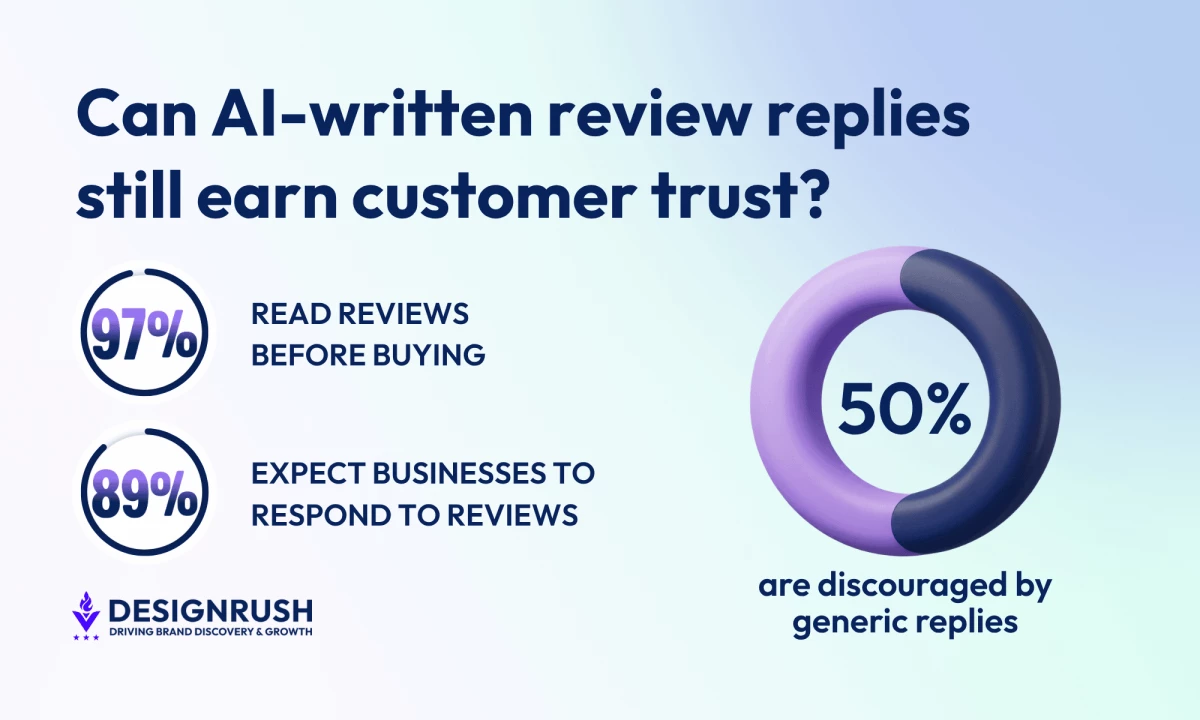
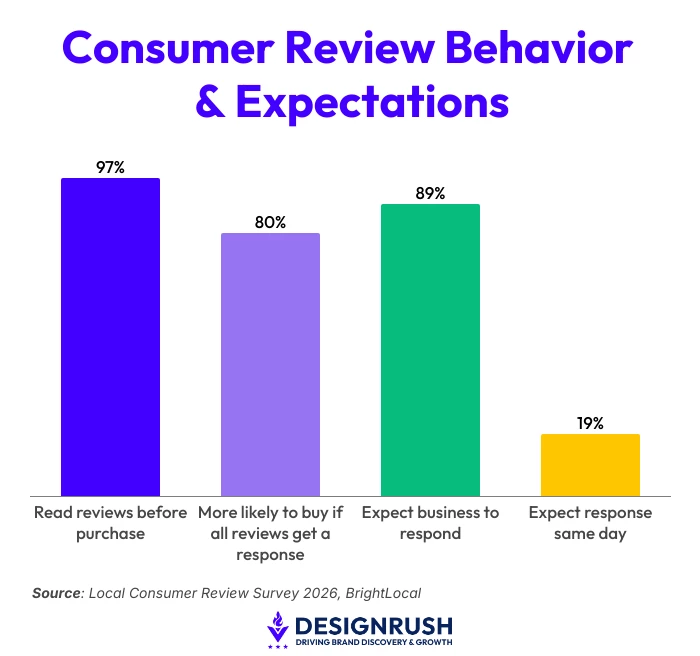
- 97% of consumers read reviews before buying, making Google’s move to AI-generated review responses in Business Profiles a key trust point.
- 80% of consumers favor businesses that respond to reviews, but nearly half are discouraged by generic replies, putting pressure on AI replies to feel authentic.
- Companies that scale AI successfully are twice as likely to trust outputs, but only when paired with governance and human oversight.
About 97% of consumers still read reviews before they buy, according to the latest data by BrightLocal.
This reliance on online reviews is the reason why Google is testing AI-generated review responses in Google Business Profile, as reported by Search Engine Land.
Google’s test allows businesses to generate replies to customer reviews and then edit them before posting.
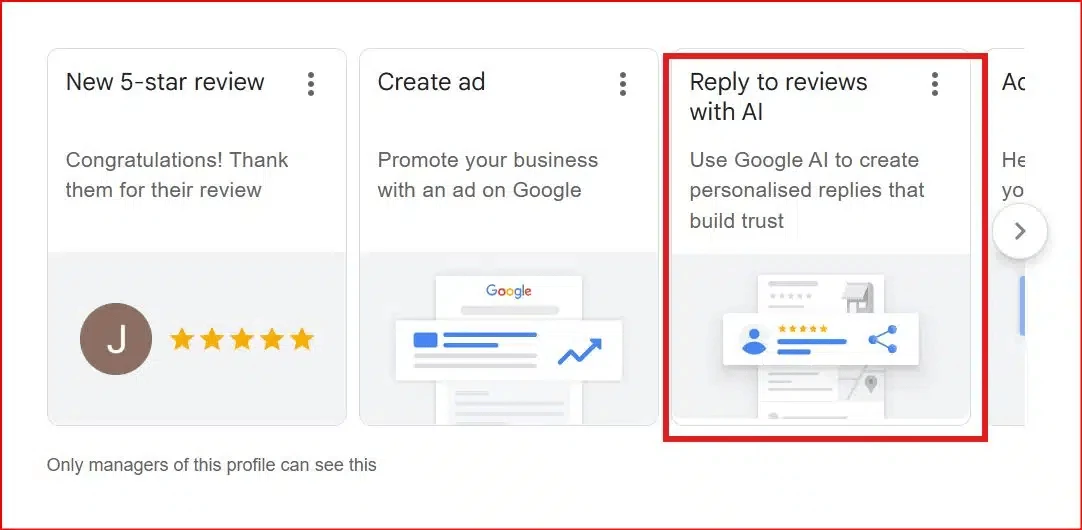
This is great since it gives businesses a faster way to reply.
But it also raises one important question.
How much automation can customers tolerate before it reads like an automated exchange dressed up as care?
As it turns out, not much.
According to BrightLocal’s data, 80% of consumers are more likely to use a business that responds to all of its reviews. But half are discouraged by templated or generic responses.
And that’s the tension that’s quietly building underneath this whole rollout.
Customers want speed, but they don’t want it to sound like it was written by a committee of exhausted robots dressed up in suits.
Ridge Anderson, co-founder of Rock Salt Marketing, is speaking from inside the work itself.
Rock Salt Marketing is a Tennessee- and Utah-based digital marketing agency focused on SEO, paid media, and SEO-friendly web design.
Anderson’s view comes from daily contact with the local search and reputation issues businesses face.
He doesn’t foresee a big difference in people’s trust in review responses, considering that the public has already been skeptical of reviews and their responses for a while.
But there’s a caveat.
“However, as time goes on, review responses will lose some of their impact because readers will assume they don't represent the sentiments of a fellow human,” Anderson said.
Why Local Trust Gets Harder To Buy
The response to a review sits in public view, which makes it part customer service, part sales asset, and part reputation signal.
About 89% of consumers expect a business to respond to reviews, and 19% expect that reply to be made the very same day, BrightLocal reported.
So, the pressure to respond quickly is real, and the temptation to automate the whole thing is increasing.
The catch is that fast replies only help when they feel grounded in the business behind them.
Anderson is blunt about the risk if brands lean too hard on automation.
“Any efficiency gained by using AI to respond to reviews will be negated by the fact that potential customers no longer give the reviews any weight,” he explained.
“Like any creative endeavor, AI has little business being a part of it.”
That sounds harsh, but the point is that if the reply sounds hollow, trust between business and consumer can be weakened.
And Anderson’s warning lines up with wider consumer sentiment.
Most (82%) generative AI users are concerned that the technology could be misused, up from 74% in 2024, according to Deloitte.
The report also found that 70% worry about data privacy and security in digital services.
Forrester then took that anxiety a step further, predicting that one-third of brands will erode customer trust in 2026 by rolling out generative AI self-service too early.
In other words, the problem isn’t whether AI can write a response. It’s whether customers believe the response still belongs to a real business with real judgment behind it.
For local search, the stakes are twice as awkward.
Anderson is on board with most local SEOs that consider review signals one of the most important ranking factors for GBPs.
Despite review responses being an indirect ranking signal, he believes that genuine review responses build trust with potential and repeat customers.
“And those individuals' engagement becomes a direct factor in ranking. Review responses do, however, have a direct impact on conversion rate, and it can go both ways,” he said.
PwC’s 2026 AI Performance Study adds a useful operational lens here.
It found that 74% of AI’s economic gains are captured by just 20% of companies.
The stronger performers are twice as likely to trust AI outputs, with Responsible AI frameworks 1.7 times more common, and cross-functional AI governance boards 1.5 times more common.
It’s a tidy little reminder that the companies getting value from AI aren’t the ones handing the whole job over to it.
It’s the companies setting rules for where the technology can help and where a human still decides what gets said.
What Brands and Agencies Should Do Next
AI deployed responsibly in customer interactions can increase customer satisfaction by between 15% and 20%, revenue by 5% to 8%, and reduce cost-to-serve by up to 30%, McKinsey found.
So the ideal is to use AI only where it helps, then stop short of letting it scrub out the business voice.
And that’s exactly where Anderson lands, too.
“Don't get me wrong; using AI to support creative endeavors can be done without diminishing creativity wholesale,” he said.
“Nevertheless, a human still has to guide the output, and the result should still reflect your true thoughts and feelings; it might just not include as many grammatical errors.”
That’s the line brands should hold onto.
AI can help draft, organize, and speed up responses, but it shouldn’t become the final author of how the business speaks to customers.
Anderson’s final point is the most useful one for teams trying to scale without turning every reply into a copy-paste job:
“Avoid submitting AI review responses without adjusting them to ensure they truly reflect your ideas.
“Make every response unique and tailored to the feedback you're responding to. In other words, say what you would have said pre-AI, just a little more efficiently.”
Build rules for praise, complaints, and sensitive reviews; don’t let the tool flatten the nuance out of the reply.
Handled well, responses are faster without reading like they were generated in bulk, which matters because customers pick up on canned language quickly.
Human oversight isn’t the slow part here.
It’s the part that prevents the whole thing from looking fake.