
Optimizing for AI Referral Traffic: Key Findings
- AI referrals account for just 1.08% of traffic today, yet they are growing about 1% month over month and quietly building a long-term advantage for early adopters.
- Brands that show up early in AI answers become recurring citations as models retrain, turning early visibility into a compounding moat.
- Waiting for AI search to mature is risky because the models will already be shaped by competitors who optimized first.
Many brands are still testing the waters of AI search.
But as the channel’s acceleration signals build, treating it as optional won’t be sustainable for long.
There’s been a lot of talk about how AI referral traffic figures haven’t been very encouraging.
A recent study by Conductor showed that AI referral traffic only accounts for 1.08% of all website traffic across 10 key industries:
Yes, it is a tiny number, but the trendline tells a different story.
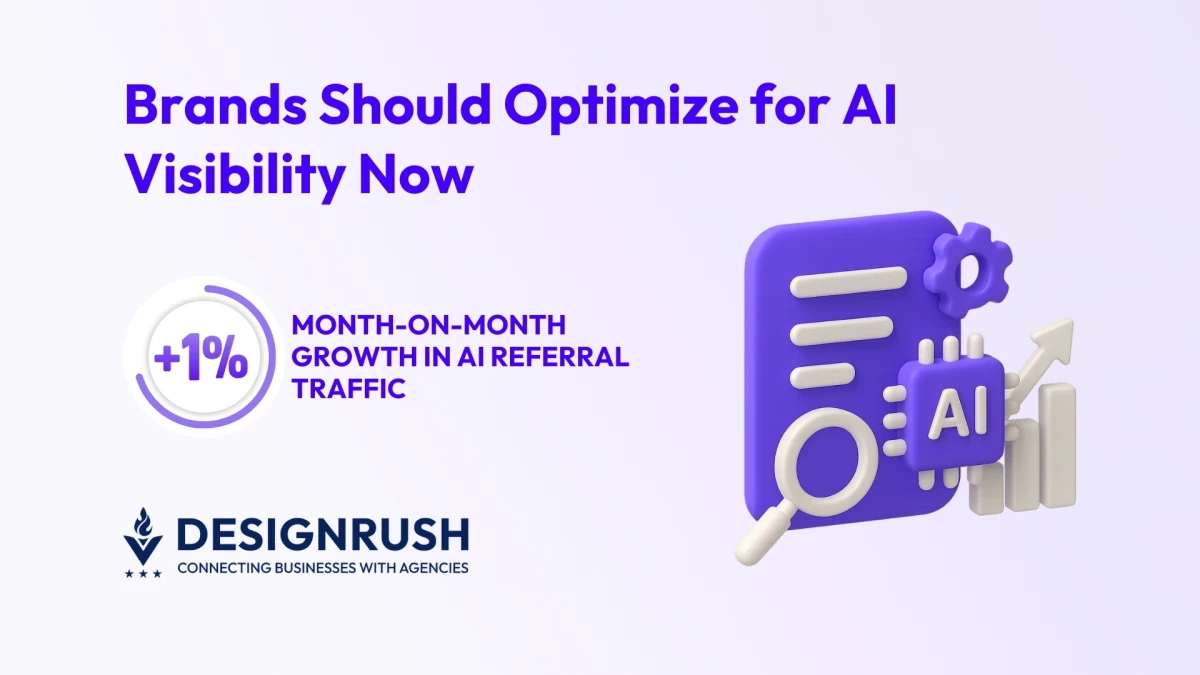
The same Conductor study showed that AI referrals are growing about 1% month-over-month on average.
Clearly, growth is coming. And the good news is, brands still have time to formulate more thoughtful and cohesive AEO and GEO strategies.
However, digital agencies like Customer Paradigm warn brands that they don’t have the luxury of waiting for AI search to mature or stabilize before making a move.
“The biggest mistake brands can make is thinking one percent doesn’t matter,” says Jeff Finkelstein, Founder of Customer Paradigm.
Early adopters will train the models, earn the citations, and become the default recommendations as AI traffic scales.”
“By the time the channel becomes ‘meaningful,’ the winners will already be locked in.”
Why Early AI Visibility Matters
AI referrals influence purchasing and informational journeys differently from traditional search.
Instead of offering a list of links, AI search engines synthesize information, choose sources, and present a conclusion.
And this is why AI visibility matters.
Since AI shapes decisions far earlier in the funnel than search engines ever have, many users form their preferences in the narrative the assistant provides.
This means the brand chosen by the model often becomes the brand chosen by the consumer.
There is also a quiet compounding effect, since early citations carry forward as models are retrained, creating a feedback loop.
If a brand becomes a reliable reference point early on, the model tends to keep returning to it, not unlike how home cooks have a favorite pan they use over and over again.
“In the early stages of AI search, the brands that show up consistently become the default answers users grow accustomed to,” said Finkelstein.
“That familiarity becomes a competitive moat over time. Waiting even a year to optimize can mean fighting uphill against models that have already memorized your competitors.”
Optimize for AI Referral Growth
Clearly, brands must optimize for AI search engines now. That’s non-negotiable.
What exactly should brands do to accomplish this?
Fortunately, optimizing a brand for AI discoverability doesn’t require rebuilding entire content systems or the like.
In fact, many SEO strategies work in tandem with GEO, albeit with a few tweaks here and there to ensure that all information can be parsed by machines without hesitation.
That said, Customer Paradigm recommends taking the following steps:
1. Strengthen Structured Data and Schema
AI models lean heavily on organized data.
Brands should use precise schema and complete metadata so product and service information appears reliable in automated summaries.
The clearer the structure, the higher the likelihood of being cited.
2. Write for Natural, Conversational Queries
AI Mode and similar tools interpret questions phrased informally.
Content written in approachable, human language performs better because it mirrors actual user phrasing.
Long-form explanations and crisp definitions help AI understand context instead of guessing at meaning.
3. Build Strong Trust Signals
Verification matters.
Why?
Reviews that come from real customers, transparent sourcing, and consistent brand identity across channels all help AI separate stable sources from questionable ones.
When credibility is easy to read, recommendations follow.
4. Answer Questions Holistically
AI looks for responses that help users reach satisfaction quickly.
Pages that address related concerns, provide context, and synthesize multiple angles have a higher chance of being selected as authoritative material.
Depth wins more often than density.
5. Monitor How AI Systems Interpret Your Brand
AI search isn’t static.
It rewrites its own understanding of your brand each time it re-trains, and those interpretations can drift if left unattended.
Brands should invest in AI visibility tools that track how often they’re cited, how their content is summarized, and where they appear.
Position Your Brand for What Comes Next
AI referrals are small today, but they are growing fast enough to signal a meaningful shift in how people discover information.
That’s why even if things are still volatile and everyone’s in the middle of figuring out what works and what doesn’t, brands that optimize early stand to gain a lasting advantage.
Because in the world of tech trends, today’s one percent has a habit of becoming tomorrow’s entire playbook.