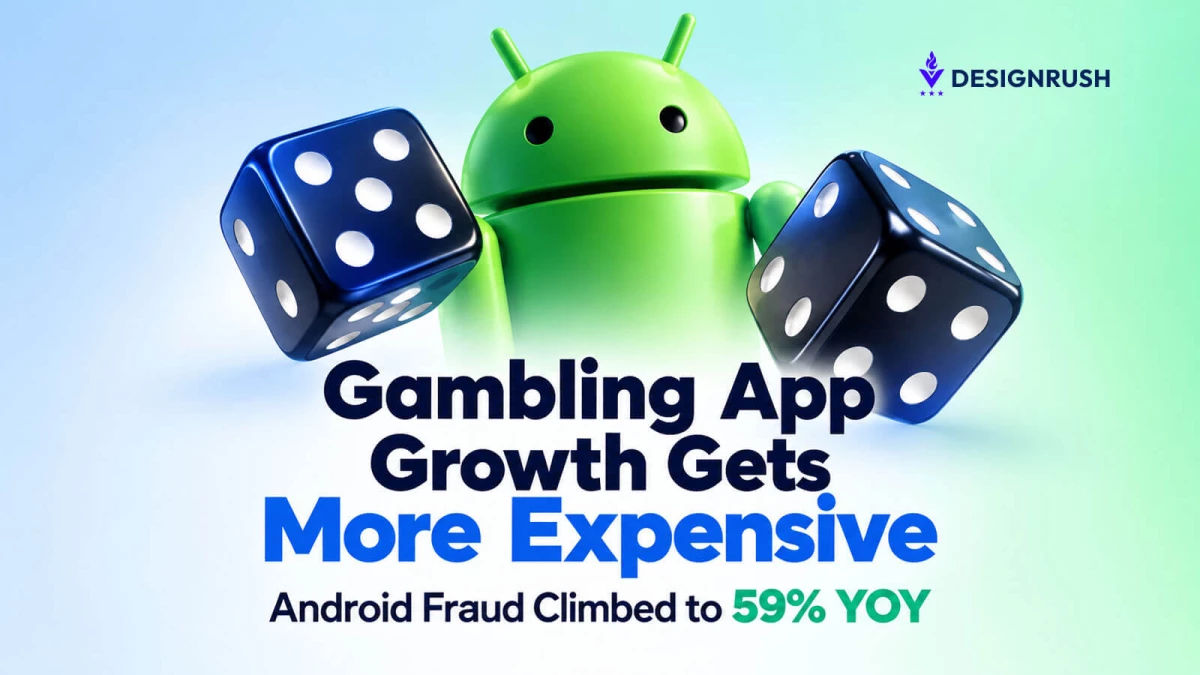

Android fraud in gambling climbed from 49% to 59% year-over-year, according to AppsFlyer’s 2026 State of Fraud for Marketers report.
The rate reached 64% in the fourth quarter of 2025, when Real Users Lift hit 175%.
So advertisers were paying for nearly two fraudulent users for every real one they acquired.
Android gambling fraud moved in the opposite direction from several other app categories, where rates remained flat or declined.
Finance on Android, for example, showed no improvement across five consecutive quarters, while iOS fraud fell 33% year-over-year.
AppsFlyer’s analysis covers 106.4 billion installs across 246,000 apps.
Gambling marketers are also putting more money into acquisition.
Casino and gambling user-acquisition spend jumped 127% year over year in 2025, according to AppsFlyer.
And when more money enters a category already carrying heavy fraud exposure, bad traffic becomes a much more expensive nuisance.
ROCKAPP, which works with gambling and fintech clients on mobile user acquisition, says the concentration fits what it sees in the market, although direct campaign management gives its teams more control over where traffic comes from.
“The result itself is not particularly surprising to us. iGaming and fintech tend to work with a large number of traffic partners, and the more complex the acquisition mix becomes, the harder it can be for a product team to maintain a clear view of traffic quality across every source,” says Richard Schmidt, Head of Sales at ROCKAPP.
Why Is Android Fraud Rising So Sharply in Gambling?
That lack of visibility can become especially costly when performance is judged heavily on early acquisition metrics.
A cheap install can look productive for a few days, while the signals that expose poor traffic quality sit further down the funnel.
ROCKAPP takes a more controlled approach before campaigns go live.
Schmidt says source selection is among the first controls the agency puts in place, with traffic sources reviewed alongside the product and its existing acquisition setup.
“If the current traffic mix already shows serious quality issues, that needs to be addressed before additional paid acquisition is added."
The agency also audits existing campaigns when product teams need help identifying sources or traffic segments that may be contributing to suspicious activity.
That pre-launch work carries more weight when historical data has already been polluted. Fraud can affect far more than the install report.
It can seep into the data used to judge future media buying, which gives automated systems and internal benchmarks a distorted picture of what good performance looks like.
“If fraudulent traffic is already mixed into the product’s historical data, optimization systems and performance benchmarks can start learning from the wrong signals,” Schmidt says.
That creates a nasty feedback loop where questionable traffic affects the data, the data influences buying decisions, and those decisions can send more money back into the same sources.
How Can Marketers Tell Real Growth From Fraud?
An agency can see campaign metrics and the events passed through the attribution setup.
The product team can see what users do after installation and whether those actions have any economic value.
“There is a limit to what an agency can determine independently because the clearest answer often sits inside the product data,” Schmidt says.
“Media data can highlight an unusual pattern, but the product team is often in the best position to determine whether those installs are turning into real users and meaningful actions further down the funnel.”
Joint scrutiny matters in gambling too, where paid acquisition makes the attribution dashboard only part of the picture.
Casino apps generated 64% of their in-app purchase revenue from paid installs in North America and Europe, according to AppsFlyer’s 2026 State of App Monetization report.
Paid acquisition, therefore, sits close to the revenue engine itself. Weak traffic can distort far more than an install count.
Programmatic buying brings another warning sign.
In Q1 2026, 54% of programmatic spend reached qualified impressions among higher-performing advertisers, compared to 32.1% among lower-performing advertisers, according to the Association of National Advertisers.
The ANA defines qualified impressions as fraud-free, measurable, viewable, and free of made-for-advertising inventory.
ROCKAPP watches several campaign signals together when checking for problems, including drops in IPM, weaker conversion, falling volume, and sudden increases in acquisition cost.
“When something changes unexpectedly, we compare the affected source with other traffic sources and also look at the organic traffic available in the data for unusual spikes or behavior,” Schmidt says.
For gambling marketers, traffic quality becomes clearer further down the funnel, where user activity shows which installs have real value.
An install alone says little about the quality of a gambling campaign.
Marketers need to look at what those users do after installation, and which sources continue to produce genuine activity.