
AI-Driven Website Engagement: Key Findings
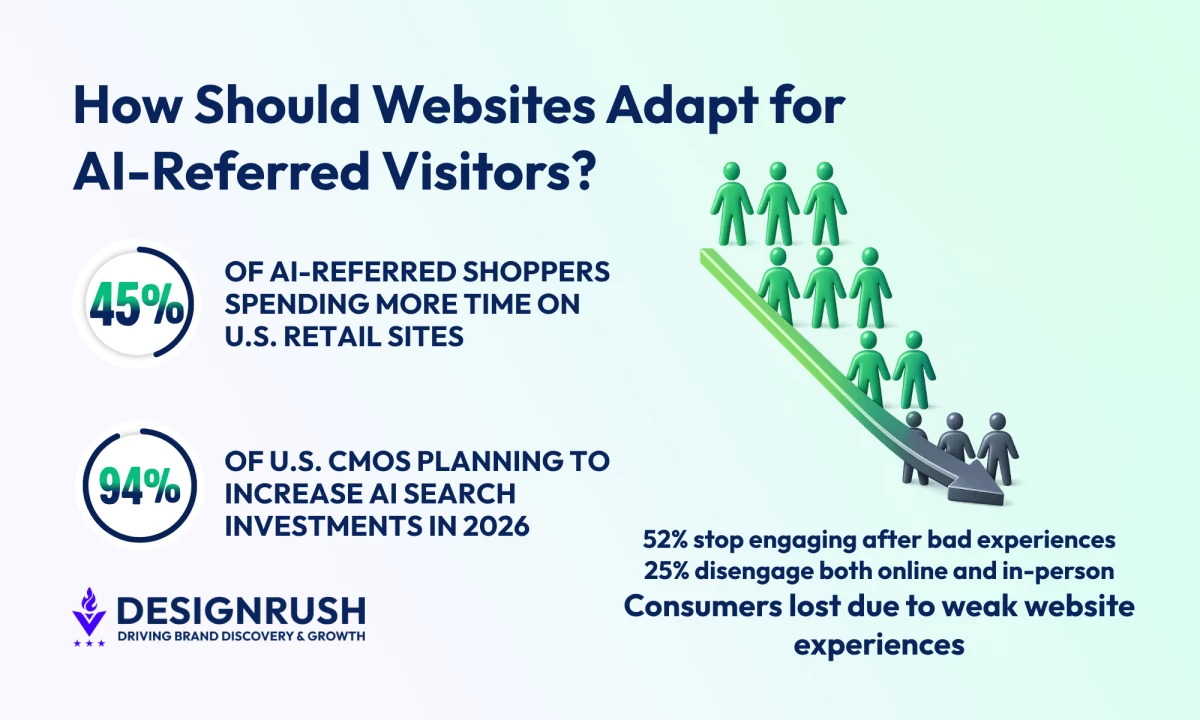
- Shoppers referred by AI spend 45% more time on U.S. retail sites, showing how AI-driven website engagement keeps visitors exploring longer.
- Simple, clear copy, strong visuals, and visible reviews help AI-driven website engagement guide shoppers to make confident choices.
- With 94% of U.S. CMOs increasing AI search efforts, keeping content fresh and highlighting expertise ensures AI-driven website engagement stays effective.
Shoppers arriving at U.S. retail sites through generative AI assistants spend more time exploring.
Adobe Digital Insights reports that these visitors linger 45% longer, view more pages, and leave less often than other visitors.
Fewer people may arrive from traditional search, but those who do are more engaged and deliberate in how they navigate the site.
Ridge Anderson, co-founder of top-tier digital marketing agency Rock Salt Marketing, said websites now have two jobs.
While Google aims to keep users inside its ecosystem, AI chatbots still gather information from brand sites.
“Your website is one of the best ways you can craft the narrative that LLMs regurgitate to searchers,” he said.
“Further, we've known for a while now that AI searchers are narrowing their lists of potential products or services using AI, but then are visiting the websites of each brand on their shortlist via Google.”
He noted that sites now act as both a source for AI and the place where users make final decisions.
To meet that role effectively, he recommended that websites “just need to be more direct and striking than ever before.”
Editor's Note: This is a sponsored article created in partnership with Rock Salt Marketing.
How Websites Capture Attention and Build Trust
To do this, Anderson outlined how websites should focus on direct engagement.
“Make your website direct, engaging, and to the point.”
He explained that all content should either answer users’ questions or show why the brand is the best option.
Fluff should be removed, and attention should be captured with clear copy, strong images, impactful case studies, and trustworthy reviews.
Navigation should be effortless since teams have only seconds to make an impression.
The website’s dual purpose extends to AI itself. A website now serves to inform LLMs for the initial pitch and acts as the closer when users evaluate options.
Adobe’s engagement data reinforces this, as it found that users referred by AI spend more time exploring content.
This means well-structured websites with strong calls to action can benefit from each visit more effectively.
Kirk Madsen, Director of Creative Services at Rock Salt Marketing, said users arriving from AI already have answers to many questions. The website’s job is now to demonstrate clearly why the product or service is the right choice.
Madsen advises focusing on what makes a site count in the first few seconds:
- The brand appears as prominently as the product or service.
- Visuals reflect real quality and attention to detail.
- Small design touches make the experience feel thoughtful and human.
- Text is concise, with key products and services easy to find.
- Reviews, testimonials, and examples of past work appear near decision points, giving people confidence.
- Pages guide users naturally, helping them move through content without confusion.
This way, pages show users exactly what to do next. Clear copy and strong visuals explain products, highlight comparisons, and include testimonials that build trust.
Every element helps users make decisions quickly and confidently.
And strong website experiences matter even when traffic changes.
Poor product experiences have caused 52% of U.S. consumers to stop supporting a brand.
That’s a devastating number, especially when accounting for the fact that 29% have also stopped altogether, whether online or in-person, according to PwC’s 2025 Customer Experience Survey.
It just reinforces the importance of maintaining website experiences for users.
This includes creating and supporting a strong brand identity to remind users of a company’s expertise.
Anderson believes that updating content and visuals keeps a website looking modern and unforgettable.
“Companies are constantly pivoting or adjusting their services, and the website should always reflect and even point out these changes.”
The same goes for changes in services or products.
“When visitors land, they should immediately understand who you are, what you offer, and why you are the right choice,” Madsen agreed.
Preparing for AI-Driven Search
This year alone, 94% of CMOs in the U.S. plan to increase AI search optimization investments, according to Conductor’s “The State of AEO / GEO in 2026: CMO Investment Report”.
Keeping up with AI search is becoming harder for a lot of teams.
The updates don’t slow down, and they tend to affect multiple parts of a site at once, from content to structure.
And some companies are already reaching a point where internal teams can’t keep up on their own.
It also means content doesn’t sit still for long; pages get revisited more often, and teams are having to rethink how information is laid out as AI tools change how people find and read it.
Anderson described how companies adapting to AI-driven search are approaching their websites.
Teams review content to make sure it answers important questions and reflects real expertise.
They highlight the most important offerings and calls to action so visitors notice them immediately.
Reviews, testimonials, and examples of past work are placed where they will help people feel confident in their decisions.
Copy and visuals get refreshed often, keeping the site current and credible.
At the same time, teams pay close attention to AI search trends, adjusting pages whenever content doesn’t appear correctly in search results.
Websites today do more than just exist.
Visitors make decisions on them, learn about a company’s expertise, and build confidence in what’s offered.
Strong visuals, clear copy, and reviews help each visit feel useful. Teams update content and design regularly to keep the site current.
Every section, from product details to testimonials, shows people who the company is and why it matters.
When all elements work together, each visit becomes an opportunity to build trust and influence decisions.