
AI Overviews Search Visibility: Key Findings
- Google AI Overviews are appearing 58% more in search results, so brands should start tracking AI citations.
- Strong organic positions no longer guarantee visibility in AI answers, so marketers need to coordinate SEO, content, and PR around AI search.
- Users engage with AI summaries, maps, and reviews first, so businesses should optimize across all surfaces where AI can pull their information.
AI Overviews are appearing in search results at an unprecedented pace.
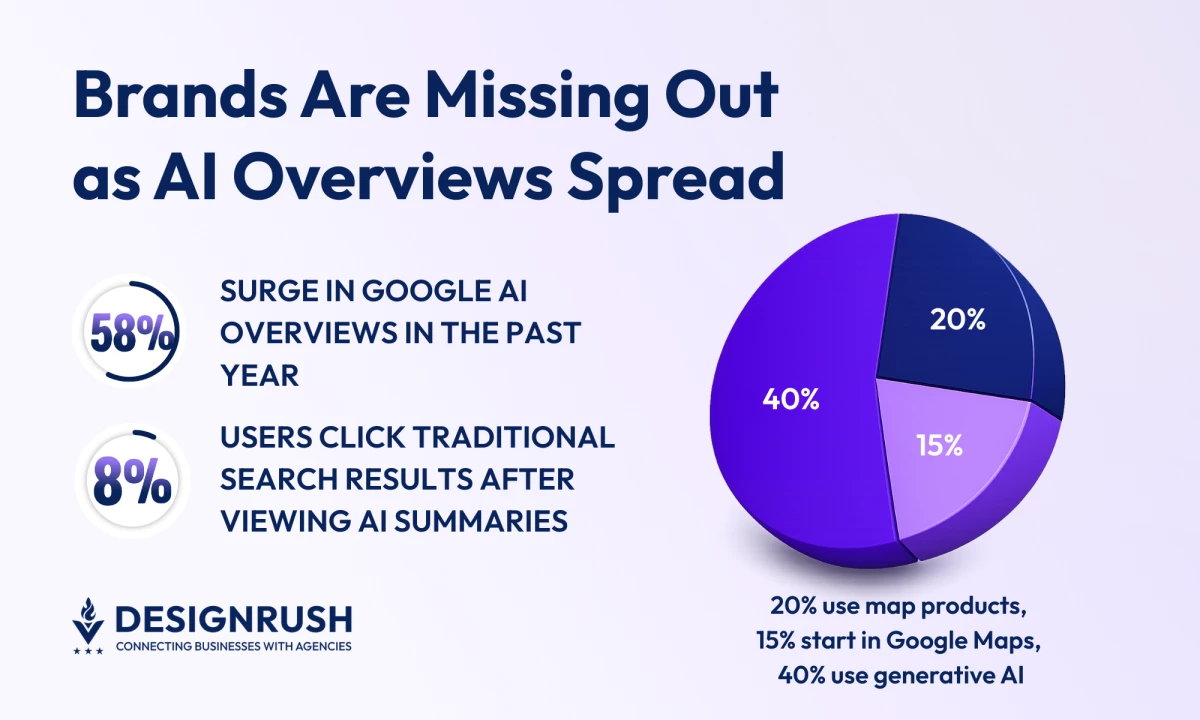
Over the past year, their presence has surged by 58%, according to Search Engine Journal, fundamentally changing how users find information online.
The research also shows that top organic rankings are no longer the strongest predictor of whether a brand will be cited in AI-generated answers.
Brand discovery is moving beyond traditional rankings toward AI-generated results. Maintaining visibility now requires rethinking Generative Engine Optimization (GEO) and Answer Engine Optimization (AEO).
Ridge Anderson, co-founder of Rock Salt Marketing, a digital marketing agency, says his team is already seeing these changes play out across client search performance.
As AI Overviews reshape visibility, brands must rethink how SEO, GEO, and AI search strategies work together, Anderson says.
“Brands are being evaluated in new ways,” Anderson tells DesignRush.
“It’s not just about appearing at the top of search results. AI Overviews pull from multiple sources, and if a brand isn’t represented accurately across those sources, it can be invisible to the user before a single click occurs,” he adds.
User behavior is starting to reflect this.
Editor's Note: This is a sponsored article created in partnership with Rock Salt Marketing.
Discovery Happens Before the Click
PwC’s review of 68,879 Google searches in March 2025 reveals how AI summaries are changing user behavior:
- Pages with AI summaries drove just 8% of users to click traditional results, compared with 15% for searches without AI summaries.
- Clicks within the AI summary itself occurred only 1% of the time.
- 26% of sessions ended after viewing an AI-powered result, versus 16% in standard search conditions.
Traditional SEO metrics like rankings and sessions can now understate a brand’s real visibility, and inclusion in AI Overviews and other AI-powered answers is becoming a primary factor in whether users even see a website.
Rock Salt Marketing emphasizes that brands should treat AI visibility as part of their search strategy.
“You need to think about consistency, credibility, and context,” Anderson said.
“It’s no longer enough to optimize a website in isolation.”
And, AI-powered answers are redefining how users engage with local search.
BrightLocal’s 2025 Consumer Search Behavior research shows that 20% of U.S. adults now conduct local searches directly inside map products, while 15% report Google Maps as their first stop for local queries.
Nearly half of respondents say they plan their travel route to a business immediately after a local search, and 40% actively use generative AI within these searches.
Clicks-to-call from Google Business Profiles are also declining as Local Services Ads mimic organic results and AI Overviews occupy prime space at the top of search pages.
The local pack now appears lower, and consumers are increasingly conducting local searches on alternative channels like YouTube, TikTok, and ChatGPT.
Instead, the full local discovery process now includes AI-driven summaries, map surfaces, and other in-SERP decision points.
Many brands remain unprepared for these changes.
McKinsey & Company’s 2025 CMO survey found that only 16% of large U.S. brands systematically track AI search performance.
This leaves most organizations measuring success primarily through traditional SEO metrics like rankings and site sessions.
“Brands often operate with a blind spot,” Anderson explained.
“They can rank highly in organic search but still fail to appear in AI Overviews, missing critical consumer touchpoints.
“Until marketing, content, SEO, and PR functions align around how AI produces answers, brands risk managing channels in silos while discovery happens elsewhere.”
He says his agency treats this challenge as a measurement and strategy problem.
Monitoring AI citations, ensuring consistency across third-party content, and applying these insights to GEO and AEO strategies helps brands maintain visibility.
Adapting GEO and AEO Strategies
AEO focuses on how information is interpreted and summarized, and structured, clear content helps systems pull accurate brand mentions.
This is why consistency across reviews, forums, and other trusted sources supports credibility.
At the local level, it means keeping Google Business Profiles complete, accurate, and optimized, monitoring reviews, and making sure location data remains the same across all channels.
Some leads, however, come from users acting on search intent without ever visiting a website.
It’s why agencies and brands should expand lead-generation channels beyond traditional web pages to reach these users.
Long-form videos on YouTube, short-form content on Instagram, TikTok, and Facebook, social media engagement on Reddit and Quora, AI SEO, digital PR, and paid local advertising are all part of a “catch leads wherever they hide” strategy.
AI Overviews, changes in local discovery, and untracked AI search activity are forcing brands to rethink visibility and lead capture.
Organic search alone no longer reflects overall brand exposure.
Performance now needs to be measured across AI citations, in‑SERP interactions, map pack engagement, and downstream lead conversions.
Brands that factor AI visibility into search strategy maintain reach as consumer behavior changes.
The ones who don’t track or optimize AI citations, in‑SERP interactions, or map pack engagement risk losing leads, even if traditional SEO metrics appear strong.
Preparing for 2026
Rock Salt Marketing notes that early adopters focus on three areas:
- AI favors content that explains topics plainly and consistently.
- Reviews, forums, and citations influence AI results as much as owned media.
- Traditional site optimization supports traffic, while AI visibility shapes discovery before users visit.
Brands should address all three areas to avoid being overlooked in AI-driven discovery.
Top organic rankings don’t capture the full picture of brand visibility anymore.
Generating leads now depends on being visible across AI citations, maps, reviews, and in‑SERP interactions, rather than just ranking at the top of search results.
The agency notes that brands best prepared for 2026 track AI summaries, keep digital signals consistent across channels, and treat search visibility as a multi-surface challenge.
Without this approach, even high organic rankings may fail to deliver clicks, leads, or conversions.