
SEO for AI Overviews: Key Findings
- Visibility now comes from being cited in search results, not just ranking on page one, as users rely more on instant answers than links.
- Zero-click search is rising fast, with 60% of searches ending without a click and engagement dropping when summaries appear.
- Brands win by building real authority, with eSEOspace expert Ben Gunther pointing to expert-led, structured, and data-driven content as key.
As Generative AI delivers answers directly, the need to click through to websites is declining.
Even so, brands compete to be cited in those results as more users turn to AI for search and discovery.
According to McKinsey, 50% of consumers now use AI-powered search engines, and more than 70% rely on them for top-of-funnel research.
As a result, traditional search results aren’t getting clicks like they used to.
Pew Research shows that when an AI summary is present, users click traditional search results in just 8% of visits, compared to 15% when no summary is present.
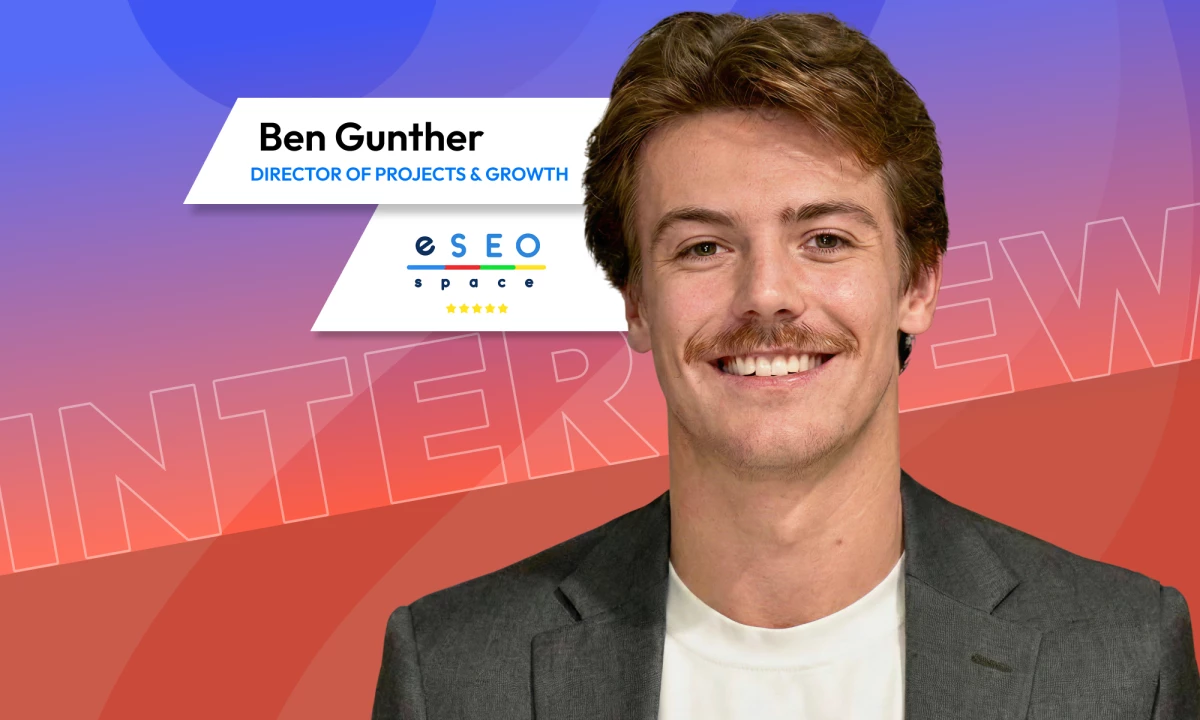
“Visibility used to mean ranking on page one,” says Ben Gunther, Director of Projects & Growth at custom website design company eSEOspace.
“Now it means being cited, summarized, or surfaced by an AI that may never send a user to your site at all.”
Gunther poses an important question for brands:
“The game has shifted from ‘can I get someone to click my blue link’ to ‘does an AI model consider my content trustworthy enough to draw from when answering a question?’”
In an interview with DesignRush, Gunther discusses why traditional SEO tactics are losing ground, what types of content earn citations from AI systems, and how brands can build authority that gets noticed.

Who Is Ben Gunther?
Director of Projects & Growth at eSEOspace, Ben Gunther leads SEO strategy and growth initiatives for the digital marketing agency. His work focuses on helping brands build sustainable visibility through technical SEO, authority-driven content, and modern search optimization.
Editor's Note: This is a sponsored article created in partnership with eSEOspace.
Why Traditional SEO Habits No Longer Work
One of the most common SEO habits brands still rely on is keyword stuffing, or over-optimizing content around widely searched phrases.
“Keyword stuffing has evolved, but its spirit is alive and well. We still see brands obsessively engineering content around exact-match keyword density rather than topic depth,” Gunther says.
“The mindset of ‘if I say this phrase twelve times, I'll rank’ hasn't fully died.”
That strategy has become increasingly ineffective as modern search systems rely heavily on semantic understanding rather than exact phrase matching.
“Google's models are sophisticated enough now to understand semantic relevance, so thin content dressed up with repetitive keywords doesn't just fail to perform; it actively signals low quality,” he says.
And so, brands must prioritize genuine topical authority over optimizing around isolated phrases to garner visibility online.
That focus on authority, clarity, and insight is exactly what AI systems look for in the content they surface.
And the types of content that surface most often share several traits, including clear structure, expert authorship, and original insight.
The most citation-friendly content, according to Gunther, tends to answer questions directly while demonstrating credibility.
“Content that answers a specific question directly, cites its sources, and demonstrates genuine expertise is what gets referenced,” Gunther says.
This type of content is more likely to surface in AI-generated summaries. Gunther explains:
“AI models favor content that is well-structured, factually grounded, and written with clear authorial authority.”
Getting in Google's good graces often involves original research, definitive how-to guides, and expert commentary that can't easily be found elsewhere.
Gunther explains that first-party data and proprietary insights are particularly powerful, as AI systems seek information they can’t easily synthesize from generic content.
Industry data supports this, showing which content formats perform best.
An Adobe survey of marketers and business owners found that 57% say data-driven pieces perform best for AI search visibility, followed closely by how-to guides at 51%.
This just goes to show that original data is something AI can’t replicate as easily from other sources.
Why Website Structure Still Drives AI Visibility
How a site is structured still shapes whether content gets discovered and surfaced in search.
Gunther argues that brands should ensure their websites remain accessible to both search crawlers and AI systems.
For example, clean site architecture, fast load times, and schema markup support both traditional crawlers and “AI ingestion pipelines.”
Beyond technical improvements, he believes brands should strengthen how their expertise is represented online.
One way to do this, he says, is to build a clear, digital “entity identity” that always signals expertise.
“Brands should invest in building a clear entity identity, making sure their brand, authors, and subject matter expertise are consistently signaled across the web,” he says.
That includes organizing content around topics rather than individual keywords.
“Think of your website less like a keyword-optimized landing page and more like a well-indexed reference source.”
Strong site structure and clearly signaled expertise make it easier to see what’s actually working in marketing.
SEO performance was measured by traffic for decades, but those numbers don’t really show what’s working anymore.
About 60% of searches end without a click, and AI-driven search experiences reduce organic traffic by 15% to 25%, according to Bain & Company.
That means marketers need to move past click-through rates to see their real impact.
“The old click-through rate obsession needs to be deprioritized in favor of metrics that reflect brand authority and downstream demand,” Gunther says.
Instead, he points to signals that better capture real-world impact.
“Branded search volume is one of the clearest signals. Are more people searching for you specifically?” he says.
Other useful indicators include direct traffic growth, share of voice within AI-generated answers, and assisted conversions.
“Ultimately, the goal of SEO in 2026 isn't just traffic,” Gunther says.
“It's being present at every stage of how someone forms an opinion before they ever visit your site.”
Real influence comes from being noticed and trusted before anyone even clicks.
Want to know how to boost your brand's SEO?
Take a look at our list of the Top SEO Agencies for 2026.