
Global Debt Pressure Takeaways:
- Global debt hit $324T in Q1 2025, or 330% of GDP, straining consumer confidence.
- U.S. cardholders added $180B in debt in 2022; two-thirds worry about rising interest.
- 90% of brand switchers say they won’t go back, citing price as the key reason.
- Gucci’s Q1 sales fell 25%, signaling weaker loyalty even among high-income buyers.
- Mid-tier brands are losing ground as shoppers trade down or splurge selectively.
A tidal wave of debt is rewriting spending habits.
Global debt topped $324 trillion in Q1 2025, up by $7.5 trillion from the previous quarter.
This is the highest level ever recorded, representing roughly 330% of global GDP, according to data from the Institute of International Finance (IIF).
And the surge is taking a toll. Inflation, rising interest rates, and pressure on household budgets are leading consumers to scrutinize every purchase.
View this post on Instagram
In the U.S., shoppers report sharper price sensitivity than seen in years.
McKinsey found nearly 43% have rising costs for essentials like groceries and fuel on top of their minds.
Over 60% have adjusted or plan to adjust their spending habits because of President Donald Trump's recently imposed tariffs.
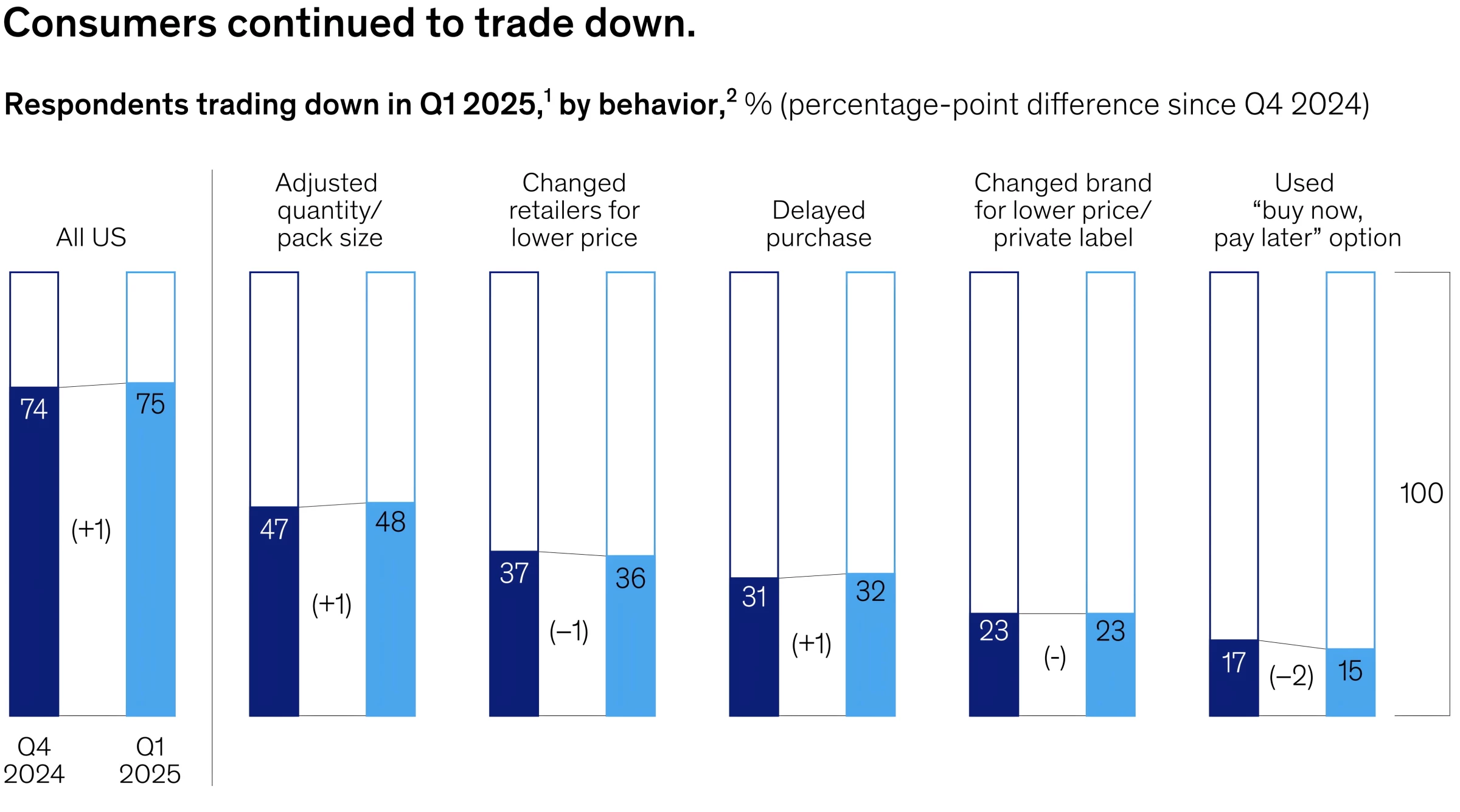
In Q1 2025, 74% of consumers reported trading down, with millennials leading the shift by adjusting pack sizes and quantities, especially in groceries.
While low-income households cut back most on meat and dairy, even high-income shoppers increasingly opted for lower-cost packaged food and private labels.
At the same time, a May 2024 Lending Tree study found that consumer credit card debt soared in 2022, with Americans adding a record $180 billion.
Additionally, 66% say rising interest rates on their debt cause them stress.
Now, these financial burdens are directly linked to weakening brand loyalty.
Price now outweighs brand trust. And the luxury goods sector confirms this trend.
In Q1 2025, Gucci sales plunged 25%, leading parent company Kering to post a 14% revenue decline overall to $4.54 billion.
View this post on Instagram
Executive warnings about weak U.S. demand underscore that even affluent consumers are reconsidering spending.
In the past, recessions triggered similar trade-down behavior:
- From 2007 to 2009, shoppers switched from mid-tier brands to private labels, according to a 2011 USDA report.
- Store brands captured around 2.5 percentage points of U.S. consumer-packaged-goods market share.
- Full-service restaurant visits dropped from 20% of adults in 2006 to 17% by 2011, while fast-food held steady at 13%, the same USDA study stated.
This kind of situation is also mirrored today, though the scale is broader. Midmarket brands are squeezed between budget private labels and upscale players.
Discounters and warehouse clubs report rising foot traffic, while luxury lines like personal care miniatures and fragrance entry points are examples of “small indulgences” consumers still permit themselves.
Are Brands Ready to Compete on Value, Not Just Identity?
As financial pressure deepens, the question for both brands and agencies isn't just how to retain customers, but how to re-earn their trust through tangible value.
Here's how today's consumer data translates into both warning signs and strategic openings.
What Brands Risk Losing When Loyalty Breaks
- Long-term loyalty is slipping fast. The ease of access to competing offers means brand affinity is no longer a strong enough anchor.
- Pricing now drives decisions more than purpose. Practical benefits like price and availability are outpacing mission statements and emotional storytelling in driving conversions.
- The mid-market is vulnerable. Mid-priced products often suffer the most attrition as consumers either trade down for affordability or up for perceived value.
- Brand investment is at risk. Gartner reports average marketing budgets have fallen to just 7.7% of revenue in 2024. That’s a 15% decline year-over-year, shrinking the resources CMOs have to retain or re-engage audiences.
Feel like you're spending more cautiously lately? You're not alone.
— McKinsey & Company (@McKinsey) June 13, 2025
As tariff news spreads, most consumers are already tightening their belts, even before prices go up.
Check out our latest research to see how sentiment is shifting, and why it matters. https://t.co/5X64ZJKj6jpic.twitter.com/TuoLXaBvDZ
Loyalty is becoming more volatile. Brands can’t afford to assume past efforts will protect them.
Without meaningful updates to how value is communicated, they could lose customers, possibly for good.
Where Smart Brands Can Still Win
- Consumers are still spending, just differently. Instead of abandoning categories, shoppers are opting for affordable indulgences, smaller SKUs, or private-label products that deliver similar quality for less.
- Excellent service is a competitive edge. Quick response times and meaningful gestures go far in a high-stress market.
“It’s the small things that keep people around—fast page loads, fewer steps to buy, a clear return policy. Those quiet details build trust when attention is short and budgets are tight,” said Gabriel Shaoolian, CEO and Founder of Digital Silk.
- Loyalty programs have renewed appeal. Rewards and personalized discounts become more valuable when wallets are tight. Consumers actively look for these signals before deciding where to shop or which brand to choose.
- Agencies have a key strategic role. Partners who can help brands reframe their positioning, adjust messaging, or offer more accessible product formats are especially valuable now. This is where creative work delivers measurable returns.
🚨US consumers believe we are in an economic CRISIS:
— Global Markets Investor (@GlobalMktObserv) May 19, 2025
Americans expected change in their financial situation over the next 12 months dropped to the lowest level on RECORD.
US consumers have never been so pessimistic about their finances prospects.
This will impact spending. pic.twitter.com/WHSlYJ8PeO
Economic stress doesn’t mean demand disappears; it's just evolving.
Brands that meet shoppers on new terms and deliver real, everyday value can hold on to customers and even outperform less responsive competitors.
For CMOs and agency leaders, this is a make-or-break period for brand loyalty.
The winners won't be the ones who defend old identities. They’ll be the ones who prove, clearly and consistently, that they’re still worth choosing today.
Another proof of this is the ongoing week-long McDonald's boycott, an economic blackout brought about by the incongruity of its inclusive branding and rising prices.
Consumers are cutting back, and these agencies help you position value without compromising your brand identity:

-(1)-preview-webp.webp)