-(1)-details-webp.webp)

Real-Time UX Growth: Key Findings
- Companies that embed real-time feedback loops are 4.2x more likely to outperform peers and achieve 30% higher revenue growth
- UX teams using session replays, predictive models, and live data pipelines make faster, smarter decisions with measurable impact.
- Pairing machine learning with human insight turns raw analytics into a growth strategy.
Quick listen: Real-time analytics and agile UX aren’t just buzzwords. Here’s how they drive real growth, in under 3 minutes.
You’re flying blind if your UX still runs on quarterly gut checks and vague KPIs.
Growth today isn’t about guesswork. It’s about building fast, testing even faster, and knowing why something works before scaling it.
The rise of real-time analytics, predictive modeling, and session replay tools means the margin for error is shrinking and the expectations from leadership are climbing.
Brands that can’t tie UX to outcomes won’t just lose users; they’ll also lose credibility.
That’s where real-time visibility changes the game.
Real-Time Insights Drive Smarter UX Decisions
Modern product and marketing teams don’t wait for lagging indicators. They're using tools like Contentsquare, Hotjar, FullStory, and Mouseflow to watch user behavior as it happens.
Instead of waiting for someone to report a problem, they’re watching sessions stall, spotting rage clicks, and seeing where users hesitate while the campaign is still running.
Likewise, performance doesn’t come at the cost of visibility anymore. Analytics pipelines are built to run in the background, collecting behavior data without slowing down the site or app.
With a flood of insights, it’s crucial to focus on fixes that align with business impact and measure success beyond just immediate numbers.
"Data tells us what’s broken and we fix what hurts the most, the fastest. We focus on issues that impact key conversion points and user flow," said James Gibson, director of digital marketing at eDesign Interactive.
"Prioritization is always tied to our client’s business goals not just appearances."
This gives teams uninterrupted access to session replays, heatmaps, and conversion funnels without sacrificing load time. The right data paired with the right tools makes growth less of a gamble and more of a process.
"We treat UX as a living process, where small data-driven tweaks happen continuously but are bundled into planned releases for stability," said Caleb Bradley, CEO and founder of Bighorn Web Solutions.
"That way, we maintain agility without disrupting user experience or the development pipeline. Regular retrospectives ensure we prioritize the highest-impact changes."
Balancing Predictive Power and Human Insight
Machine learning can surface patterns at scale, but it can’t decide what to do with them. Turning those signals into meaningful action takes strategic thinking, and the right systems to keep insights flowing.
For example, in their work with Gaido, Goji Labs helped scale a complex healthcare product through iterative UX testing.
"To support continuous UX testing, we keep data pipelines lightweight, modular, and integrated directly into the product layer," said David Barlev, CEO and co-founder of Goji Labs.
"That way, designers and PMs don’t have to wait on engineering to validate hypotheses; we can move fast without breaking the backend."
This kind of setup ensures that every insight can feed straight into design decisions without delay.
But data alone doesn’t drive change; it’s how teams translate those signals into focused sprint priorities that count.
Anton Zenkov, VP of delivery at Kanda Software, believes that momentum always beats perfection.
"Don’t get paralyzed trying to craft the perfect KPI set from day one. Start with a small set of simple, relevant metrics that actually work, then refine as you learn."
Every sprint delivers proof of impact. Campaign tweaks and UX changes rest on fresh user data, not gut calls.
Small, continuous updates reduce risk and preserve site stability. And predictive personalization drives retention. For example, Netflix’s recommendation engine alone saves an estimated $1 billion a year.
Finally, session replays and heatmaps go beyond clicks. They reveal frustration and delight in real customer journeys.
Leadership now demands clear ROI on every initiative. In other words, tying UX to concrete business outcomes isn’t optional; it’s the only way to stay credible, move fast, and win.
Continuous measurement, rapid tests, and human interpretation turn analytics from a checkbox into a true growth engine.
Ready to put this into practice?
Getting Started with Agile Analytics and UX
Follow these seven steps to weave data and design into every sprint:
1. Audit your data flow
Confirm your analytics pipeline captures every user action without slowing down your site or app.
Gartner forecasts that by 2026, 50% of enterprises with distributed data architectures will have adopted data observability tools, a sharp rise from less than 20% in 2024.
That rapid increase shows why real-time monitoring of your data landscape is now essential to trust your UX insights.
2. Choose tools that fit your stack
According to Deloitte Digital’s report Scaling Real-Time Digital Experience Personalization, brands need session-replay and heat-mapping tools that capture data from all sources instantly.
If those tools introduce any lag, you lose crucial insights and risk frustrating users.
3. Define your core metrics
Focus on a handful of KPIs that map directly to your outcomes. Think conversion by channel, time on mission-critical pages, and cohort-based retention.
McKinsey explains that effective digital transformations track three types of indicators: value creation (your top-line impact), team health (how well your agile squads perform), and change-management progress (adoption and engagement rates).
Continuous alignment around these metric categories keeps your dashboard sharp and your team accountable.
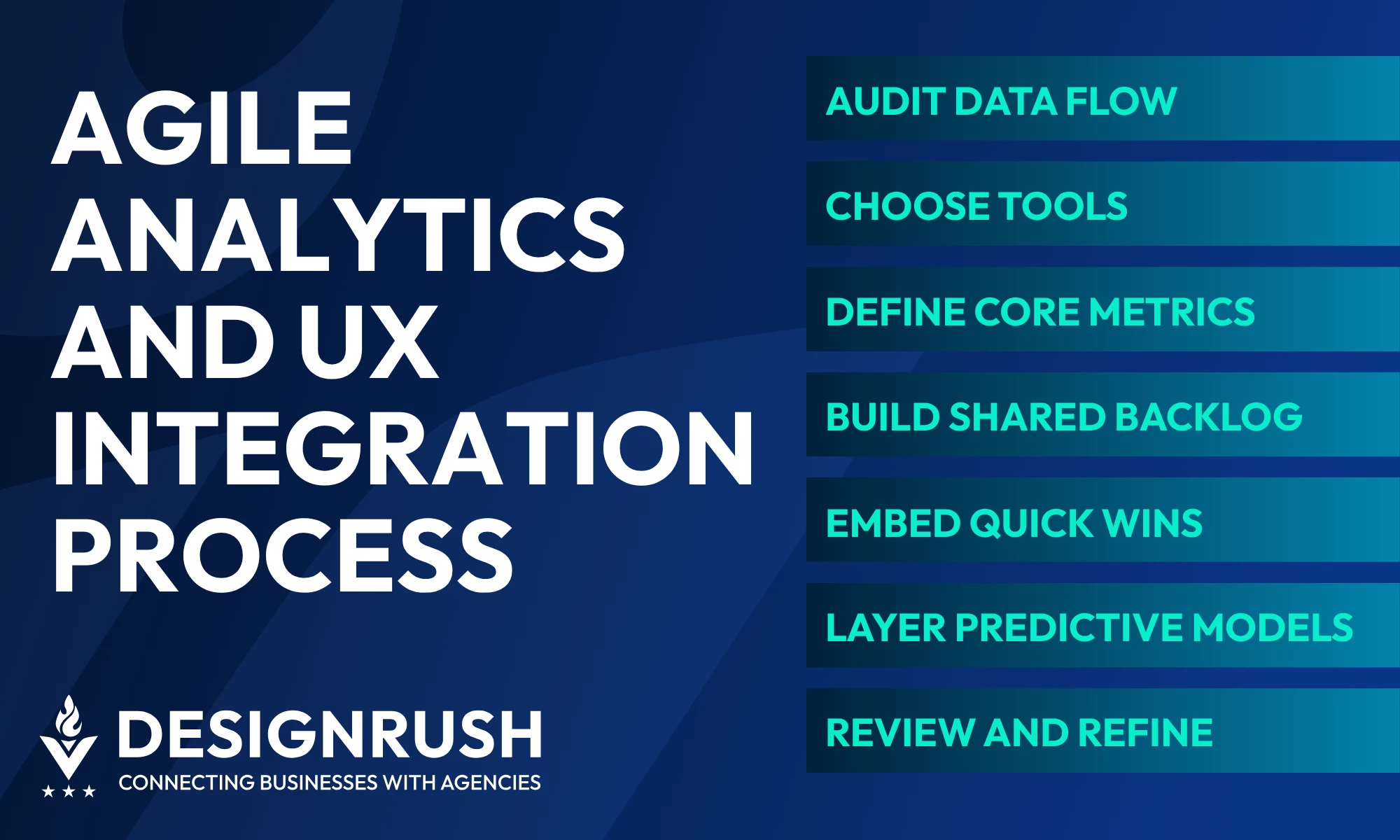
4. Build a shared backlog
Centralize session replays, support tickets, survey feedback, and dashboard alerts in a single board and rank each item by impact divided by effort.
Even with good intentions, only 46% of Agile projects are completed on time and within budget; often because teams lack a unified view of priorities, according to Celoxis.
A clear, scored backlog makes sure everyone tackles the highest-value work first.
5. Embed quick wins in sprints
Reserve capacity in each development cycle for small, data-driven UX tweaks.
McKinsey notes that high performers balance agile ways of working with rigorous sprint management to capture “quick-win” improvements without derailing major releases.
In this DesignRush Podcast episode from July, trainer Chris Croft shares the surprisingly simple tools that rescue failing projects and explains why most teams overlook them:
6. Layer in predictive models
Begin with simple churn or engagement-scoring models, such as logistic regression or survival analysis, and validate them through A/B tests and metrics like AUC.
According to Forrester’s 2024 Total Economic Impact report, organizations using its analytics guidance achieved a 259% ROI over three years and saw revenue growth accelerate by 4%.
Always pair those quantitative scores with qualitative checks like user interviews or session replays to turn predictions into testable hypotheses.
7. Review, refine, repeat
At the end of each sprint, revisit your metrics, session recordings, and hypotheses. Did the change deliver the expected lift?
If not, adjust your approach. If it did, expand on it.
Companies that embed continuous performance reviews and iterative adjustments are 4.2 times more likely to outperform peers and achieve 30% higher revenue growth, as per McKinsey's findings.
Continuous refinement is what turns good experiments into lasting improvements.
We’ve seen teams transform when they stop relying on delayed reports and start acting on real‐time insights.
No more flying blind.
By weaving analytics, agile UX, and strategic judgment into every sprint, you move from guesswork to certainty.
That’s how you earn leadership’s trust, keep users engaged, and turn each design change into measurable growth.