
ChatGPT Content Strategy: Key Findings
- Most ChatGPT use is for daily tasks, with 30% work-related. Nearly 9 in 10 B2B buyers use generative AI across the purchase journey.
- GEO and AEO make content discoverable in AI-driven answers and guide users to decisions.
- Structured content, topical authority, and clear data turn AI visibility into real outcomes and give brands an edge over competitors.
OpenAI’s study of 1.5 million ChatGPT conversations shows AI is no longer an afterthought.
Most interactions focus on everyday tasks, such as writing, planning, and guidance, with approximately 30% being work-related.
Last year, Forrester’s Buyers’ Journey Survey found that 89% B2B buyers use generative AI tools at every stage of the purchase process.
They rely on tools such as ChatGPT, Perplexity, Claude, or Gemini, often on mobile or within enterprise software, to gather insights and evaluate solutions.
The question now is: if ChatGPT is now a daily tool for both personal and work tasks, what does that mean for how brands optimize content for Generative Engine Optimization (GEO) and Answer Engine Optimization (AEO)?
“AI is changing how buyers research and make decisions. Businesses that integrate SEO, AEO, and GEO are not just optimizing for search,” said Irina Shvaya, Partner and Marketing Consultant at eSEOspace, a San Diego-based SEO and AI optimization agency specializing in web design and local search strategies.
“They’re positioning themselves as trusted sources in the conversations happening across AI platforms. Staying visible today means thinking beyond links and ensuring your expertise is included wherever your customers are looking.”.
That means adapting how you present information so it’s easily found in both traditional search results and AI-driven answers.
Editor's Note: This is a sponsored article created in partnership with eSEOspace.
The latest trends revealed by OpenAI’s study show that AI is becoming a mainstream tool for both personal productivity and professional tasks.
OpenAI’s recent push into eCommerce with Instant Checkout also underscores this shift.
Users can complete purchases directly in ChatGPT, starting with U.S.-based Etsy sellers, with plans to expand to over one million Shopify merchants, including brands such as Skims and Glossier.
For brands, this means making visibility wherever customers interact with it essential, whether for guidance, tasks, or transactions.
Which also means that traditional SEO alone is no longer enough.
Now, content should be optimized for AI-driven platforms using GEO and AEO to appear in conversational results, answer queries clearly, and stay relevant across search engines and AI tools.
“Businesses need to think beyond simply being found. AI-driven interactions reward clarity, accuracy, and actionable information.
Companies that structure content for GEO and AEO can guide users from questions to decisions, turning AI engagement into measurable business outcomes,” Shvaya noted.
That shift is already changing how visibility works online.
Digital presence has become the new storefront, and how easily customers find you still determines growth and opportunity.
As eSEOspace has found, AI now decides which sites get noticed, prioritizing quality, structure, and usefulness.
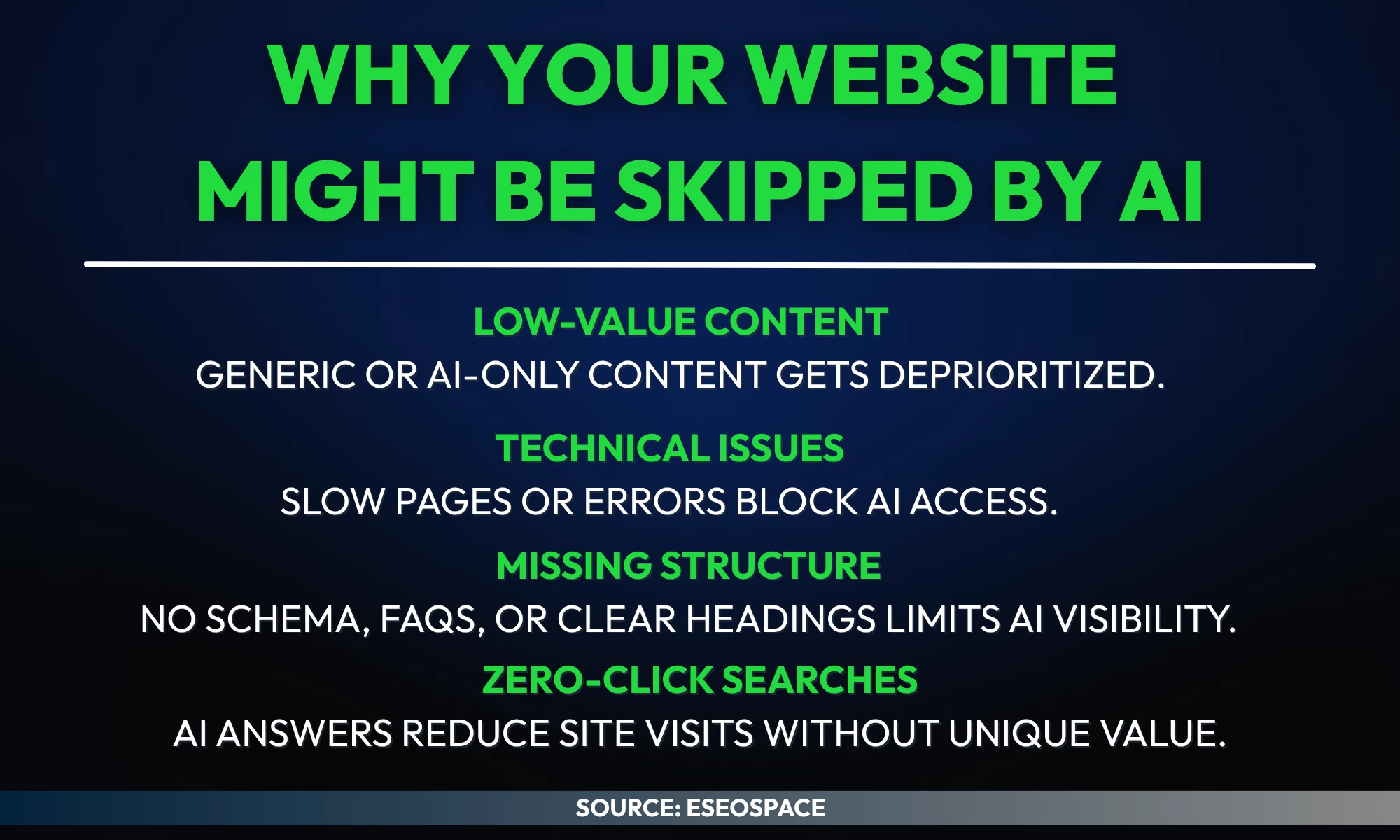
Here’s why your website might be skipped:
- Low-value content: Generic or AI-only content without insight or expertise gets deprioritized. AI favors actionable, trustworthy content.
- Technical SEO issues: Slow pages, broken links, rendering errors, or sitemap problems can block AI from accessing your site.
- Missing structure: Without a schema, FAQs, and clear headings, content is less likely to appear in rich snippets or AI answers.
- Zero-click searches: AI often delivers answers directly. Sites that don’t offer unique value miss out on visits.
Traditional SEO built that foundation, but now generative AI is rewriting the rules. As experts at eSEOspace explained, it’s no longer enough to simply show up in search results.
To stay competitive, businesses need to structure content, anticipate customer questions, and optimize for both traditional search and AI-driven answers.
Integrating SEO with GEO helps brands earn trust within AI-powered conversations.
For local businesses, this approach turns visibility into measurable results, guiding customers from discovery to decision without relying on clicks alone.
Turn AI Visibility Into Business Growth
Generative search is changing the rules of traditional discovery.
How?
Brands in digital services, healthcare, and SaaS are already seeing organic clicks drop as AI summaries replace standard search results.
An Ahrefs study of 300,000 keywords found that the top organic listing loses 34.5% of clicks when an AI overview appears.
Visibility is no longer just about ranking.
It’s about being referenced as a trusted source within AI-generated answers.
Drawing from its experience, eSEOspace shows that combining GEO with traditional SEO helps brands capture high-intent traffic before it reaches a search results page.
This approach focuses on:
- Using structured data to strengthen context and accuracy
- Creating conversational content that aligns with AI-driven queries
- Building topical authority to increase the chances of being cited and trusted by AI
At the end of the day, businesses that combine GEO and SEO effectively can convert AI engagement into real outcomes, outperform competitors, and maintain authority across traditional and generative search.