
Generative Engine Optimization (GEO): Key Findings
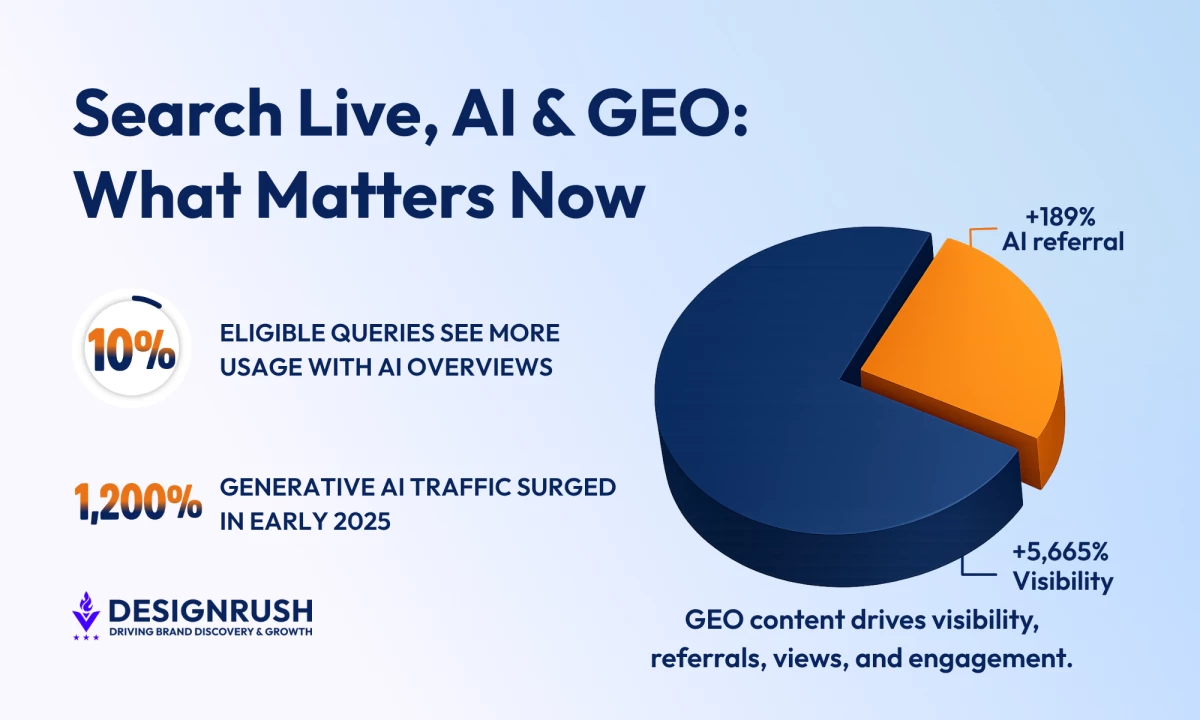
- Google reports AI Overviews drive 10% more usage for eligible queries, showing brands that rely on traditional SEO risk missing visibility without GEO.
- Generative AI traffic jumped 1,200% in early 2025, showing clear schema and structured content get noticed.
- Clients using GEO saw up to 5,665% more generative search visibility and 189% growth in AI referrals, proving AI-ready content boosts reach and revenue.
Companies that rely solely on traditional SEO might find themselves underrepresented, or not at all, in AI-powered summaries.
With Google’s global rollout of Search Live, which Gemini 3.1 Flash Live powers, users can interact via voice, camera, and ongoing conversation threads.
When conducting a search, users are submitting longer, more descriptive queries and engaging with AI-generated responses more often.
According to Google, its AI Mode queries are, on average, twice as long as traditional search queries.
This changes how content gets discovered, and instead of traditional SEO, structured content optimized for Generative Engine Optimization (GEO) is stealing the spotlight.
Editor's Note: This is a sponsored article created in partnership with Intero Digital.
Google reports that AI Overviews drive over 10% more usage for queries eligible for AI summaries in major U.S. markets.
Even shoppers are turning to AI, with 73% of consumers using AI for their primary product research, an Adobe survey found.
Which means that not only are AI answers supplementary, they’re replacing huge chunks of traditional search.
Traffic to U.S. retail sites from generative AI sources jumped 1,200% in early 2025 compared with the previous year, according to data from Adobe.
Around the same time, Deloitte’s 2025 Generative AI Survey found that 69% of generative AI users interact with AI embedded in familiar software and services, including search engines.
“AI search isn’t just changing how people look for information, it’s changing how brands get found,” says Christina Adame, President of SEO and GEO at Intero Digital.
“We use our own platform, Intero GRO, to track how content shows up across AI-driven results and identify where clients are missing visibility. That lets us structure content in a way AI can actually use, so it appears earlier in the search process.”
Conversational and Multimodal Search
Multimodal discovery is becoming more common. People can mix text, voice, and visuals in a single search interaction.
Searching is also becoming more back and forth. Users don’t just type one query and move on; they adjust their prompts as they go until they get the answer they want.
Not everything about AI search is straightforward. About 53% of consumers still distrust AI results, according to a Gartner survey.
That means it’s not enough to just appear in AI-powered summaries. Companies also need to be credible and clear.
Intero Digital explains this in a recent YouTube video. Adame talks about how Google is evolving with AI features like AI Overviews and zero-click answers.
She shows how organizing content with GEO, using clear structure, schema markup, and semantic signals, helps AI pick up information accurately:
One Intero Digital client, Global Industrial, a major distributor of industrial equipment and supplies, started with no presence in AI overviews.
Within a year, it appeared in more than 1,200 summaries. Their Page 1 rankings went up 34%, and organic revenue grew 24%.
How? By doubling down on SEO fundamentals, high-quality content, and GEO tactics like optimizing entity-rich Schema, query-aligned, semantic heading structure, and clear, direct answers.
For another client, Intero Digital went “full Gordon Ramsey” on the digital strategy, “refining, replating, and garnishing” the online presence of a kitchen brand.
Here’s a summary of the results:
- 5,665% increase in generative search visibility
- 189% year-on-year growth from AI-driven referrals
- 111% more total views
- 66% growth in engaged users from AI traffic
The structured approach helped AI surface the content accurately, kept users engaged longer, and led to clear gains in visibility and revenue.
What This Means for Businesses
With Search Live, search does not start and end with keywords and a list of links.
AI-generated summaries now show up earlier in the process, often before a user clicks through to a site.
They are used to explore options, compare information, and narrow decisions, especially in high-intent situations.
For content strategy, that raises a few immediate priorities:
- Clear semantic structure so AI systems can extract and present information accurately
- Authority and trustworthiness to address user skepticism toward AI-generated results
- Content that works across text, voice, and visual inputs, reflecting how people now search
Using a GEO approach in this way helps content appear in AI summaries, reach more people, and increase engagement and revenue.
“Brands need to move beyond optimizing for rankings and start structuring content for how AI systems interpret and surface information,” Adame says.
“That’s where visibility is now determined.”
With GEO in place, pages are written for summary extraction from the start.
Search Live puts summaries before the click, so the page has to answer the query on the page itself.
That calls for direct copy, accurate schema, and content that stays consistent across text, voice, and visuals.
When brands build this into every page, AI-driven results capture the right information and guide users toward the next step, whether that’s exploring products, reading details, or completing a transaction.