
Alphabet raised $84.75 billion in equity to fund AI data centers and computing infrastructure, the largest equity capital raise in U.S. corporate history, per the company.
The raise comes as Alphabet's annual revenue exceeds $422 billion, making it the second largest company by market cap globally.
Alphabet has increased the size of its equity offerings to $84.75 billion, in a sign of strong investor appetite for big tech companies as they expand their AI infrastructure and computing power. https://t.co/QrhzzShwfz
— Reuters Legal (@ReutersLegal) June 3, 2026
The deal included a $10 billion private placement from Berkshire Hathaway, a holding company known for its historical reluctance to bet on tech.
Berkshire Hathaway's involvement signals that AI infrastructure has moved from speculative territory to expected return.
That raise is backed by results as Google Cloud revenue grew 63% year over year in Q1 2026, its strongest quarter on record.
Alphabet CEO Sundar Pichai stated that it would have been greater if supply had met demand, which is why the company is raising capital.
Supply has long been a main restriction for many major tech companies.
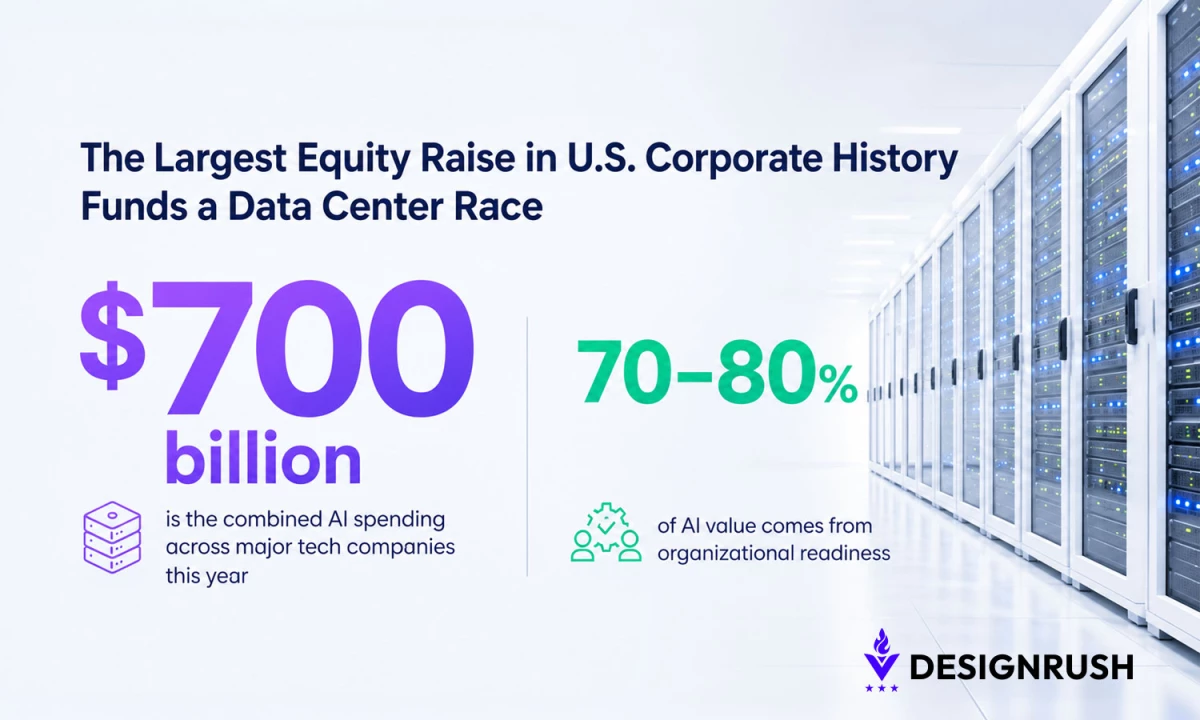
This is why cumulative AI spending is set to approach $700 billion this year, up from initial projections of $600 billion at the start of 2026.
For enterprises built on top of that infrastructure, the rate at which hyperscalers extend it directly influences how quickly their own AI capabilities scale.
The Race Is About Infrastructure
Compute is the bottleneck in the AI race. AI consumes tokens during training and inference, the process of generating responses in real time. And both are limited by physical infrastructure.
More demand means more data centers, and more data centers require capital most organizations cannot self-fund.
The chips in those data centers will be outdated within four years. Every investment must generate returns before the hardware depreciates.
That timeline sets the pace at which the industry moves, and organizations that delay modernization find the distance to competitors compounding faster than expected.
Marcello Gracietti, CEO of Cheesecake Labs, a software development firm specializing in AI product engineering, sees the raise as confirmation of where the real constraint is.
"This is a once-in-a-generation race. The first to win customers often keeps them, regardless of where product quality eventually lands," he says.
"Speed itself has strategic value."
In new markets, early customers stay locked in before product quality even settles, which is why speed carries strategic weight regardless of execution quality.
The upsizing from $80 billion to $84.75 billion shows how much institutional capital is following AI infrastructure right now.
That trust flows toward compute, the constraint on both sides of the stack, training and inference.
Data and Engineering Are the Real Differentiators
Alphabet, Amazon, Microsoft, and Meta are competing on infrastructure because the models themselves are converging.
Any organization can access the same large pre-trained AI system through an API, which makes the model a starting point rather than a differentiator.
Gracietti describes AI as a stack where every layer has to evolve together.
Chips from NVIDIA, AMD, and others power the cloud infrastructure that Microsoft, Amazon, and Oracle are racing to expand. The models sit on top of that cloud.
In other words, a fragmented data layer or an outdated database does not just slow one system. It limits everything built above it.
"Once a model is trained, it becomes roughly what everyone else can access too. The differentiator is the quality of your data and how well your systems are integrated," Gracietti says.
Case in point, two companies using the same model will produce different outcomes based on the data available and the systems built around it.
The one with cleaner data systems and tighter integrations will move faster, personalize better, and recover from failure more quickly.
Legacy Systems Create the Real Distance
The most common obstacles that businesses have when attempting to scale AI are legacy systems and fragmented data.
This is because data sits across disconnected tools and architecture built for a different era of software, leaving models with nothing solid to stand on.
It used to take 18 to 24 months to migrate an on-premise database to a modern platform or move off a legacy CRM.
That timeline kept many organizations comfortable with systems they knew were holding them back.
With AI-based migration tooling, Cheesecake Labs now completes those migrations in under six months.
The new architecture runs in tandem with the heritage infrastructure, with the original kept live as a backup until the replacement proves itself in actual working conditions.
"The moment one competitor modernizes, everyone else has to follow. Nobody can afford to be the slow one," Gracietti says.
Competitors leverage every quarter spent on outdated infrastructure to create tighter integrations, quicker deployment cycles, and cleaner data pipelines on top of the same models.
AI Readiness Starts Before the Tools
Clean infrastructure is a prerequisite, not a guarantee.
People, process, and organizational readiness account for 70% to 80% of where AI value comes from, per the Wharton Human-AI Research and GBK Collective study.
So, what separates organizations that scale AI from those that stall in pilots? Research shows it is rarely the tooling.
The companies moving fastest are the ones that thoroughly and honestly assess AI readiness and redesign their workflows before selecting tools.
An agent needs a procedure based on what autonomous systems can accomplish, rather than on what humans used to do manually.
The organizations that modernize now accumulate the only AI asset that cannot be bought off the shelf.
Institutional knowledge of where AI fails in its specific workflows builds through iteration, and no budget can shortcut it.
Every deployment cycle adds to that knowledge, and it is what distinguishes companies that scale from those that keep restarting pilots from scratch.