
Podcast listening keeps climbing.
In fact, an estimated 167 million Americans aged 12 and older tuned in to a podcast in the last month, up from 158 million a year earlier, according to Edison Research's Infinite Dial 2026.
That increase in listeners has also led to an increase in the number of shows chasing that audience.
The podcast database Podchaser tracks roughly 407,000 shows that are actively publishing. Just 7% of them ever crack 10,000 listeners.
That means the audience is growing, but the competition for it is growing faster.
In response to this, Riverside, an AI-powered content creation platform, released a rebuilt version of its editor this summer, aimed squarely at that exact pressure.
Spotify, Apple, and Marvel are already among its clients, alongside creators like Gary Vee and Mark Zuckerberg, according to the company.
Why the Editor Needed a Rebuild
Riverside's Editor 2.0 is part of what Riverside CEO and Co-Founder Nadav Keyson called the company's biggest release wave since its launch.
The original editor earned its following through speed and simplicity. But that same simplicity started working against creators as their projects grew.
"As creators started producing more ambitious, longer-form content, they needed more control without losing that speed," Keyson says.
Editor 2.0 is the answer to that tension, built to be more robust and flexible while still feeling effortless the moment someone opens it.
Power and simplicity usually trade off against each other, Keyson says, and the rebuild was an attempt not to accept that trade.
Inside Editor 2.0: Speed, Control, and AI in One Place
Riverside built more capability into Editor 2.0 without giving up the simplicity the original editor was known for. Four changes show what that looks like once you're inside the timeline.
- Cut sections disappear from the timeline entirely, so creators only see the parts they're using.
- Dragging a track to a new spot in the sequence, once impossible, is a simple drag-and-drop.
- Copying a highlight, once limited to grabbing it from the transcript, now works straight off the timeline.
- Overlays snap to cuts and scene changes automatically.
Keyson calls it "the fastest web editor there is out there."
AI runs underneath that same speed. It gives solo creators, what once took a full team, sharper cuts, added motion, and an intro built without outside help.
Editing time drops from a weekend to an afternoon. Yet that speed doesn't extend to judgment.
"It doesn't touch the thing that actually makes content work: whether it's genuine," Keyson says.
"AI can make you faster and more capable. It can't make you interesting, and it can't make you honest. That's still on the creator."
Listeners share that concern. In fact, 62% of weekly podcast consumers see AI as a threat to podcast credibility.
Fifty-nine percent say the same about creativity, according to Edison Research's June 2026 Podcast Consumer report.
That skepticism is aimed at judgment, the part Keyson says stays with the creator. It isn't aimed at the operational side of the work.
Creators need that kind of control more, especially now that podcasts have become a visual medium too.
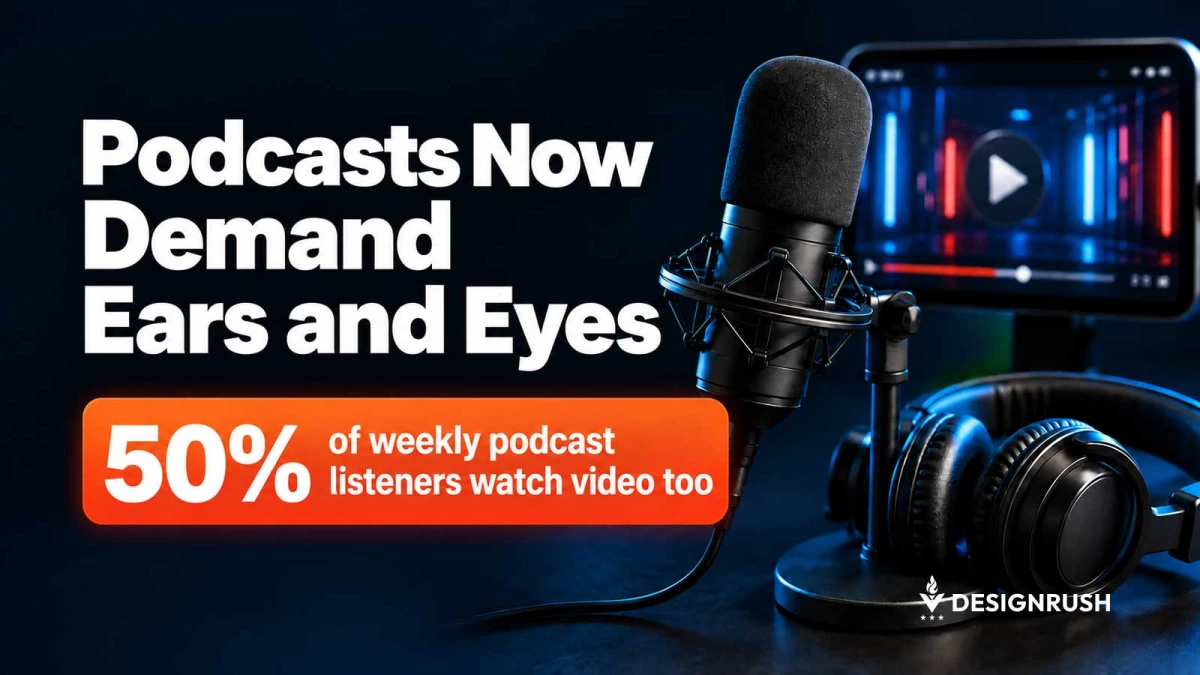
Case in point, 50% of weekly podcast consumers already watch video while they listen.
That's up from just 28% in 2022, according to Cumulus Media and Signal Hill Insights' Podcast Download – Fall 2025 report.
Why One Good Episode Isn't Enough
Keyson sees inconsistent output as the more common trap, even ahead of raw production quality.
Staying consistent is the harder discipline in a market already crowded with 167 million monthly listeners choosing where to spend their attention.
A strong episode gets someone to click once. What keeps them coming back is everything built around it.
"The mistake is thinking about content as a series of one-off wins," Keyson says.
"Record an episode, cut some clips, post them, move on. In a market this crowded, that's not enough."
His fix is to treat content as one connected system spanning the episode itself, the clips cut from it, the community around it, and the follow-up after it.
"Any single piece can be good. What compounds is consistency and authenticity across the whole ecosystem, not just the polish on one episode," he adds.
What Riverside's Editor Does Next
Riverside's next wave of automation aims to understand a project, going beyond simply executing commands inside it.
"The goal since day one hasn't changed: make it easier to get an idea out of your head and in front of an audience," Keyson says.
He points to four groups the rebuild was built around.
- The solo creator who loses a weekend to editing.
- The stretched-thin marketing team asked to repurpose more.
- The media company scaling output without scaling headcount.
- The enterprise that needs production infrastructure that keeps pace.
Ultimately, the platform will lean less on adding new buttons and more on an editor that has learned enough from a creator's footage to flag what's worth cutting.
"We're not there to replace judgment," Keyson says.
"We're there so you spend less time hunting for the good parts and more time putting them in front of people."
Because the software was never the finish line. What a creator does with the time it saves is.