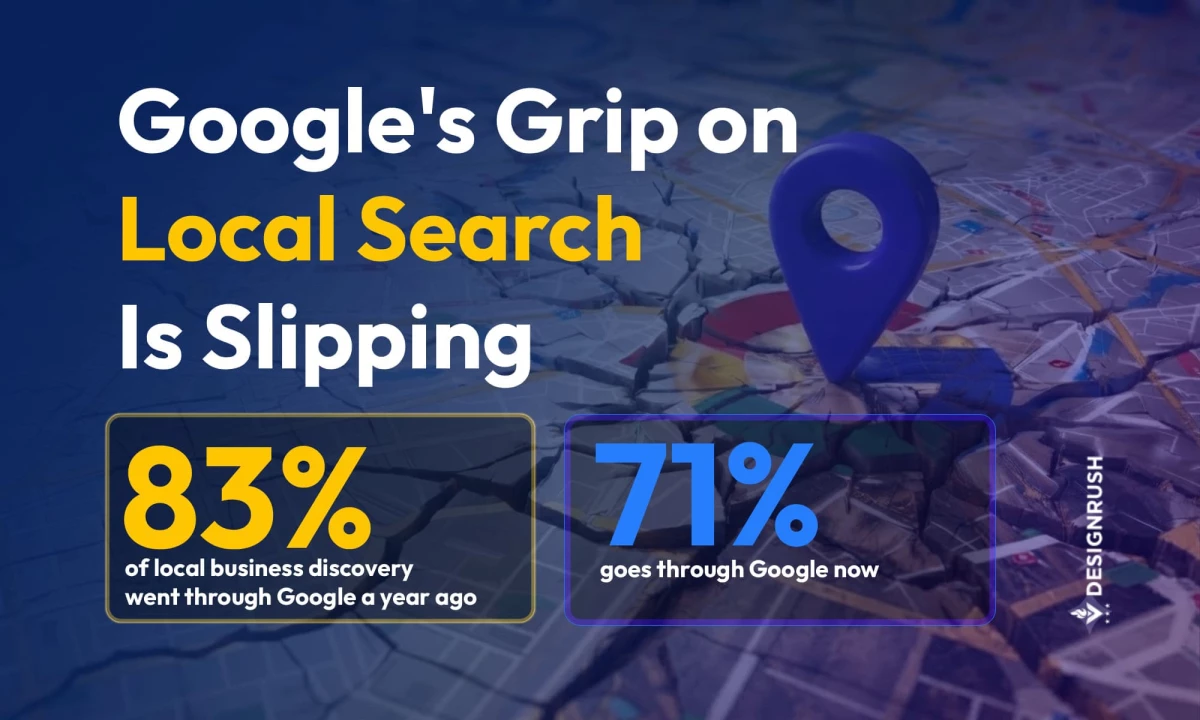

ChatGPT or other generative AI tools now account for 45% of local business discovery in the US. A year earlier, that share was 6%.
Even Google felt the shift, with its share dropping from 83% to 71% during the same period.
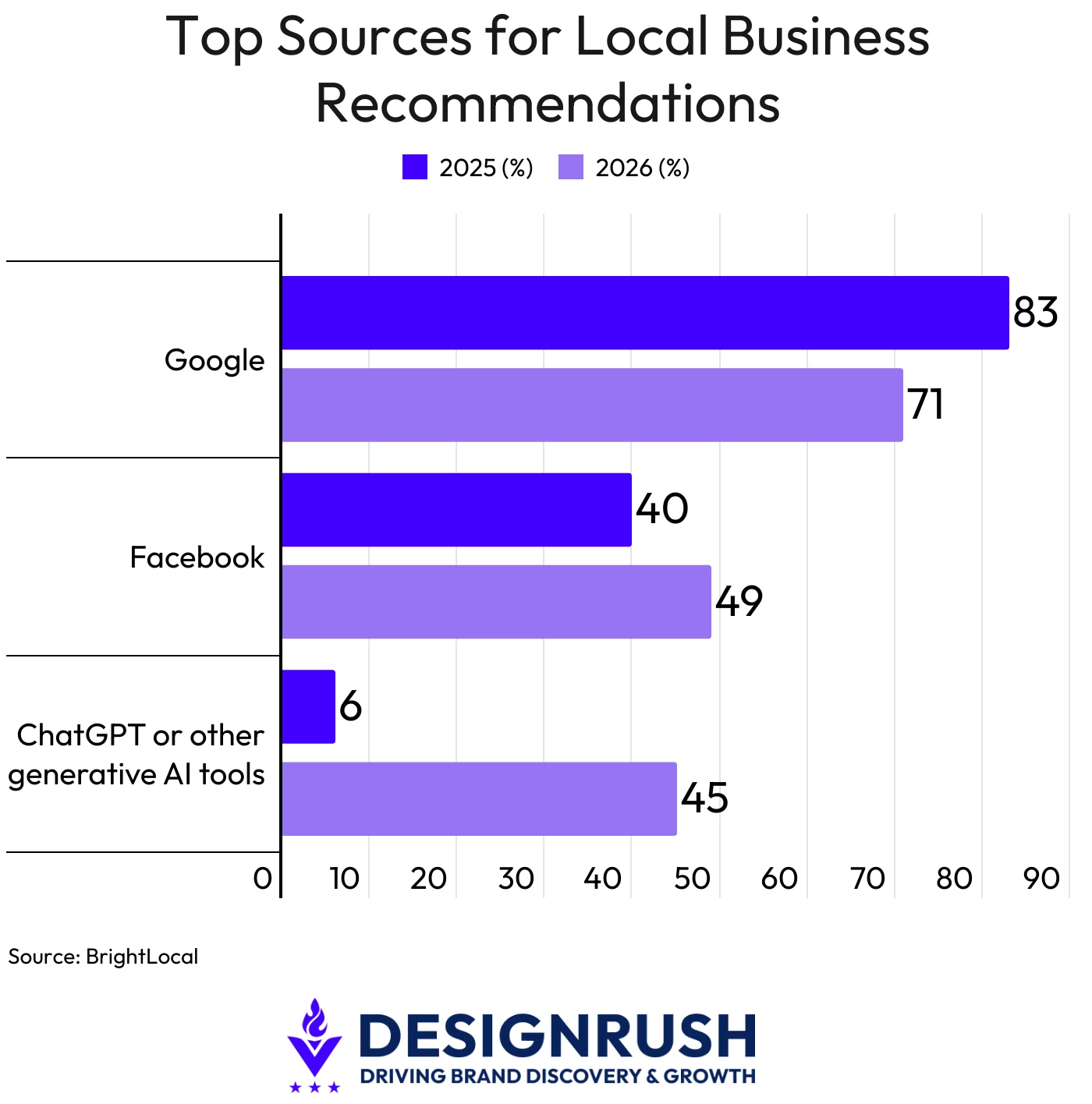 Both numbers are from BrightLocal's 2026 Local Consumer Review Survey, an annual study of how customers evaluate and select local companies based on a sample of 1,002 US adults.
That means that an increasing number of potential buyers now interact with a company through an AI-generated response rather than a search results page.
Vague Copy Now Costs More Than a Sale
A person scanning a homepage forgives a vague sentence. They can scroll, click around, and fill in the blanks themselves. An AI tool can't do that.
If hours, service area, or pricing aren't stated plainly on the page, the tool leaves the business out of its answer entirely.
That's already happening across the industry, not just for one type of business.
Agencies like Doodle N Dash are running into this shift directly, building small business sites that now have to work for human visitors and AI tools alike.
That same requirement has already reshaped how AI systems read a brand's own site to answer questions on its behalf, and local businesses are running into it at a smaller scale.
"We used to write a services page to sound persuasive first and informative second," says Sam Vivek, Head of Growth and Customer Success at Doodle N Dash.
"Now the informative part has to come first, or an AI tool has nothing solid to pull from."
For a small business, the plainest version of a services page often works better than the most polished one.
AI Rewards the Small, Specific Business
Many small business owners assume AI discovery is a big-brand problem, something that matters for national chains and not a single-location shop. It's the opposite.
A national brand's site has to serve hundreds of locations at once, which forces it toward broad, generic language.
"Small businesses have less competition here than they think," Vivek says.
"There's far less content fighting for a specific, local answer than there is fighting for a broad, national keyword."
For example, a question like "who's the best plumber in a specific neighborhood" rewards a page that names that neighborhood directly, not a homepage built for broad appeal.
So a national brand optimizes for volume. A local business only has to be the clearest answer for its own market.
Inconsistent Listings Are the First Thing AI Catches
An AI tool cross-references what's on the website against the business profile and directory listings.
A mismatch between those sources is often enough to drop a business from the answer entirely, before the content on the page is even weighed.
That's why Doodle N Dash doesn't start with technical markup when a client wants more visibility in AI answers.
The first step is checking whether the basic facts, hours, address, services, match across the website, the business profile, and every directory listing.
Only once that foundation is solid does the work move to content depth, then to structured data.
"Schema markup helps, but it can't fix missing or contradictory information underneath it," Vivek says.
"We fix the foundation first because everything after that depends on it."
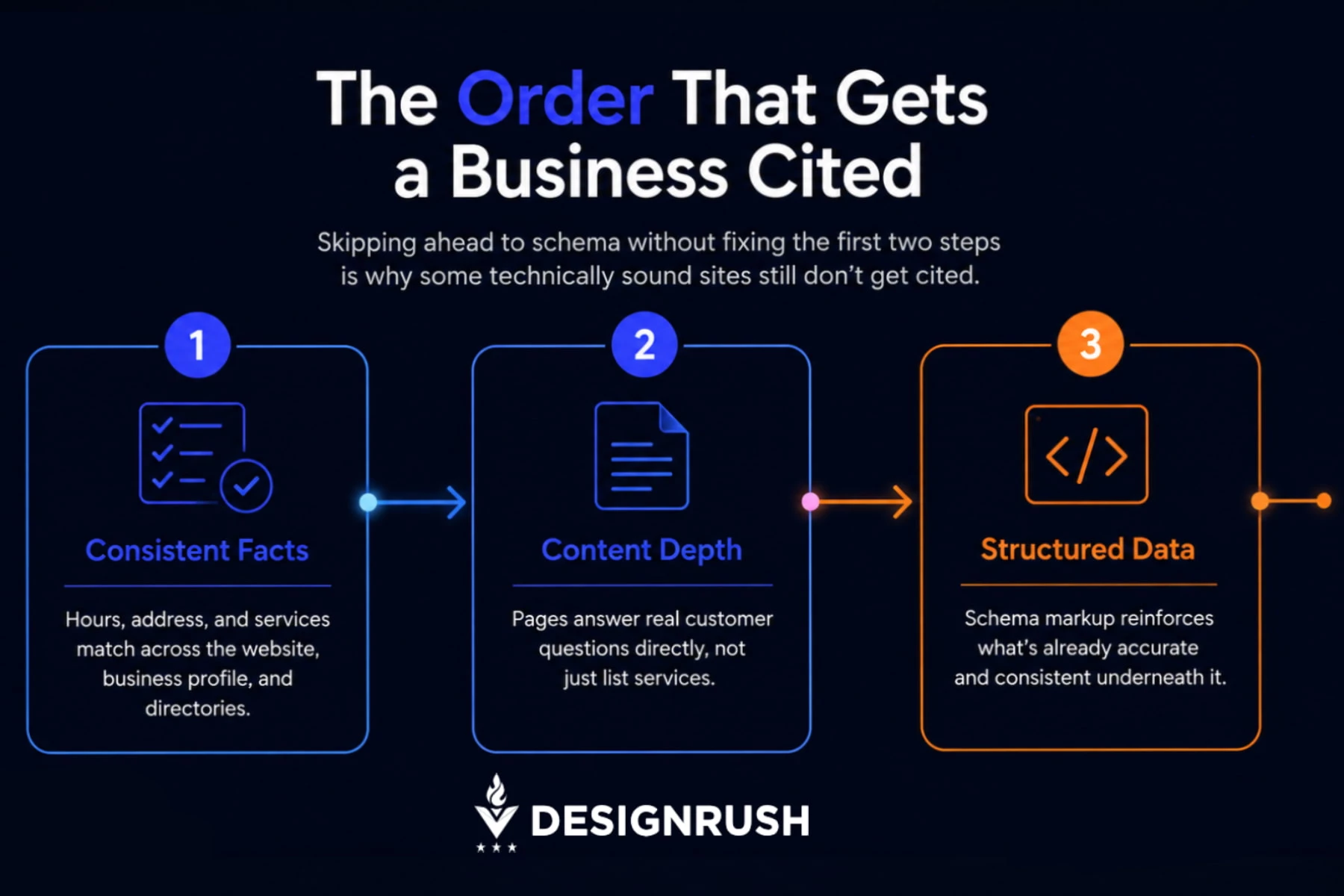
Some technically sound websites still don't appear in AI answers because they skip that phase.
Fix the Pages Closest to a Sale First
The previous fix was about order within a page: facts first, then depth, then schema. The same logic applies across an entire site, in which pages get attention first.
Concretely, start with the pages closest to a transaction. That means service pages, location pages, anything a customer would act on directly.
Broad blog content comes after that's solid.
In fact, a blog post about industry trends can build authority over time, but it rarely answers the question an AI tool is trying to resolve in the moment. A service page does.
That's why the highest-intent pages get fixed first. After all, a business with a polished blog and a thin service page still loses to a competitor with the opposite setup.
What AI Discovery Didn't Change
For all that's shifted, the fundamentals of a small business website haven't moved.
Customers still buy from businesses they trust, and reviews, real photos, and clear answers to their questions still do most of that work. AI just changes who reads the page first.
That same trust dynamic shows up in how people actually use AI recommendations.
Even among consumers who already use AI tools for local search, most still cross-check a recommendation before contacting a business, per BrightLocal.
"A fast, accurate, easy-to-navigate site was always going to convert better, AI or not," Vivek says.
"This didn't rewrite the rules. It just added a new way people find you before they ever land there."
In the end, an AI answer earns a business a shot at the contact. Everything after that still depends on trust.