
AI-Powered Business Workflows: Key Findings
- AI agents are becoming strategic infrastructure, no longer just automating tasks but managing workflows and customer conversations at scale.
- Adoption of AI agents is accelerating rapidly, with a 233% increase in daily use and strong links to productivity and job satisfaction gains.
- SMBs and agencies are gaining enterprise-level capabilities, using AI agents to maintain high-quality communication without increasing headcount.
Something subtle but significant happened to business conversations this past year. They started answering themselves.
A prospect filled out a form at 11:47 PM and received a personalized, helpful reply by morning. A missed call from a potential client became a scheduled meeting without a single follow-up email. A support request was handled instantly, with no ticket, no agent, and no delay.
For many companies, these weren't one-off moments. They were the earliest signs that something fundamental had shifted.
Communication was no longer carried solely by people. It was being powered, shaped, and scaled by intelligent AI agents.
Editor's Note: This is a sponsored article created in partnership with Newo.ai.
Intelligent AI agents are no longer backstage actors. They are part of the main feature, becoming key to everyday business conversations, while stepping in at the moments where speed, clarity, and continuity mattered most.
In doing so, they began to change how companies engaged with customers, responding in real time and scaling communication capabilities without adding complexity.
Luba Rein, co-founder of leading AI technology company Newo.ai, says that these systems are no longer limited to just automating simple tasks.
“After analyzing 22,000 agents on the Newo platform, we found that the median AI agent works 43 days, or 1.4 months, without any human intervention,” Rein says.
"They now support customer interactions, manage workflows, and assist teams across channels in ways that feel natural and timely. The result is a new communication model, one where speed, relevance, and continuity are expected by default.”
This transformation is not confined to just large enterprises.
Small and mid-sized businesses, as well as agencies, are increasingly relying on AI agents to meet rising expectations without adding operational strain.
Why AI Agent Adoption Is Accelerating
The momentum behind AI agents becomes clearer when you look at the numbers.
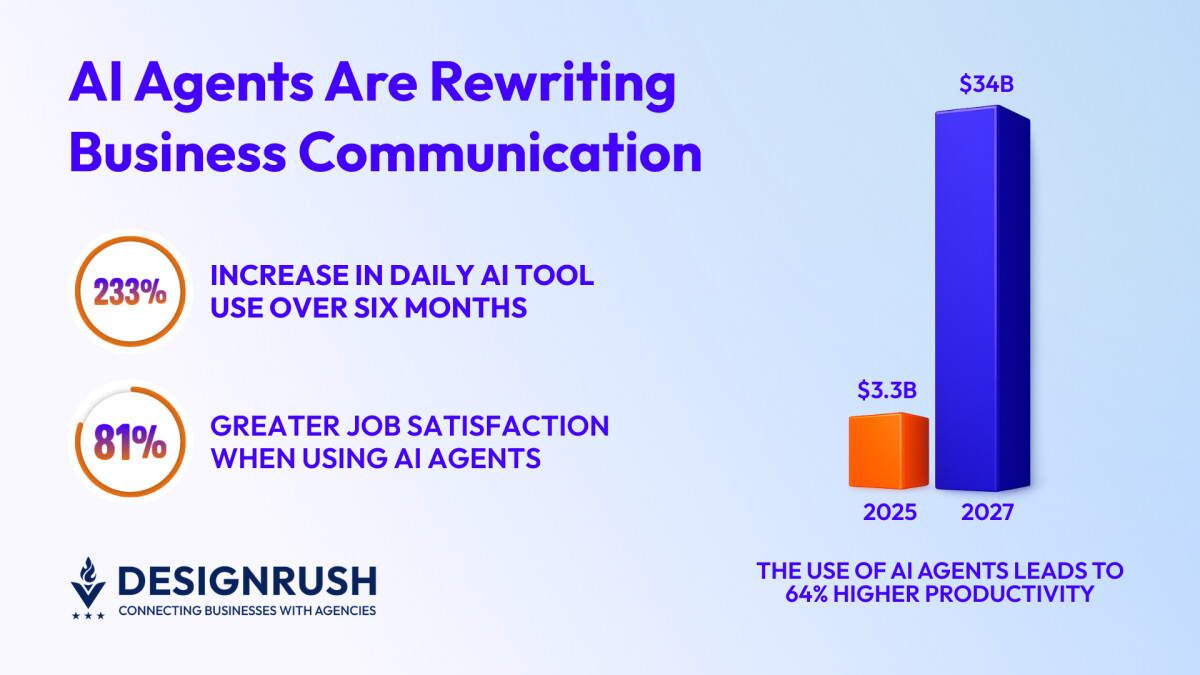
The Slack Workforce Index, cited by Demand Gen Report, reports a 233% increase in daily AI tool usage over six months. Workers who use AI every day also report 64% higher productivity.
The impact extends beyond internal workflows.
Research firm Juniper Research projects that customer interactions handled by AI agents will grow from 3.3 billion in 2025 to more than 34 billion by 2027.
Slack’s findings also show that daily AI users report 81% higher job satisfaction than colleagues who do not use AI regularly.
The report further notes that 154% of workers say they are more likely to turn to AI agents to improve task performance and creativity, rather than using them only for automation.
Taken together, the data suggests AI agents are moving from optional tools to embedded infrastructure across business communication.
“AI agents are no longer experimental tools and are becoming a foundational layer in how businesses communicate, both internally and externally,” Rein says.
The Evolution of AI Agents
Early AI adoption focused on efficiency, using tools designed to speed up isolated tasks or reduce manual effort.
That model, however, began to change in 2025 when AI agents started to manage entire workflows rather than supporting individual steps.
“This marked the transition from automation to strategy,” Rein says.
“AI agents have moved beyond just performing task automation. They are now trusted with work that used to need a human’s eye such as handling inbound inquiries, sequencing outreach, generating campaign assets, and pulling insights from live conversations.”
And rather than waiting for step-by-step instructions, these systems can now work toward defined goals and adjust based on what’s happening in real time.
That’s pushed teams to rethink their workflows.
With agents managing the execution, teams are now freed up to focus on what really moves the needle, such as strategy, messaging, and relationship building, instead of getting bogged down by repetitive communication tasks.
How AI Agents Help SMBs and Agencies Scale Communication
For small and mid-sized businesses, this shift presents a great opportunity.
While limited resources once dictated how quickly organizations could respond to leads or support customers, the integration of AI agents offers a way to maintain consistent, high-quality communication without increasing headcount.
Rein says that agencies are seeing similar benefits.
“With AI agents supporting client engagement, agencies can now deliver faster response times, richer insights, and more scalable services.
“This makes it possible to offer enterprise-level communication capabilities to smaller clients, while maintaining efficiency and margins.”
After reviewing more than 100,000 calls handled through the Newo.ai platform, Rein adds that a large share of missed calls represent potential new customers.
In the restaurant sector, about 44% of callers were first-time customers, while in dental practices, the figure was 12.7%. When these missed opportunities are translated into revenue terms, the result amounts to millions of dollars in lost business on the back of unanswered calls.
AI Agents in B2B: The New Competitive Advantage
Despite growing awareness, adoption remains uneven.
Demand Gen Report notes that only about one-third of B2B organizations have implemented agentic AI at scale.
However, those that have done so report cleaner execution, stronger alignment between marketing and sales, and more predictable performance outcomes.
This gap highlights a widening competitive divide.
“Organizations that treat AI agents as strategic infrastructure, rather than isolated tools, are building communication systems that convert interactions into insights and insights into action,” Rein says.
How AI Agents Are Shaping the Future of Business Communication
In 2026, the question isn’t whether to use AI agents; it’s how to use them well.
That shift comes with new demands: How do we design systems where AI works with people, not around them? What guardrails are needed to keep things clear, ethical, and effective?
This isn’t about replacing people. It’s about creating space for them to do what they do best.
“As AI agents become a standard part of the communication stack, the companies that thrive will be the ones that treat them not as tools, but as partners, and ones that amplify human connection and not replace it,” Rein says.