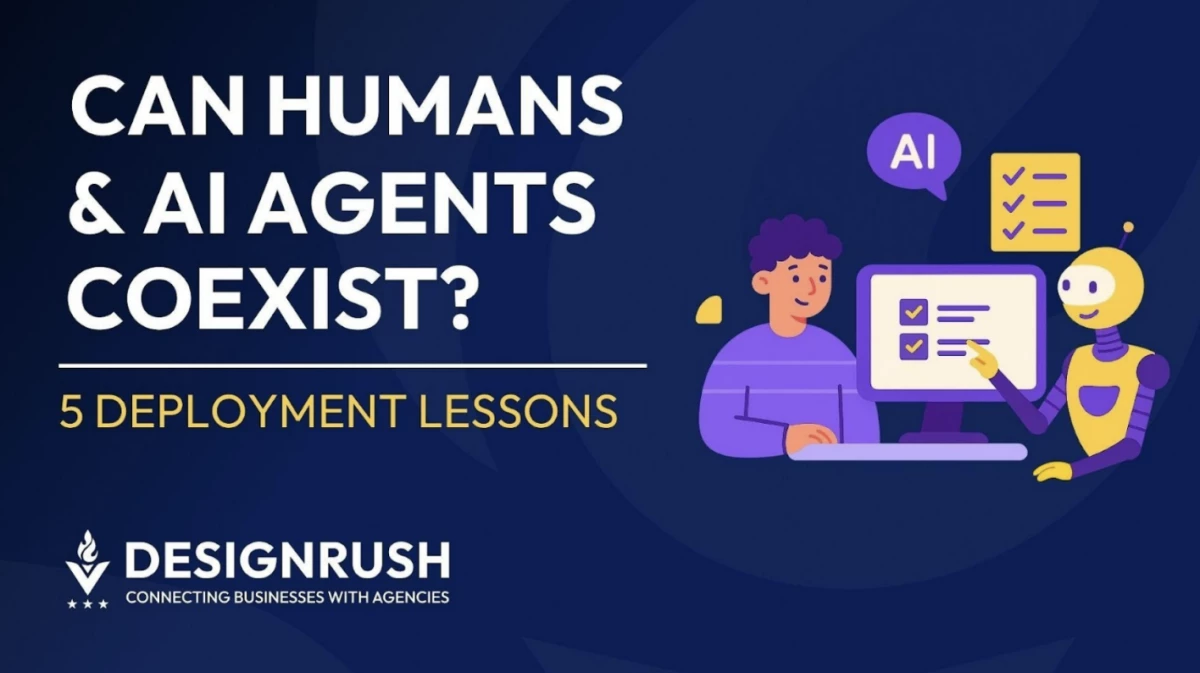

AI vs Human Agents: Key Findings
- Design AI around people, not just processes. The companies seeing real ROI treat automation as a redesign of how humans and machines work together.
- Build for accuracy, context, and adaptability. Sounding human isn’t enough; successful AI systems behave dependably and adapt to real-world complexity.
- Keep AI alive and evolving. Like employees, AI agents need ongoing training, monitoring, and updates to stay aligned with business goals.
When Salesforce CEO Marc Benioff confirmed that 4,000 support roles had been replaced by AI agents, it reignited a global debate.
What happens when technology doesn’t just assist people, but replaces them?
In an interview, Benioff explained that Salesforce’s Agentforce platform now handles about 1.5 million customer interactions each week, covering nearly half of its total support volume.
Editor's Note: This is a sponsored article created in partnership with Newo.ai.
Meanwhile, a recent OpenAI report cited by McKinsey found that 80% of U.S. workers could have at least 10% of their tasks automated by generative AI, and 20% could see half or more of their jobs impacted.
This scale of disruption raises a critical question: if automation is inevitable, how can companies design systems where humans and AI elevate each other, rather than compete?
The answer lies in how organizations approach AI adoption as a complete redesign of how work gets done.
Industry players such as Newo.ai, after reviewing hundreds of AI deployments, have surfaced five recurring lessons that consistently distinguish effective automation from costly mistakes.
1. Sounding Human Isn’t Enough. Focus on Accuracy
Many early AI systems impress in demos because they speak naturally and respond fluidly. But fluency doesn’t equal reliability.
Without context-aware safeguards, AI agents can skip critical workflow steps, misinterpret customer intent, or provide inaccurate information; small errors that quickly erode trust and revenue.
“Sounding human is easy; behaving dependably is hard,” said Lyva Ovtsinnikova, CEO and co-founder at Newo.ai. “If an AI can’t execute a workflow correctly 99% of the time, it’s not ready for customer-facing work.”
That standard is especially critical for AI Receptionists handling customer bookings or AI Sales agents managing inbound leads, a single missed call or wrong quote can mean thousands in lost revenue.
In other words, fluency may win the demo, but accuracy drives ROI.
2. Design for Real-World Complexity
Businesses often assume that if an AI agent can handle one location or process, it can handle all of them.
But scaling introduces complexity: different time zones, services, and customer expectations.
If the AI doesn’t account for these nuances, it can route calls incorrectly, create scheduling conflicts, or promise unavailable services.
Companies that succeed with automation build context-aware systems: agents that understand the rules and conditions of each operation they serve.
It’s not about teaching AI to do one job perfectly, but teaching it to adapt as reality shifts.
3. Unify AI Experiences
Too often, companies deploy separate AI tools for phone, chat, and email, creating disjointed experiences.
One agent “forgets” a prior chat, another follows a different script.
“When an AI forgets what happened five minutes ago, customers feel it instantly,” said Dr. David Yang, CPO and co-founder at Newo.ai. “Unified memory is what makes automation feel genuinely human.”
Modern customers don’t see channels; they see one brand. They expect continuity whether they start with a text, continue by phone, or finish via web chat.
Industry examples like Newo.ai emphasize unified AI memory and workflow logic, ensuring every interaction builds on the last.
That cohesion reduces frustration, speeds up issue resolution, and makes the AI feel like a single, consistent employee.
4. Empower Non-Technical Teams
AI tools that rely solely on developers to make changes quickly become bottlenecks.
In fast-moving industries, teams need to update scripts, messages, or workflows weekly, often without technical help.
When AI systems are rigid, they lag behind the business and lose value.
Forward-thinking companies are designing no-code or low-code frameworks that allow operations and marketing staff to adjust logic, test new approaches, and stay aligned with evolving goals.
Automation only works long-term if the people closest to customers can guide it.
5. Treat AI as a Living System
AI implementation isn’t a “set it and forget it” project. Like human employees, AI agents need ongoing training, monitoring, and updates.
Without structured oversight, even the best systems drift out of sync with business needs, causing inconsistent performance and outdated interactions.
The companies getting this right manage AI as part of their operational lifecycle: tracking performance, rolling out improvements, and scaling updates across locations.
Automation that evolves alongside your organization will compound in value; automation left alone will quietly degrade.
Build the Systems That Help Humans and AI Work Better Together
AI agents can improve customer experience, reduce operational costs, and recover lost revenue, but only when integrated with care.
Fluency without reliability, customization without accessibility, and automation without oversight all lead to disappointment.
Whether managing one storefront or a global enterprise, the lesson remains the same.
AI isn’t a replacement for people. It’s a reflection of how well we design systems around them.