
Building Multi-AI Agent Systems: Key Findings
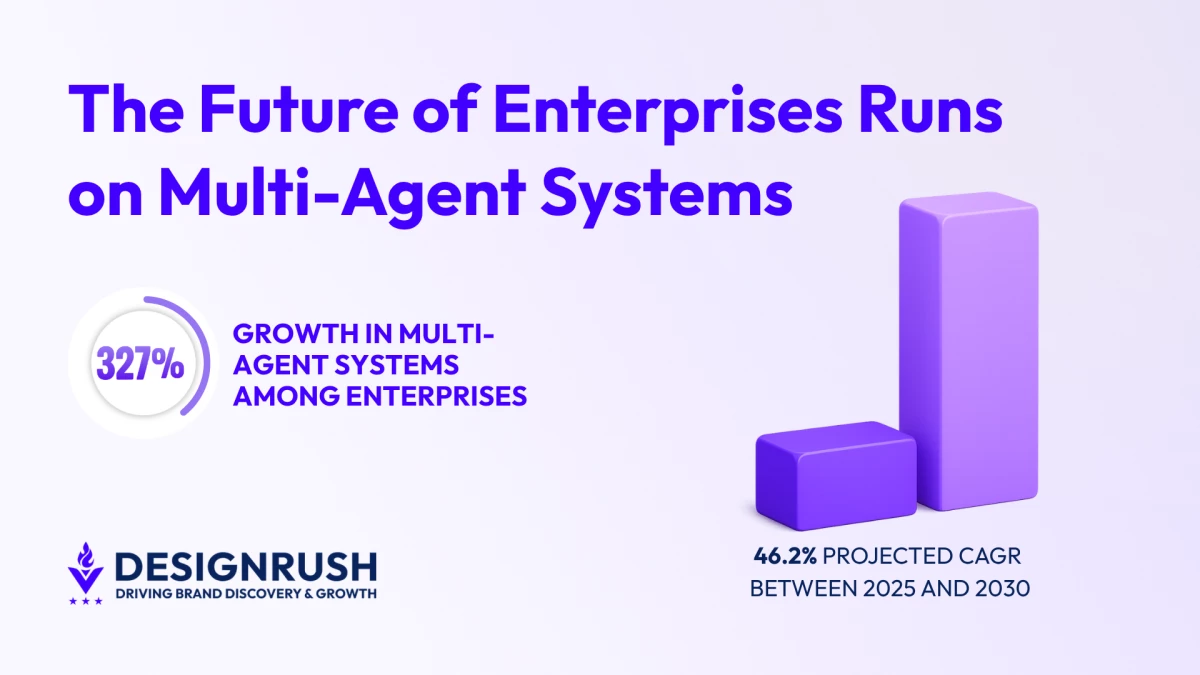
- Enterprise adoption of multi-agent systems surged 327% in less than four months in 2025, signaling rapid interest despite major implementation challenges.
- Over 40% of agentic AI projects are expected to be canceled by 2027, highlighting how difficult it is to scale multi-agent systems beyond early pilots.
- Instinctools’ GENiE framework prioritizes orchestration, context, and governance, helping enterprises build multi-agent systems that survive production.
Most enterprises building multi-agent systems (MAS) inevitably come to a dire realization: it’s nothing like deploying a chatbot.
They start with promising demos with AI agents automating complex workflows.
Somewhere between four and six months later, these systems are offline, and employees are performing manual tasks.
In fact, this scenario is so common that Gartner’s experts predict that enterprises will pull the plug on over 40% of agentic AI projects by the end of 2027.
The problem isn’t in the software itself, but in how those multiple chatbots pass information between each other.
Shifting from Single AI Assistants to Coordinated Agent Ecosystems
Single chatbots excel at quickly reassuring customers that their issue is going to be resolved shortly.
Unfortunately, they quickly lose competence when they have to check inventory and process refunds at the same time.
Multi-agent systems are built to address the bottlenecks of single AI chatbots by dividing complex workflows among specialized agents.
After all, it’s much easier for today’s AI assistant to focus on one specific task.
One manages inventory, the other only processes refunds, and a third one takes care of a frustrated customer by hyperpersonalizing responses.
And the numbers back this up. According to experts, the use of multi-agent systems in enterprise settings grew by 327% in less than four months back in 2025.
Yet expectations should always be tempered.
It always sounds good on paper, but without a fine-tuned system, these agents often create more problems than they solve.
MAS Adoption Challenges
Multi-agent systems introduce an array of problems that many enterprises don’t think about until they are already deep into them.
Complexity of multi-system operations
Enterprise workflows involve a multitude of tasks touching hundreds of different systems.
Humans can manage these complexities because we can see the picture from a bird’s eye view and have the intuition to spot a contradiction before acting.
Multiple AI agents, on the other hand, have to correctly distribute CPU cycles, sync their internal ‘clocks’, and communicate through encrypted channels while accounting for latency.
Essentially, MAS is a technical house of cards, where a delay caused by one agent can trigger unwanted logic errors in the other agent, leading to a chaotic sequence of actions that break the system.
Tools integration and orchestration
Most organizations fall into the trap of ‘modular intelligence’. It’s easy to see the value in distributing the task between different agents that take on one specific task.
This is paradoxical, but the more specialized firms make their agents, the harder it becomes to handle complex tasks, and the more specific your coordination rules have to be.
In a nutshell, most fail to put enough focus on the orchestration layer.
This involves developing rigid communication protocols to prevent agents speaking different languages.
Small formatting errors lead to feedback loops that not only fail tasks, but also burn tokens.
Scalability and efficiency
Many companies assume that if three agents perform well, three hundred will perform even better.
This idea rarely translates well into production, as the resources needed for coordinating these hundreds of agents often exceed the computing power needed for actually solving the task.
Having more agents means more competition for CPU time, memory, and API calls.
If poorly orchestrated workflows remain, the agents at the beginning of the chain will degrade the performance of those at the end.
Governance and compliance
When it comes to highly-regulated industries, such as healthcare or banking, every agent becomes a potential hacking attack target and audit point simultaneously.
Without enforced rules and oversight layers, agents lack the context to flag data privacy violations or unauthorized financial transactions, leading to ‘blackbox’ failures.
It’s paramount to implement a dedicated referee layer that checks agent actions in real time and leaves an audit trail.
From Experimental Setups to Production-Ready Systems
Most companies start their MAS journeys by building single agents for specific departments to test the waters.
A PoC gets built, stakeholders get excited, and then the system breaks in unforgiving enterprise conditions.
The issue is that high loads, sensitive data access, and context sharing weren’t part of the controlled environment in which the system was tested.
Expert-led frameworks like GENiE tackle this exact pain point.
Instead of focusing on making these agents work in a controlled environment, GENiE means figuring out architecture, orchestration, and data access as foundations that mold the whole system from the ground up.
When you determine data flow and orchestration rules before establishing a single workflow, you significantly raise the chances of the system being as reliable in demo as in production.
Implementing Enterprise Mult-Agent Systems with GENiE
GENiE was built to address the MAS-specific adoption challenges and accelerate its implementation.
Here is how its pillars translate into a system that is scalable, adaptive, and secure.
Task-adaptive hybrid architecture
LLMs are probabilistic, which is exactly what allows them to reason through user inputs and generate responses.
However, in the enterprise context, a certain degree of predictability is a necessity.
Without clear boundaries and integration of rule-based processes, a refund processing AI agent will gladly accept the reasoning of fraudulent customers.
GENiE’s task-adaptive hybrid architecture supports a mix of deterministic and probabilistic approaches, providing enough room for creative reasoning, while still bound by rigid enterprise-specific rules.
Goal-oriented context management
Context loss is one of the most common causes of failure in multi-agent systems.
If individual agents can’t reliably reference what happened before their turn to process information, output quality will degrade drastically.
GENiE tackles this issue by relying on a tiered memory architecture with hot, warm, and cold context layers, ensuring agents spend computing power only on what’s relevant to their current task.
Short-term session-specific information and long-term enterprise-wide preferences are managed in parallel, resulting in contextually aware output at all times.
Event-driven agentization
Given the sheer scale of many enterprise-grade MAS, running all agents at all times is a sure way to burn resources.
But making human employees oversee automation defeats its very purpose.
The workaround?
GENiE’s event-driven approach means agents wake up only in response to specific triggers set by the user, such as a document upload or a keyword provided by another agent.
The system can automatically handle the routing without the need for human intervention, allowing for significant cost savings.
Cross-platform integration
Enterprises have to juggle between a multitude of different systems like SaaS tools, CRMs, and legacy applications from multiple vendors.
GENiE’s OpenAPI-first design allows AI agents to connect to such ecosystems, mitigating the need for hard-coded wrappers and customer integrations.
This significantly reduces adoption time and engineering overhead while allowing enterprises to keep their unique tool stack.
Multi-agent AI orchestration
Orchestration is a breaking point where most multi-agent systems either persevere or fall apart.
GENiE’s orchestration layer is a single workspace that works across open-source frameworks and vendor-specific platforms like:
- LangChain
- crewAI
- Agno
- Azure Agent Framework
- AWS Bedrock AgentCore
This ensures that regardless of what is under the hood of individual AI agents, they operate according to a unified set of protocols.
AI governance and observability
In highly regulated industries, like finance and healthcare, blackbox agents are a liability.
Bias detection, regulatory compliance checkers, and elaborate monitoring systems are built into GENiE’s core.
Its visual tooling provides enterprises with full visibility into agent interactions and performance, not only serving as an audit trail for compliance needs but also making AI’s behavior explainable.
Build MAS That Survives Production
The gap between an outstanding demo and a system that performs as well in production is rarely a software, talent, or budget problem. Most of the time, the issue lies in the infrastructure.
MAS is not yet another tool in your tech stack, but a self-contained ecosystem that requires its own foundation with well-thought-out orchestration, context management, and data access rules.
The burden of developing these emerging systems can be significantly alleviated by choosing the right framework from the start. Getting that choice right is what separates enterprises that scale their MAS from those that rebuild it.