
The average client-agency relationship now runs about seven years, according to the Association of National Advertisers and the American Association of Advertising Agencies’ data.
That is a long run in an industry where priorities change quarterly, leadership teams rotate, and budgets tighten when results slow down.
But MarTech’s March 2026 outlook shows many agencies still lose momentum within 12 to 24 months when they can’t prove ROI consistently.
That instability often starts before a contract is even signed.
In a recent DesignRush podcast episode, DesignRush’s Marketplace Head Cathleen Vermaak said many founders still choose agencies based on price or quick comparisons instead of long-term fit, which increases the risk of churn and costly rework.
What Makes Retention Harder for Agencies
Companies are putting more pressure on existing accounts to produce growth, which changes how agencies are judged.
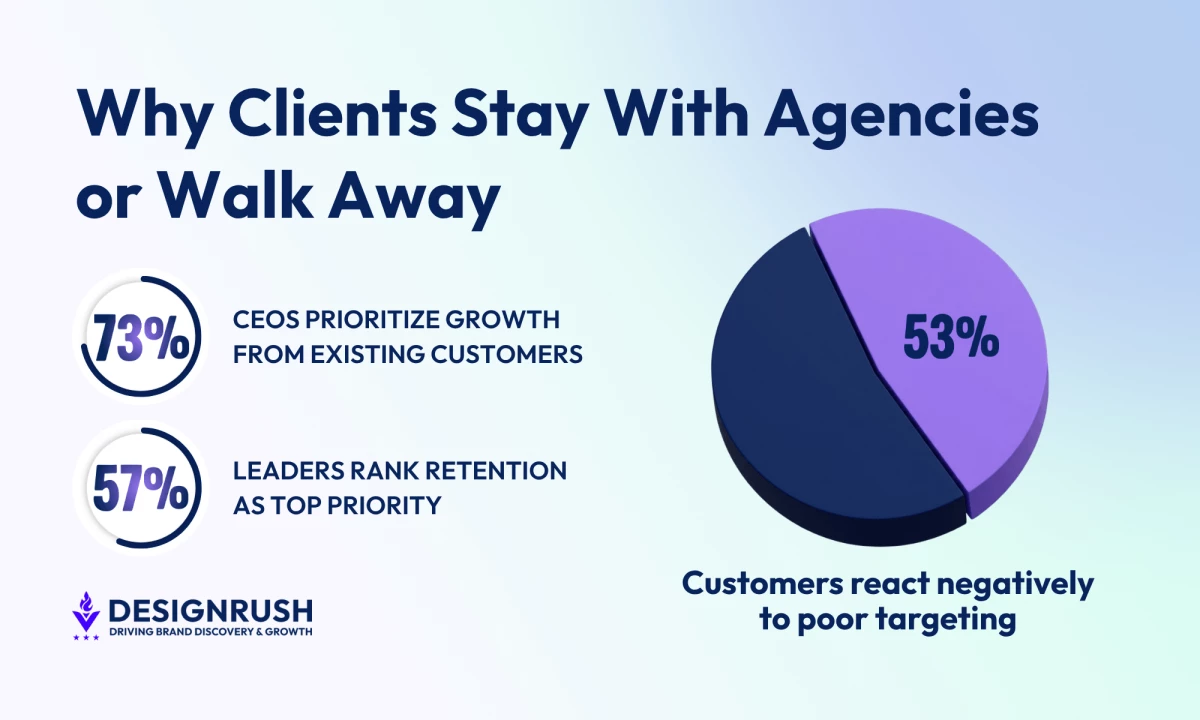
Seventy-three percent of CSOs prioritized growth from existing customers in 2025, according to Gartner.
Meanwhile, 57% placed retention and account growth among their top three priorities.
But retention becomes harder when reporting is vague, campaigns fail to improve performance, or clients can’t connect the work to results.
Poor execution also affects the client’s own customer retention.
In fact, Gartner found that poorly executed personalized marketing created negative experiences for 53% of customers, who were 44% less likely to buy again.
That kind of damage builds from poor targeting, inconsistent messaging, and campaigns that create activity without improving customer experience.
Forrester’s 2025 Global Customer Experience Index tells a similar story from another angle. A quarter of U.S. brands saw their CX rankings decline, while only 7% improved.
When customer experience declines, and clients stop seeing business impact from the work, agencies are often the first partners held responsible.
This is where firms like Lounge Lizard can speak with more authority than most.
Founded in 1998, the agency has worked with brands including Canon, ISUZU, and Honeywell across web development, digital marketing, branding, SEO, and UX.
That kind of long-term client work usually depends on how well agencies connect services that clients would otherwise manage separately.
“When SEO, paid media, content, UX, analytics, and development operate together, clients can track performance across the full customer journey instead of reviewing disconnected reports from different vendors,” says Ken Braun, co-founder and chief brandtender at Lounge Lizard.
Brands still struggle to keep content, campaigns, and customer journeys moving efficiently, increasing the demand for agencies that manage those systems together.
When one agency handles the website, content structure, paid landing pages, and reporting layer, the work rarely sits in isolation after launch.
A website build means ongoing testing, maintenance, content updates, conversion work, and channel coordination.
Over time, that raises switching costs because replacing the agency often means rebuilding workflows, reporting structures, and institutional knowledge.
Fifty-three percent of organizations still operate with a content supply chain that’s linear and resource-intensive, according to Adobe’s 2026 AI and Digital Trends report.
On the other hand, only 47% use generative or agentic AI for journey design or omnichannel activation
That operational reality explains why many systems depend on continuous agency support rather than fixed deliverables.
“Clients notice the impact when replacement means disruption, delays, and added risk. That’s when retention metrics start getting closer attention,” adds Braun.
“If the agency relationship ends at launch, the client inherits a tool that slowly goes stale. If the relationship continues, the platform keeps adapting to new priorities.”
Accenture’s 2025 Global Banking Consumer Study shows banks with the highest customer advocacy scores achieved 1.7x faster revenue growth, rising to 2.6x in North America.
Those customers also held, on average, 17% more products with their primary bank.
Higher engagement levels consistently translate into more expansion across existing accounts.
Agencies that stay embedded in client systems retain more scope over time as they sit inside ongoing decisions across channels and workflows.
How Agencies Keep Accounts Over Time
For founders and CMOs, agency decisions come down to whether performance is clear enough to justify continued spend.
That means asking a sharper set of questions before signing a retainer:
- Can the agency connect strategy, execution, and reporting without making the client stitch everything together?
- Can it keep performance visible across channels?
- Can it evolve the platform after launch instead of treating the build as the finish line?
“If the answer is no, the account drifts toward churn, regardless of how polished the pitch looked in the first meeting,” says Braun.
Websites, search performance, and consumer behavior rarely stay fixed for long.
Founders also make poor agency matches when decisions are based on price, speed, or surface-level comparisons instead of communication style, workflow fit, and long-term execution.
Redesign cycles have become shorter as brands respond to shifts in analytics, mobile usage, and conversion performance.
At the same time, omnichannel marketing relies on tighter reporting, content coordination, and ongoing optimization across platforms.
“Agencies that manage those systems together tend to stay involved longer because the work continues after launch,” Braun adds.
“That means fewer disconnected deliverables, tighter measurement, cleaner handoffs, and work that keeps performing after the first deck is gone.”
New-business wins still matter, but they don’t offset accounts that underperform over time.