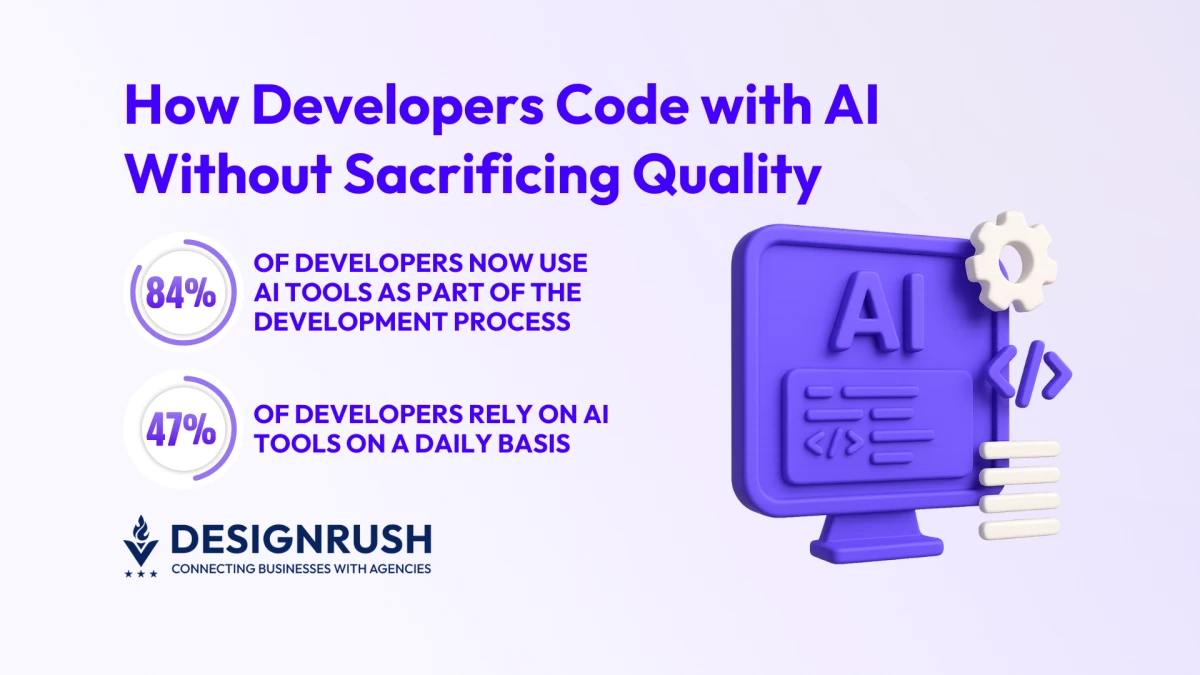

Integrating AI Coding Tools: Key Findings
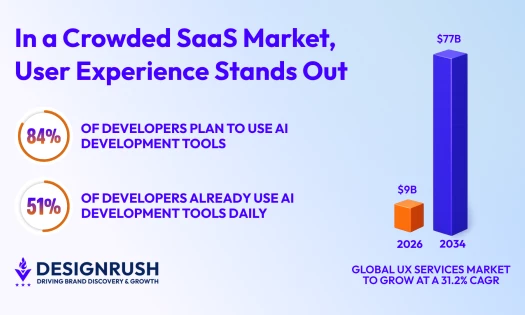
- 84% of developers now use AI tools to code, increasing the pressure on teams to balance speed and precision.
- 47.1% of developers rely on AI daily, yet overuse can erode problem-solving skills and introduce quality and security risks.
- Teams must pair AI acceleration with human code reviews and audits to achieve stronger, more compliant software performance over time.
It’s no exaggeration to say that AI has become embedded in almost every industry, to the point that it’s not surprising to learn just how many professionals use it.
Even in the world of coding, AI tools like GitHub Copilot and ChatGPT have become invaluable tools for developers.
This truth can easily be seen in the latest Stack Overflow Developer Survey, which revealed that 84% of surveyed developers either already use or plan to use AI tools to assist with development, compared to just 76% of developers in 2024.
Furthermore, 47.1% of respondents claim that they rely on AI tools on a daily basis.
This shift has changed the rhythm of the development cycle, whether it’s mobile app development, chatbot development, or SaaS development, leading to several benefits:
- Prototypes appear in a matter of days instead of weeks.
- Early bugs are caught before they ever make it into testing environments.
- Complex solutions are now more accessible, especially for non-technical founders.
However, this scenario has also led to more tension.
Due to the speed afforded by AI coding, engineering teams are under pressure to ship faster than ever before, all without sacrificing quality, compliance, or creative integrity.
For experts like Suffescom Solutions, an award-winning mobile app, AI, and Web3 development company, the challenge wasn’t getting engineers to start coding with AI, it was about how to maintain discipline while doing so:
“AI-assisted development has completely redefined what speed means in software, but true engineering maturity lies in restraint,” said Gurpreet Singh Walia, CEO of Suffescom Solutions.
“It’s about knowing when to let AI accelerate the process and when to slow down for quality assurance, merging precision with velocity without losing accountability.”
The Hidden Tradeoffs of AI Coding
The surge in AI-assisted software development has raised the bar for coders and engineering teams in terms of speed.
However, that same speed can also be turned into a disadvantage when AI tools are implemented incorrectly.
After all, a development cycle that runs ten times faster is only an asset if it doesn’t rack up technical debt and other errors at the same rate.
In many cases, teams tend to encounter three major issues:
- Quality degradation over time: Over-reliance on AI leads to code that functions in the moment, but becomes more brittle with each iteration, leading to constant reworks and debugging.
- Security exposure: Some AI tools unknowingly replicate open-source snippets with hidden flaws or licensing issues, which can create nightmare scenarios for clients in highly regulated industries.
- Erosion of problem-solving skills: The more developers depend on machine suggestions, the less they practice the problem-solving skills that drive innovation. Teams begin to optimize for completion speed instead of innovation.
To extract real value from AI coding, teams must start treating these tools as apprentices/assistants, not as primary architects.
Suffescom’s Playbook for Smart AI Adoption
For experienced developers like Suffescom Solutions, AI adoption doesn't mean surrendering the entire process to automation.
On the contrary, it’s about creating a structured system of collaboration between experienced developers and machine precision.
To do this, teams must:
- Integrate the right guardrails: AI coding works best when guardrails like structured human code reviews, automated scans, and QA that value root-cause fixes over surface-level patches.
- Prioritize explainable code: Engineers must be able to articulate the idea behind each line of code AI writes. If no one can explain the logic, then no one can secure or improve it.
- Fortify data pipelines: Enterprise code demands enterprise privacy. The data used to inform AI must meet standards that satisfy governance, security, and industry compliance.
- Balance efficiency with imagination: Creative sprints and AI-assisted brainstorming help developers retain their problem-solving instincts, preventing oversights due to “auto-piloting.”
- Audit performance and output regularly: AI tools should be monitored and reviewed just like any other member of the development team. These regular audits allow teams to calibrate the AI tool, ensuring it works as intended.
Protect What Makes Better Software
AI coding tools may be the baseline of modern development, but human oversight and experience will always be the multipliers that turn functioning code into resilient systems.
Teams that embrace that balance will outlast the trend and outbuild the competition.
Because when it comes to coding, progress isn’t about writing more lines. It’s about knowing which lines to keep.