
Custom Software: Key Findings
- Over 68% of financial firms are investing in custom fintech to improve compliance, security, and portfolio-wide control.
- Custom tools give PE firms real-time visibility and standardized reporting across multiple portfolio companies.
- Starting small with targeted custom software turns day-to-day systems into scalable engines of operational value.
Two industry trends are reshaping how private equity (PE) thinks about software.
Over 68% of financial firms plan to invest in custom fintech solutions within the next 12 months, according to a 2024 Deloitte report cited in Medium.
At the same time, security has also become a portfolio-wide concern.
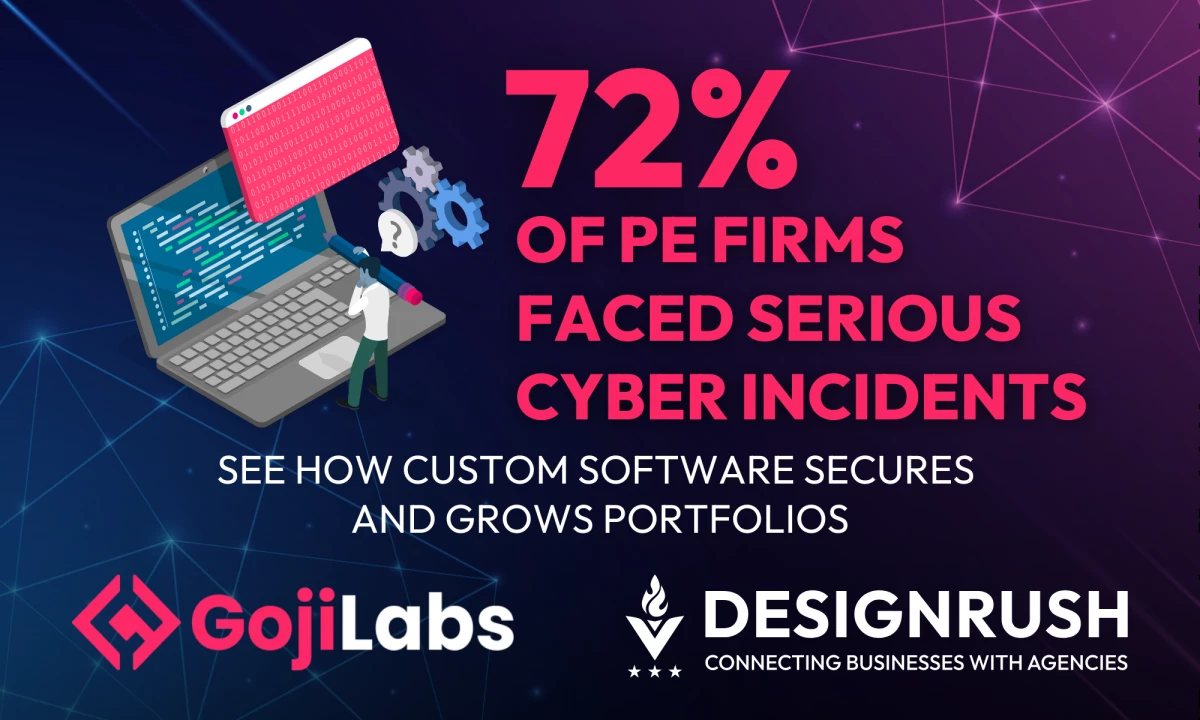
72% of private equity firms suffered a serious portfolio cyber incident in the last three years, and the average major incident cost roughly $3.4 million, per S-RM’s 2025 research.
Those two trends are changing deal checklists: teams now want consistent reporting, tighter oversight, and software that can be tailored to each holding.
The industry shift toward custom solutions comes down to three drivers:
- Compliance complexity: Europe’s Third Payment Services Directive talks and tougher Know Your Customer (KYC) and Anti-Money Laundering (AML) requirements create frequent, jurisdiction-specific work that generic platforms struggle to absorb.
- Cyber risk and cost: Serious incidents are common and expensive, which puts security at the top of the deal and post-deal checklists.
- Portfolio control: Custom apps let PE firms standardize reporting, integrate niche systems, and enforce governance across companies.
That’s why digital product agency Goji Labs recommends custom web apps to standardize reporting, enforce governance, and reduce operational risk across multiple portfolio companies.
Editor's Note: This is a sponsored article created in partnership with Goji Labs.
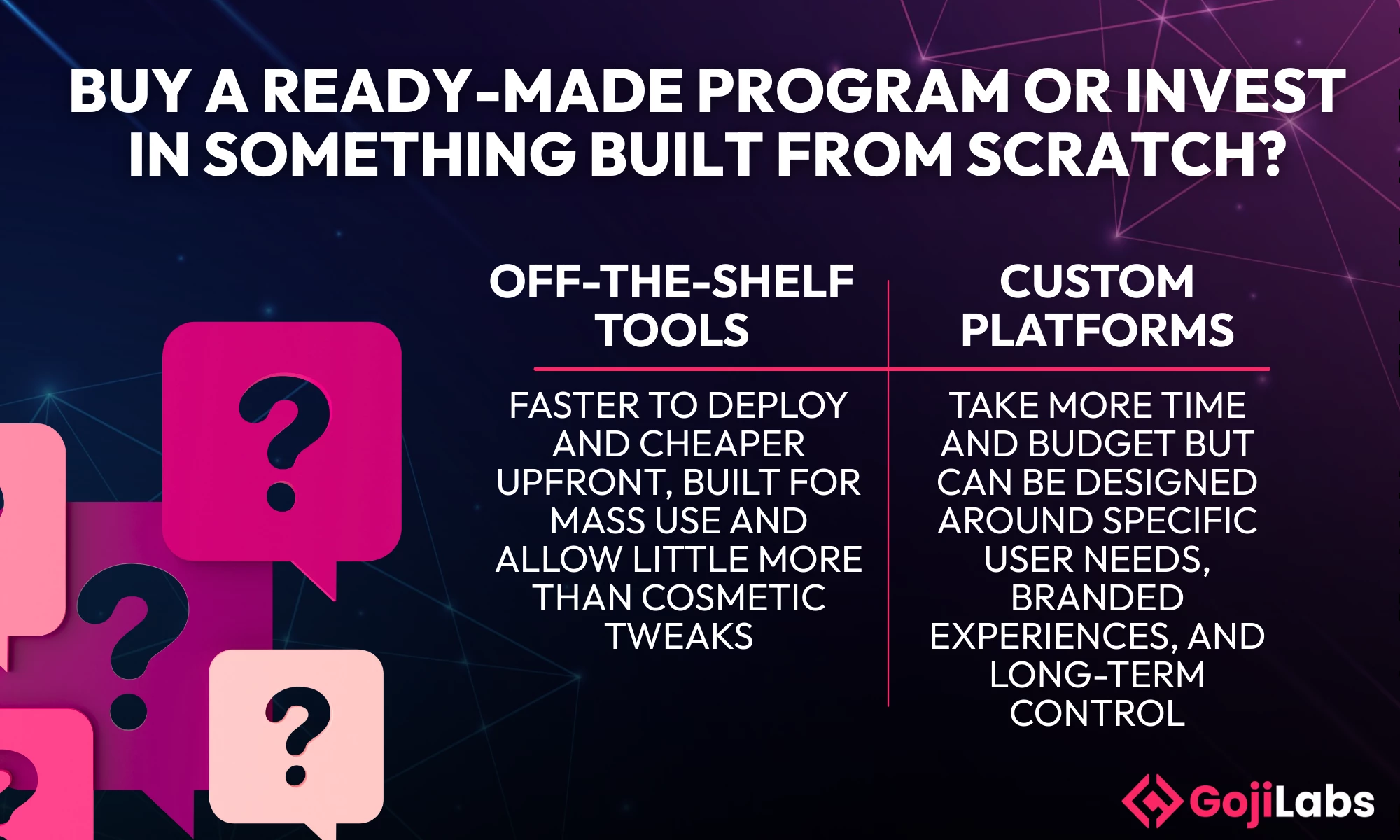
Off-the-shelf tools are faster and cheaper but limited in customization. Custom platforms take more time and budget but allow tailored features, branding, and long-term control.
The shift toward custom web app development isn’t unique to private equity.
Goji Labs notes that edtech has been wrestling with the same question for years: whether to buy a ready-made program or invest in something built from scratch.
This is the biggest difference between the two:
- Off-the-shelf tools are faster to deploy and cheaper upfront, but they’re built for mass use and allow little more than cosmetic tweaks.
- Custom platforms take more time and budget but can be designed around specific user needs, branded experiences, and long-term control.
Each route comes with trade-offs, which makes the decision less about features and more about priorities.
Goji Labs has seen the off-the-shelf versus custom debate play out in many sectors.
For private equity, the stakes are higher because it’s about scaling gains across a portfolio.
That is where custom software stops being optional and becomes a lever for performance.
Top Growth Levers for PE-Backed Companies to Unlock Value
Custom tools help teams run better and get more out of each company in the portfolio. Based on Goji Labs’ experience, the top ways PE-backed companies can benefit include:
- Streamlined Operations: Automate repetitive tasks and integrate workflows to free teams for higher-value work.
- Real-Time Visibility: Access consistent, portfolio-wide data to make faster, more informed decisions.
- Scalable Processes: Build systems that grow with the business without requiring proportional increases in headcount.
- Portfolio-Wide Consistency: Deploy tools across multiple companies to standardize reporting, governance, and compliance.
- Tailored User Experience: Design tools that reflect specific business needs and branding, improving adoption and efficiency.
These levers turn software from a support function into a value-multiplying tool, helping firms scale operational improvements across all portfolio companies.
Why Custom Software Design Creates Leverage
However, custom software does not always mean building massive systems from scratch.
It often means creating lightweight internal tools targeted at specific bottlenecks. This approach creates leverage in four areas:
- Efficiency: Teams can remove repetitive, manual tasks by automating workflows.
- Visibility: Companies gain real-time access to data across departments or even across multiple portfolio companies.
- Scalability: Firms can handle higher volumes without needing a proportional increase in headcount.
- Integration: Tools designed to unify systems and teams post-acquisition simplify operations instead of complicating them.
In short, teams work through systems rather than around them, reducing effort and improving results.
“This means that a pricing engine, demand dashboard, or integration tool developed for one company can often be deployed across others with similar needs,” said David Barlev, CEO and co-founder of Goji Labs.
“It also allows teams to track performance consistently, spot trends faster, and make better-informed decisions across the portfolio.”
This spreads development costs, standardizes reporting, and delivers faster insights for decision-making.
And more importantly, it establishes a foundation for scaling operational improvements rather than starting from scratch at each company.
Starting Smart: When and How to Build
When do you decide it’s worth building a custom tool instead of patching existing systems?
When critical workflows rely on spreadsheets or disconnected systems, existing tools require constant workarounds, or overlapping systems from acquisitions slow integration.
The smartest approach is to start small.
Focus on a single high-impact problem, build a lightweight tool, test it, and iterate.
This method delivers value quickly without overcomplicating the system.
Work with design ops teams who understand both operations and development to ensure the solution addresses problems from day one.
Custom software is not about building for the sake of it.
For PE firms, it turns day-to-day systems into engines of performance.
When designed thoughtfully, these tools reduce friction, improve visibility, and create scalable systems that multiply value across the portfolio.
Start with the everyday bottlenecks, and the software will follow, turning small wins into lasting operational advantage.
Remember: bespoke platforms are a lever, not a luxury, for operational and strategic gains.