
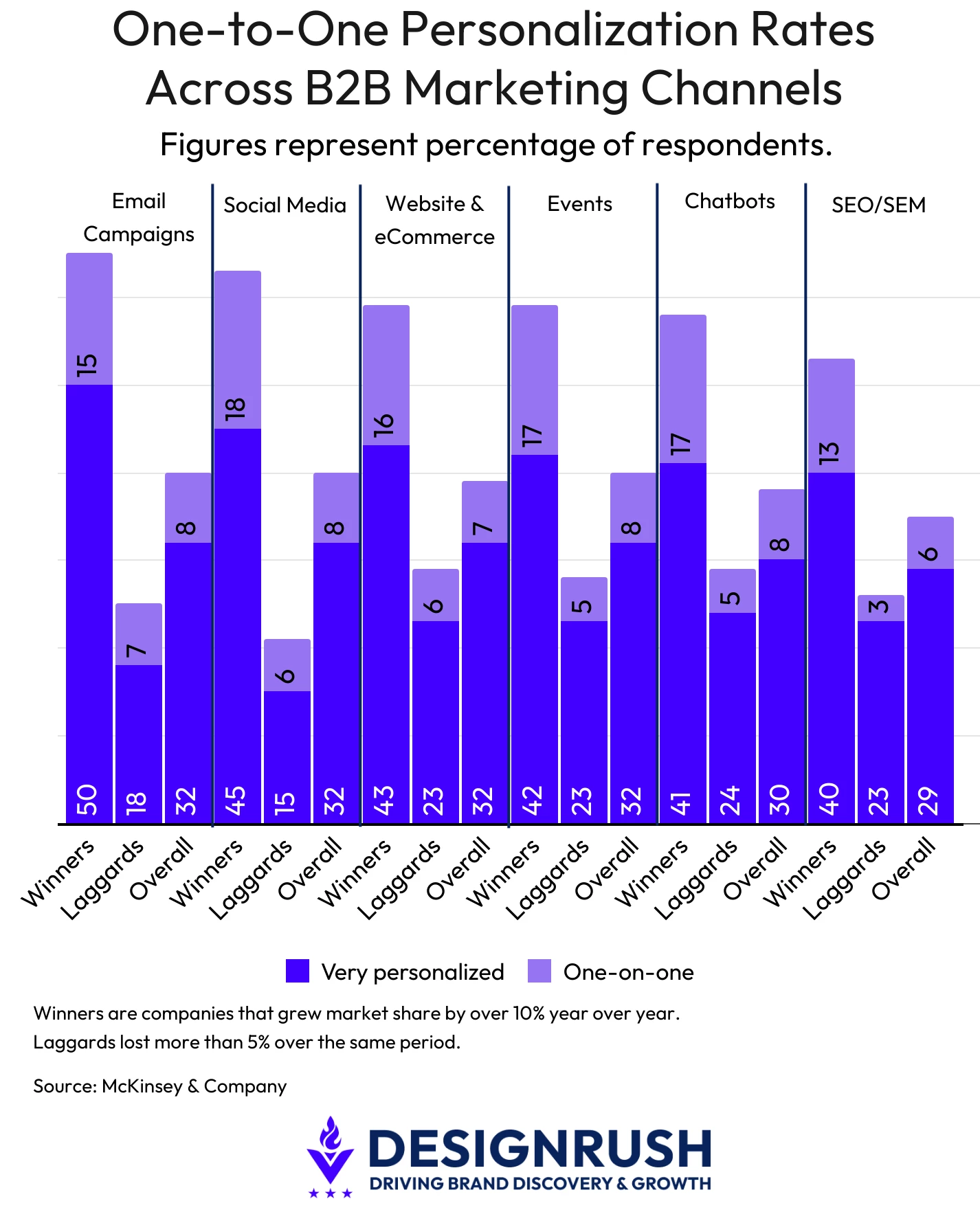
More than 90% of B2B organizations report personalizing content across email, websites, and social media.
Among market leaders, only 20% deploy true one-to-one personalization, compared to 5% of their peers.
That comes from McKinsey's 2026 Global B2B Pulse Survey, drawing on nearly 4,000 decision-makers across 13 countries.
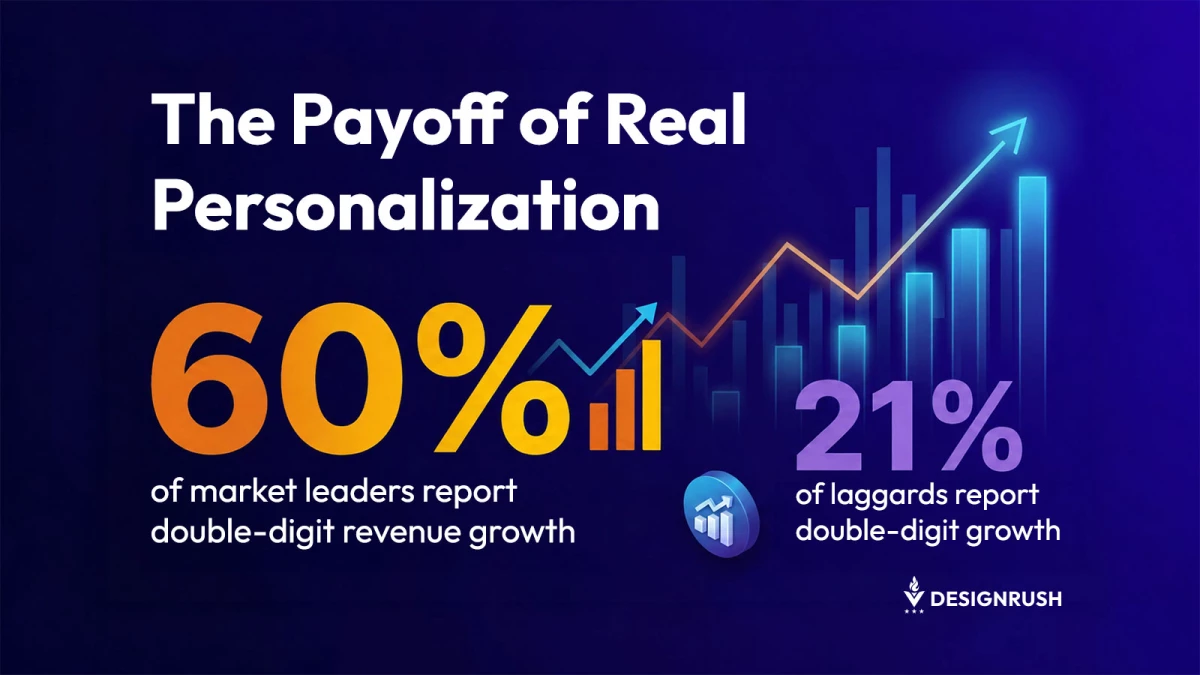
Those same leaders report double-digit revenue growth at nearly three times the rate of laggards, 60% versus 21%.
The two patterns travel together, which is why the distance between claiming personalization and executing it is as much a website architecture problem as a strategy one.
Personalization Has a New Baseline
The average B2B buyer now uses ten channels across the purchasing journey and expects to move among them without friction, per McKinsey.
Buyers expect that movement to feel personal.
In fact, nearly 80% say personalized communication makes a brand feel like it cares, yet only about a quarter of marketing leaders prioritize the practices that deliver it, per IDC.
That space between expectation and delivery has a cost. Inconsistent information across teams is now the top reason B2B buyers switch suppliers, with 52% citing it as a trigger, per McKinsey.
The website is where that consistency either holds or breaks.
Paul J. Scott, Founder and Chief B2B Website Strategist at GoingClear, an award-winning B2B web design agency, traces the problem to how the sites are built.
"Most B2B websites are built around what a company sells, not around what a buyer needs to understand at each stage of their decision," he says.
“That is a fundamental mismatch between how the site was designed and how buyers evaluate vendors.”
Cosmetic Changes Leave the Page Generic
B2B companies don’t ignore personalization, but most of them confuse it with segmentation.
Swapping a homepage headline by industry, or showing different content to returning visitors, is not what McKinsey measured.
True one-to-one personalization means the site responds to account context, buying stage, and behavioral signals in real time.
The global management consulting firm frames the same distinction.
Market leaders pull ahead through individualized engagement that reflects account context, buying history, and next-best-action insights, rather than classic needs-based segmentation.
"What we see most often is companies personalizing the cosmetic layer, changing an image or a headline. The underlying architecture still serves every visitor the same page in the same order," Scott adds.
"The conversion sequence, the information hierarchy, the calls to action, none of it reflects where the buyer is in their journey."
In fact, buyers rank their shortlist before they ever contact a seller, and the vendor ranked first wins nearly 80% of the time, per 6sense's 2025 Buyer Experience Report.
By then, the website has already done most of the selling, which means a generic page loses the deal before anyone picks up the phone.
Architecture Determines Whether Personalization Converts
Personalization that converts starts by building the structure around the buyer, then filling it with content. That means the buyer journey gets mapped before any design work.
Spin up a site fast from a prompt or a template, and you get a page that looks finished and still loses the buyer who could not find what they came for.
Concretely, the site that answers a buyer's questions in the order they ask them makes the shortlist, and the generic one does not.
Buyers settle that shortlist before they ever make contact.
"When we map the journey first, we are really answering one question for the buyer at every step. Am I in the right place? Get that wrong on the homepage and they are gone," Scott says.
For most companies the hard part is reading what a buyer needs to see first, what they compare next, and what makes them hesitate before choosing a vendor.
GoingClear's trademarked G3 framework works on that problem by mapping the buyer journey first, then building the site to carry a visitor from discovery to a decision.
Quick link to learn more about G³ Framework:https://t.co/e1b0QGzwHy
— GoingClear | Digital Agency (@goingclear) October 2, 2025
How to Build a B2B Website Around the Buyer Journey
The buyer's order is knowable. Recovering it takes a short stretch of research and an honest look at the site you already have.
Interview Your Last Five Customers
Recent buyers remember what they needed to figure out, and in what order, before they ever reached out.
Ask your last five customers which questions they had at each stage and where your site left them guessing.
Their answers reflect the real buyer journey, drawn from outside the company rather than from within.
List the Questions in Buyer Order
Buyers move from defining their problem to identifying who solves it, to confirming whether you fit.
Write the actual questions under each stage. That ordered list becomes the structure your site should follow, one question resolved before the next begins.
Audit the Site Stage by Stage
Open the site and answer each question using only what is on the page, in the order a buyer reaches it.
Mark every answer that is missing, buried, or several clicks deep. Each one is a point where a buyer loses confidence, and a competitor gains ground.
Measure Where You Rank Before Contact
Traffic tells you people arrived. Whether the site moved them toward choosing you is a different question.
Ask new customers where you ranked before they made contact, and whether the site raised or lowered that standing.
That answer measures what the page did for the decision.
Build for the Buyer Who Already Decided
The companies winning B2B deals today understand one thing about their website.
A buyer rarely arrives to be convinced. They arrive to confirm a judgment they have already started forming, and they read each page to see whether it holds.
That changes what a high-performing site looks like.
It answers the question they carry at each stage, in the order they carry it, so the visit reinforces their lean toward you instead of giving them a reason to look elsewhere.
The good news is that this is within reach for any company.
The advantage comes from knowing your buyer well enough to map what they need at each step, which is a research problem more than a spending one.
A company that learns how its buyers decide can shape each page around the question it raises.
Miss it, and they quietly rank someone else higher, with no form, no bounce alert, no metric to tell you it happened.