
A potential customer may first encounter a company through search, an event, a referral, or a piece of content before contacting sales.
The decision often happens on the service page, where someone checks the offer, looks for proof, and works out whether a conversation is worth the time.
When that page is outdated or unclear, the money spent attracting visitors can end without an inquiry.
That cost rarely appears in a report, as the visitor leaves before filling in the form.
The colleague who supported the purchase cannot secure approval, and AI recommends another provider whose published information answers their questions.
Adobe surveyed more than 1,500 senior B2B leaders for its 2026 customer experience research.
It found that business buyers take around 14 interactions before making a decision, including websites, reviews, demos, internal conversations, and live meetings.
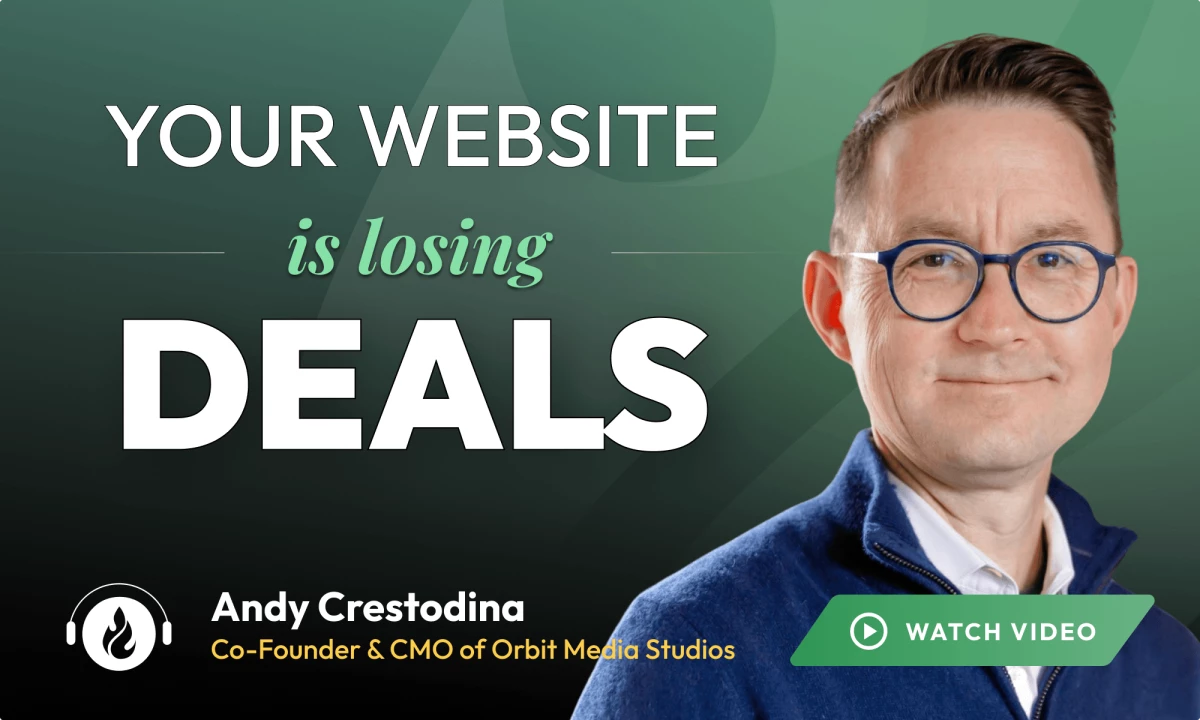
In the latest episode of the DesignRush Podcast, I asked Andy Crestodina, Co-Founder and CMO of Orbit Media Studios, where sales inquiries are lost and what CMOs should fix first.
“The shortest, fastest path is not through content marketing. It’s to fix your sales pages. It’s to fix those money pages, the products and service pages,” Crestodina tells DesignRush.
In Episode 146 of the DesignRush Podcast, Crestodina lays out what service pages need to answer and how published proof affects AI recommendations.
He also gives CMOs a clear order of work for reviewing contact forms, sales calls, case studies, and company information.
Watch the full episode now on YouTube or listen on Spotify.

Who is Andy Crestodina?
Andy Crestodina is Co-Founder and CMO of Orbit Media Studios, a Chicago web design and digital marketing company that helps organizations build websites that support sales and customer acquisition. Over 25 years in the field, he has published 600+ articles, built a newsletter of 250,000+ subscribers, and authored “Content Chemistry,” now in its seventh edition with updated AI guidance.
1. Fix the Contact Path First
Once a visitor reaches the service page, whether they become a lead depends entirely on what happens next.
Crestodina works backwards through the process.
He starts with the contact form, then reviews the buttons that lead to it, the service page, and the homepage. One broken field or unclear step can stop the inquiry.
“If there’s a problem on your contact form, nothing else matters. You gotta fix that,” Crestodina says.
DesignRush’s guide to conversion rate optimization explains how forms, page copy, and calls to action affect contact rates.
“People panic if they don’t have a blog post this week, but they leave their sales pages live unedited for years. That is insanity,” Crestodina adds.
Left untouched, a service page can fall behind the business.
New services remain unseen, recent proof becomes difficult to find, delivery details stay unclear, and questions raised during sales calls never make it onto the page.
2. Give Each Marketing Activity a Clear Role
The first interaction with a company may happen long before anyone is ready to contact sales.
A potential lead reads an article, a recommendation comes up in a meeting, or a colleague mentions the company’s work.
Brand marketing keeps the name familiar during that time.
Performance marketing records when interest becomes action through a completed form, booked call, or proposal request.
“Why do I need a quarter million subscribers from all over the world? Like I don’t.
It’s just brand marketing and it’s lovely and I’m happy to help,” Crestodina says.
No one can act on that familiarity without a clear service page and a working contact form.
3. Publish Proof Teams Can Use
Once a provider is under serious consideration, the person recommending it needs evidence that colleagues can review during approval.
Original research supports the discussion with data, while thought leadership shows how the company understands the problem.
“Thought leadership is counter-narratives. It stands out because the person is expressing a strong point of view,” Crestodina says.
A case study does both jobs at once. It names the client, the problem, the work, and the result.
“Case studies are really the easiest way to do that. It trains the AI and it gives your visitor something that they can bring to the rest of the people on the buying committee,” he adds.
The same evidence helps AI tools understand which clients the company serves, what it delivers, and which results it can support.
4. Help AI Recommend the Company
Before contacting a provider, a potential customer may ask an AI tool to compare available options.
The response depends on what the system can find about each one, including its services, the problems it solves, and the results it can document.
“Did you inject into AI’s training data all the things, all the answers to all the sales questions, all the proof points, all the success stories, all the objection handling into the places that AI is training about your brand?” Crestodina asks.
DesignRush’s guide to answer engine optimization explains how direct answers, credible information, and clear page structure help AI systems use published content.
A company's own website supplies part of that record.
Crestodina also reviews directories, review sites, industry lists, and certification platforms to identify which sources appear in AI responses for the category.
“Any one size fits all recommendation in AI, which is a hyper personalized channel, is probably way off. Don’t use best practices. Do research,” he says.
5. What CMOs should check first
The review starts where an inquiry can disappear.
Follow the route from the service page to the contact form, then compare what a company publishes with the questions its sales teams hear and the sources AI tools cite.
Focus on three areas:
- Contact forms and page steps that make it easy to reach sales
- Sales questions and concerns still absent from service pages
- Case studies, reviews, and outside sources that document the company’s work
Most of the material may already sit in sales-call transcripts, form submissions, customer interviews, reviews, and completed project records.
“Stay obsessed with your buyer, focus on those key pages, understand why they do and don’t make decisions, update those pages, pull for better conversions and to train the AI to recommend you,” Crestodina says
One service page, one sales-call transcript, and recent form submissions provide enough material to start.
Together they show where the contact path fails, which evidence is missing, and what sales still has to explain.
The next content brief can wait.
Open the page that is expected to earn the inquiry and read it as a potential customer looking for a reason to continue.