

Proactive Site Management: Key Findings
- Website downtime can cost companies almost $14,056 per minute per incident, quickly escalating the issue from a technical one to a financial and reputational threat.
- Proactive site management prevents outages and protects both revenue and brand credibility.
- A stable site shifts teams from constant firefighting to confident, growth-focused work.
Websites were once considered a brand’s virtual storefront. In 2025, it’s become much more than that.
They are now control centers of brand identity, customer trust, and revenue. So if they fail, you can be sure that they won't fail quietly.
A 2024 EMA Research study cited in a Big Panda report showed that unplanned outages or website downtime can cost companies nearly $14,056 per minute per incident.
And that’s just for the average business. Larger enterprises operating in key industries can see costs soar to $23,750 per minute per incident.
But money is only part of the equation here.
Website downtimes also tend to disrupt campaigns, frustrating users to the point that a brand’s integrity can come into question.
Despite the risks, many companies still operate as if their websites were simply machines that can be patched up after a breakdown.
The mind-boggling thing is that companies make this decision in an effort to save money, yet they always seem to end up spending more just to fix the problem.
This is why top web design and development companies label proactive site management as an essential service for any business.
“When a site stays dependable, customers may not notice. But the moment it falters, the entire balance sheet of credibility shifts,” said Marina Marsh, president at Web Loft Designs, a full‑service digital agency.
“The irony is that businesses still see downtime as a problem to be solved, when in truth it is a risk to be prevented. That’s what proactive management protects”.
Set Up Retainer-Based Site Management
Businesses often want to see the potential ROI of a new product or service before committing resources.
But the best way to think about proactive site management is to liken it to insurance.
You don’t pay a premium because you expect to be involved in a car crash every month. Instead, you’re paying for it because you know that you cannot afford the consequences should it happen.
Website retainers operate in the same way.
The service keeps monitoring, updates, and vulnerability checks running quietly in the background to make sure problems don’t escalate into catastrophes.
In the case of proactive site management, the ROI often shows up in different layers:
- Customer experience stays smooth, cutting down on abandoned transactions and brand-switching.
- Data integrity improves, which makes campaign reporting and forecasting more trustworthy.
- Financial predictability holds because the smaller routine cost of the service outweighs the sudden costs of fixes.
Likewise, consistent site stability allows organizations to breathe easy. Marketing teams can be confident in their decision-making, while in-house developers don’t have to wake up at odd hours just to put out late-night fires.
In other words, this creates an environment where your employees are able to stop worrying about firefighting and devote more time and effort to strategic planning and execution.
As small a shift as that may sound, this spells the difference between survival and a successful fiscal year.
Take The Learning Experience (TLE), a leading national and international preschool with 500+ locations, as an example.
Their website was struggling as it was viewed as just another daycare site, and low conversion rates were crippling both new enrollment and vital staff recruitment efforts.
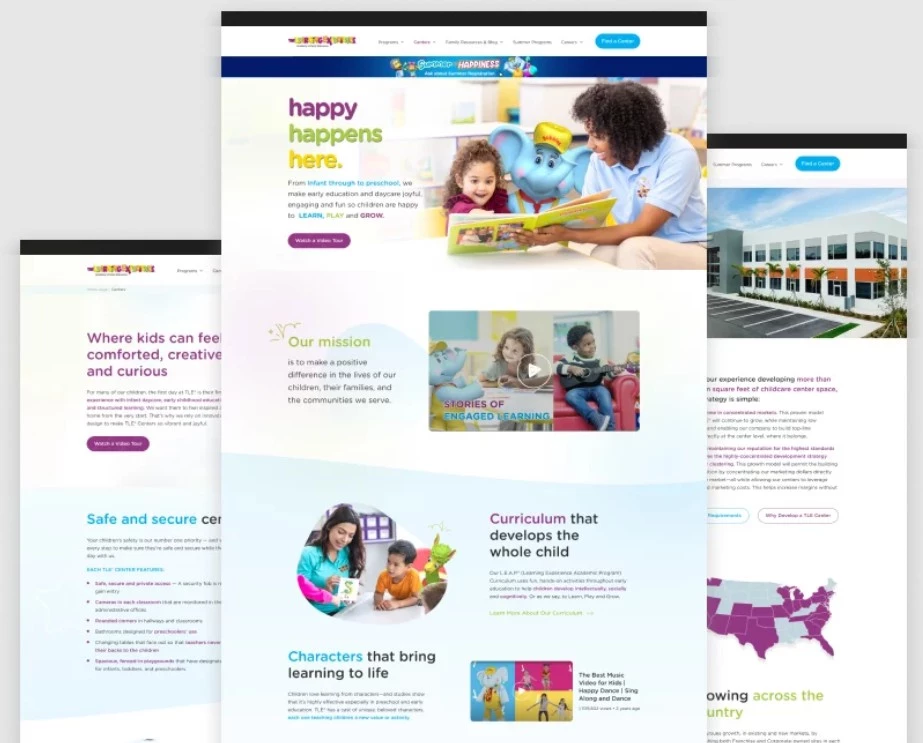
To course correct, TLE enlisted Web Loft Designs to overhaul its digital strategy.
The project went far beyond surface-level aesthetics. Changes included:
- Streamlining the parent and job seeker paths for maximum submissions as part of CRO efforts
- Creating emotionally resonant content to reposition TLE as a premium, growth-focused preschool
- Redesigning the career section as a recruitment magnet to address TLE's staffing issues
These changes instantly clarified TLE’s value, and now TLE’s site acts as a dual engine driving both high-value client inquiries and top-tier staff applications.
Equally important was what happened behind the scenes.
Proactive site management ensured that updates, monitoring, and performance checks became part of TLE's daily digital rhythm.
Overall, the stability provided meant fewer disruptions and a better customer experience, allowing the brand to sustain trust and drive growth.
"Our marketing teams enjoy working with Web Loft Designs," said Sharla Sookdeo, Associate VP for Marketing at TLE.
"They keep our projects moving along quickly, provide us sound advice on how we should proceed with our website issues, both design-wise and technology-wise, and make themselves instantly available when we run into a problem requiring immediate attention.
We appreciate their flexible and responsive nature, and their willingness to work with our timelines and special requests."
Protect What Your Brand Represents
With so much at stake when it comes to keeping a business website up and running, brands should definitely treat their websites more than just lines of code and content.
After all, in a world that expects near-instant results, trust, reliability, and foresight are simply non-negotiables.
“Every brand says it values trust, but the real test is whether that trust survives a glitch. Proactive management is less about fixing websites and more about proving, day after day, that a brand is trustworthy,” said Marsh.
To put this into perspective, Benjamin Franklin once said that “an ounce of prevention is worth more than a pound of cure.”
Given how much business is conducted through a screen nowadays, preventing that trust from breaking is brand stewardship in its purest form.