
Our analysts track the weekly developments reshaping organic visibility and AI discovery. Brands building search programs can partner with vetted SEO agencies for strategic implementation.
Google spent this week under pressure from every direction.
- Major publishers are weighing a full Google block, with USA Today, Politico, Reuters, and Reddit all reconsidering access.
- The EU hit Google with its first DMA fine, €890 million, plus a binding order to share search data with rivals.
- Google rewrote its crawl budget docs, confirming every site starts throttled until demand and quality earn more room.
- Google's SVP claimed AI Search sends billions of weekly clicks, a number the SEO community wants proof of.
Each story circles the same question of whether Google is still setting the terms or is quietly losing control of them.
Our Take: Who Gets to Define Visibility Now?
Google has set the terms of online visibility for two decades, counting on nobody being able to check the math.
We think this grip is weaker than it looks right now.
Publishers weighing a block have more pull than they realize, since Google's AI answers need fresh, crawlable content to say anything at all.
A few big sites cutting access wouldn't sink Search, but it would force Google to negotiate on click data for once.
The EU already proved the point, making Google share search data only because regulators required it and attached a price.
Below is the same pressure playing out in detail, and every one of these stories decides a little more of who sets the terms next.
Publishers Weigh Blocking Google Entirely
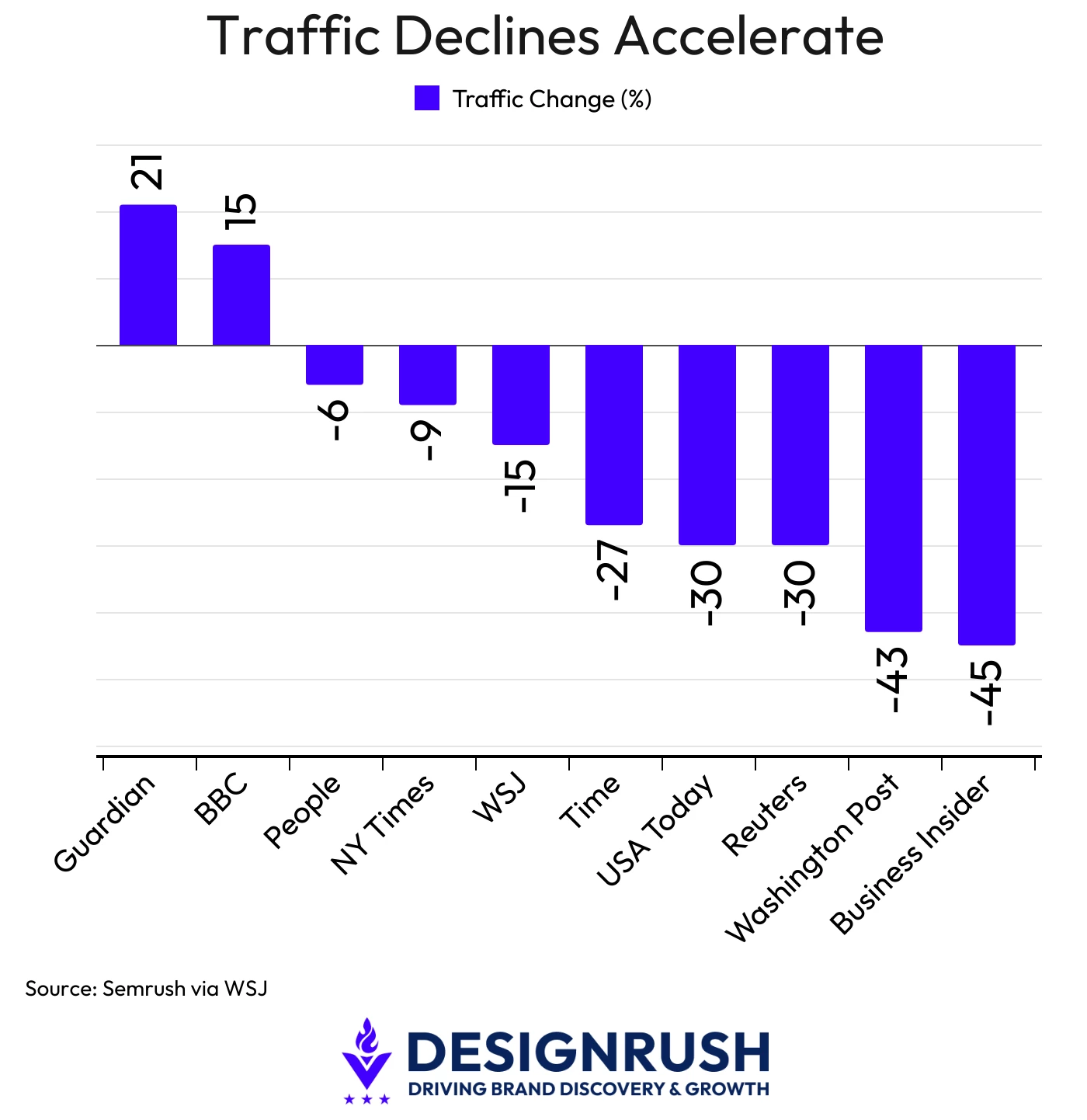
Several major publishers are seriously weighing whether to block Google Search from crawling their content, the Wall Street Journal reported.
USA Today, Politico, Reuters, the Economist, People, and Time are among the outlets reconsidering the trade of content for search traffic.
Gannett CEO Mike Reed said it's time for publishers to take a stand and stop accepting the current terms.
People Inc. CEO Neil Vogel called blocking "100% on the table," but said it isn't that simple.
"We can't actually block Google, because Google uses the same crawler for search as they do for AI," he explained.
Reddit faces the same dilemma, with its roughly $60 million Google data deal up for renewal soon.
Its content already feeds a big share of the AI answers that Google licenses through that deal, which raises the stakes on renewal.
Still, not everyone is ready to pull the plug, with The Economist's Josh Muncke saying his team is staying put for now.
"Traffic can be choppy and declining, but traffic is still traffic," he said.
The math is the same for every name on the list.
Once Google's referral traffic no longer pays for the content these publishers hand over, blocking it becomes the next rational move.
EU Cracks Down on Google Search and Play
The European Commission had a busy week, hitting Google with its first fine under the Digital Markets Act, €890 million, or about $1 billion:
- €460 million covers self-preferencing in Google Search.
- €430 million covers Play Store rules that blocked developers from pointing users to cheaper purchase options.
It also ordered Google to share its search data with rivals under the Digital Markets Act.
The penalty follows the €4.1 billion Android fine that the EU's top court upheld on July 2.
Rivals said that Google's post-March 2025 compliance proposal fell short, so this week's order replaces it with binding terms.
Google now has to share anonymized query, click, view, and position data with competitors, with pricing to be set by January 2027.
A separate Android measure gives third-party AI assistants deeper access to core Android functions.
The Commission said the change closes a gap affecting roughly 60% of EU users.
Across this week's actions, the Commission is treating Google's search data as an asset rivals can pay to license.
This approach could set the template for how regulators handle search data across the AI market.
Google Updates Its Crawl Budget Rules
Google quietly rewrote its crawl budget documentation this week, laying out how much crawl room a new site gets before Google opens up more.
The key addition is that every site starts at the same conservative default crawl limit, with demand and site health unlocking more room over time.
Google also detailed what drives this demand, where site size, update frequency, page quality, and relevance all factor in, per the changelog.
The update clarifies that crawl capacity is shared across all of Google's crawlers.
Heavy demand from Googlebot-Image can eat into the capacity left for indexing standard pages.
This also explains why new content can be slow to get crawled, since new or lower-authority domains are throttled by default.
The limit only lifts once a site proves enough demand and quality to earn more room.
So the practical step for a throttled site is to strengthen content and internal signals, which a technical SEO audit can map out.
Google Touts Billions of AI Search Clicks
Google is sending websites billions of clicks a week through AI features in Search alone, SVP of Knowledge & Information Nick Fox wrote on X.
Fox credited recent additions like subscription connections and preferred source selection.
We’ve been continuing to improve how we show links in our AI features in Search, to make it easy for people to click to websites. One of my personal gripes (as the team knows!) is whenever I can’t easily find a link for something I want to go deeper on.
— Nick Fox (@thefox) July 17, 2026
As we’ve continued to…
The replies weren't buying it, with the top response called "billions of clicks" a vanity metric with no denominator.
Others asked why Search Console still won't release click data for generative AI results if the numbers hold up.
This pattern holds across every story this week.
Google keeps announcing the value it sends back to the web while keeping the click data that would prove it locked up.
SEO Industry Insights
Google's Merchant Center began piloting AI performance data for shopping queries, SEO consultant Brodie Clark reported on X.
It's the first Google product to show query-level AI Overviews and AI Mode data, split into Discovery, Evaluation, and Purchase stages.
Clark called it a step forward on data but still short on anything actionable, with no way to cross-reference it against standard filters.
Ecommerce SEO News: Google Merchant Center is (surprisingly) the first Google product to give query data for AI Overviews and AI Mode.
— Brodie Clark (@brodieseo) July 14, 2026
I now have access to the new AI performance insights for one of my sub-accounts for a client. Here's what you need to know about this rollout:… pic.twitter.com/nfPSSAYFfq
Elsewhere, a federal judge dismissed Google's DMCA lawsuit against SerpApi, the data provider behind many rank trackers that agencies use daily.
The court ruled that public search results aren't copyrighted, so scraping them isn't circumvention.
SerpApi's CEO said even the low end of Google's damages theory reached $7.06 trillion, with the maximum topping U.S. GDP.
Meanwhile, SEO leader Alistair Lattimore summed up the irony in a LinkedIn post.
In the comments, he added that the bigger issue is where the scraped data ends up, which is Google's biggest AI competitors.
The ruling gives every rank tracker built on scraped search data more legal room to operate, whether the target was SerpApi or the AI labs downstream.
AI search tools now have a firmer legal footing to build on the same public data that Google spent years treating as only its own.
Three Ways to Reduce Search Data Blind Spots
The debate over search data may take years to resolve, but brands can start with three practical checks today.
- Check content licensing terms. If a platform you rely on renegotiates its Google deal, cut your dependence on that channel.
- Track crawl activity against Google's new default. Limited crawling on newer or smaller sites is expected, lifting as demand and quality grow.
- Cross-check Google's totals against your own analytics. One aggregate number rarely matches what a single site sees.
Each of these checks builds an independent read on search performance, one that a brand controls no matter what Google discloses.
For a breakdown of Google's tracking URL rewrite, ChatGPT's hidden retrieval pipelines, and the AI visibility measurement problem, check out last week's SEO roundup.
If Google stopped sending your site clicks tomorrow, would you find out from your own analytics or from a press release?
These top SEO agencies help brands navigate a search landscape where the platform holding the data doesn't have to show its work.