
Our analysts track the weekly developments reshaping organic visibility and AI discovery. Brands building search programs can partner with vetted SEO agencies for strategic implementation.
Search got pickier this week about what it shows.
- Google's AI Overviews now appear in 43% of searches, up from 15% a year ago, and AI Mode visits more than doubled in the same period
- AI models search for brands they already know 3.2 times more often than unfamiliar ones, giving established brands a head start before search even begins
- Google's new AI opt-out setting may cost publishers a Top Stories placement, but Google won't say whether the two controls are actually linked
- A forum with 500,000+ posts got hit with a manual action for thin content, and the timing points squarely at its AI auto-reply bot
Here's what that means for your search visibility strategy, followed by the full story behind each one.
Our Take: What Happens When AI Doesn't Know a Brand?
It evaluates whatever it finds live instead.
Don't assume brand recognition will carry you. Nearly a third of fan-out searches don't mention any brand at all. In those moments, AI has no familiar name to favor.
That creates an opening for smaller or lesser-known businesses, but only if they give AI something worth finding.
Thin, generic content doesn't just hurt rankings. It removes the chance to appear when a model is actively looking for the best available answer instead of a familiar name.
The sites that surface in these open searches tend to publish original insight and firsthand expertise.
That's information a model can't pull from memory alone. And that's where underdog brands can gain visibility.
What follows is the detail behind these developments.
AI Overviews Hit 43% of Search
The share of Google searches returning an AI Overview climbed from 15% a year ago to 43%, according to Similarweb.
That's a jump the industry hasn't seen slow down all year, even through a brief dip back to 12% in mid-2025.
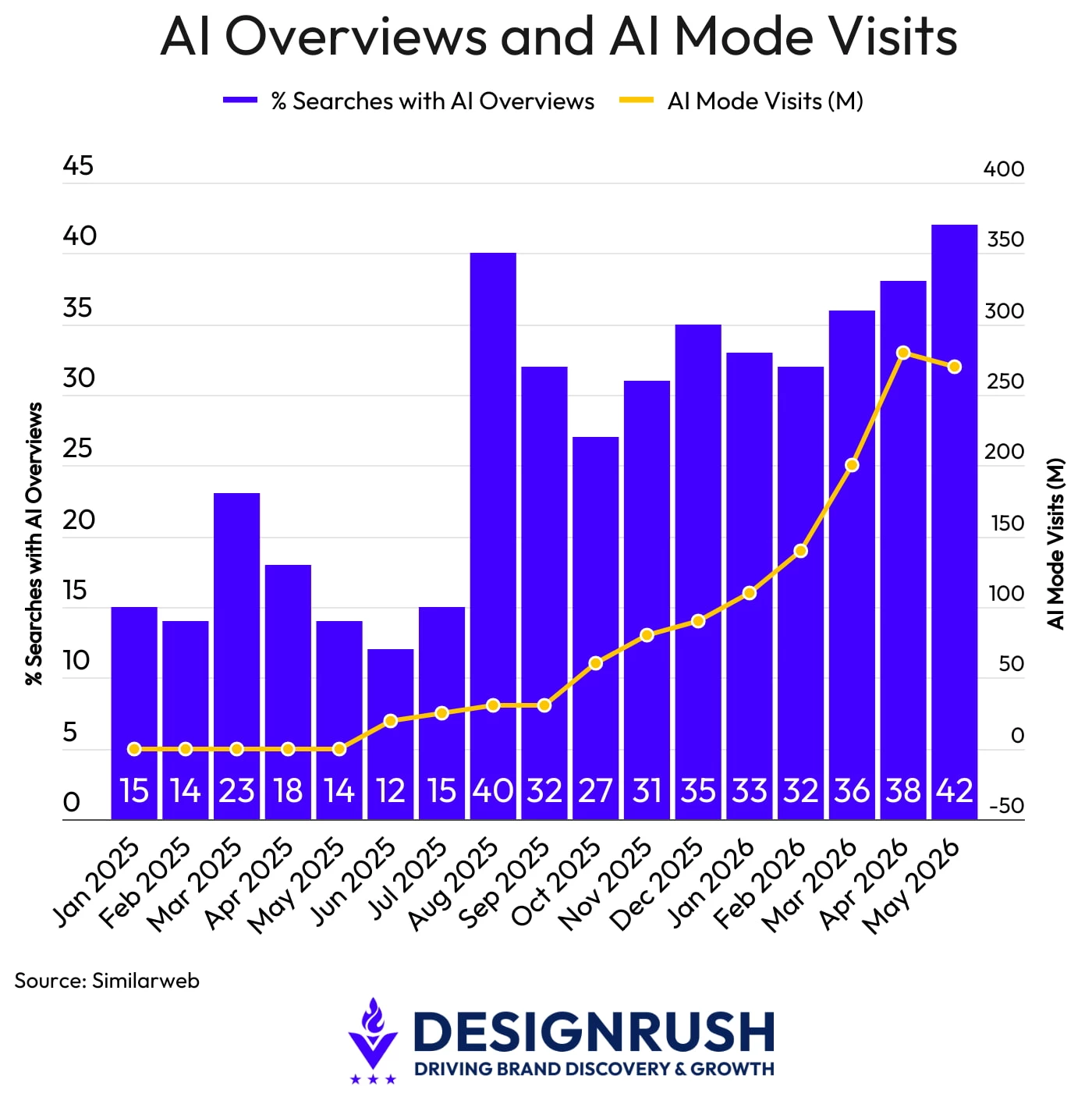
AI Mode visits followed a similar climb, but with a twist. Visits rose from roughly 120 million in mid-2025 to a peak near 320 million in March 2026, then eased back to about 280 million by May.
Even after that pullback, AI Mode traffic still runs more than double where it started. Neither AI Overviews nor AI Mode sends anyone to an outside site by default, the defining trait of a zero-click search.
The cost lands specifically on the sites that AI Overviews summarize.
Citations rose more than fivefold. But a citation isn't a click, which means the traffic a brand used to earn from ranking well no longer follows automatically.
There's one exception worth planning around. ChatGPT desktop referrals more than doubled after a May 7 update, climbing from 25% to nearly 60%.
That means a brand cited by ChatGPT is far more likely to see actual traffic than one cited inside a Google AI Overview.
Familiar Brands Get the AI Edge
AI models searched for brands they already knew 3.2 times moreoften than unfamiliar ones, according to a geoSurge study, an AI visibility analytics platform.
Researchers tested 66 U.S. buyer prompts 60 times each, generating nearly 4,000 responses and over 13,000 searches.
When a model searched for a specific brand by name, 63% of those searches went to one of its five most familiar names in that category.
The effect ranged from 41% to 82% familiar-brand preference depending on industry. Only 31% of searches named a brand at all.
Gemini, in one tracked example, searched for a payment provider outside its known top brands, proof that live search still finds names memory alone wouldn't surface.
The researchers flagged correlation, not causation.
Even so, a brand's presence in a model's training data shapes which brands get considered before a query result even loads.
That means marketing teams are now competing for placement in a dataset, not just a results page.
Opting Out Could Cost Top Stories
Google has started placing the Top Stories carousel inside AI Overviews instead of showing it separately below the fold, per an analysis from NewzDash.
The firm, which tracks search visibility for news publishers, found that nearly one in six U.S. trending news queries show Top Stories inside the AI Overview.
The tracking tool logged 15.5% in the U.S. and 17.46% in the U.K.
The two placements never appeared together, meaning a publisher's headline now lives inside the same feature that Google's new opt-out setting controls.
That overlap creates a risk publishers are already misreading, according to NewzDash founder John Shehata.
Sites often assume any AI opt-out works the same way. It doesn't. Blocking Google-Extended, the older crawler setting for AI training data, has no effect on Search visibility.
The Search Console opt-out that just went live is the one that matters here, since it's built into the same feature now running Top Stories.
Shehata's read is that using it will likely pull an outlet's headlines from Top Stories too. Google hasn't said either way, which means anyone opting out this month is making that bet blind.
Thin Content Now Means AI Content
A classifieds forum received a partial manual action for "thin content with little or no added value," per a Reddit post, affecting more than 168,000 threads and half a million posts.
The same site runs an inactive syndicated headline feed and an archived knowledge base, both textbook thin content, neither flagged in fifteen years spanning every major algorithm update.
Only the active forum section was hit.
SEO consultant Gagan Ghotra flagged the likely reason. The forum runs an AI chatbot listed as a staff member, active since 2023, with more than 111,000 posted responses.
Probably their AI bot auto replying to most of posts triggered this 😅 pic.twitter.com/Dsg26DoSwA
— Gagan Ghotra (@gaganghotra_) July 26, 2026
Google's own policy on thin affiliate content requires "original insight or research or analysis" to count as valuable.
An AI system answering from received knowledge, at scale, produces neither.
That explains why the forum's genuinely old, inactive content stayed untouched while its active AI output got flagged.
Reddit's reaction split along a familiar line. Some blamed Google's market dominance for the arbitrary-seeming penalty, arguing that thin threads exist on every forum, including Reddit itself.
Others noted that pruning old, low-value content is standard forum maintenance, penalty or not.
SEO Industry Insights
Google’s John Mueller told an SEO on Bluesky that there's no way to know which signal wins when your metadata contradicts itself.
His advice was to fix the conflict rather than guess how Google resolves it, since no publicly defined order of precedence exists.
The exchange followed a specific case. An SEO spotted a product ranking #1 in Google's Popular Products carousel showing "available" in structured data.
The rendered page said, "out of stock."
Hi @johnmu.com 👋 how do free listings handle availability? The URL below is #1 in Popular Products for "notebook gigabyte", but the rendered page shows out of stock while the server HTML / structured data says available. Is the crawl reading the pre-hydration state?
— Sebastián Galanternik (@sgalanternik.bsky.social) July 13, 2026 at 5:20 PM
[image or embed]
Elsewhere, Google engineer Gary Illyes admitted on LinkedIn that he didn't know whether pushing an "unavailable_after" indexing meta tag's date forward repeatedly carries any penalty.
In the comments, he wrote he had "no idea" and would need to check. His gut read was that it's fine, since Google just needs to recrawl the page to register the new date.
Former Google Search Quality staffer Pedro Dias confirmed the same approach worked at two large marketplace sites. But it needs enough lead time for a few crawls to catch the change.
Neither Illyes nor Google's documentation settles either question definitively. Sites fixing their own signal conflicts now aren't gambling on how Google's systems will interpret ambiguity later.
Three signals worth auditing today:
- Your brand's presence in AI training data. A model that doesn't know your brand won't consider it before the search even runs.
- AI-generated content running at scale for original value, not volume. Google's latest thin content actions target exactly that profile.
- Structured data against what actually renders on the page. Conflicting signals are a liability now, not a formatting detail Google resolves for you.
None of these depend on the search engine changing anything first. All three surface in an audit before they surface in a traffic drop.
For a breakdown of publishers weighing a Google block, the EU's $1 billion fine, and the crawl budget update, check out last week's SEO roundup.
If an AI model has never heard of your brand, would it even think to search for you?
These top SEO agencies help brands build the kind of presence AI systems recognize before a query is ever typed.