
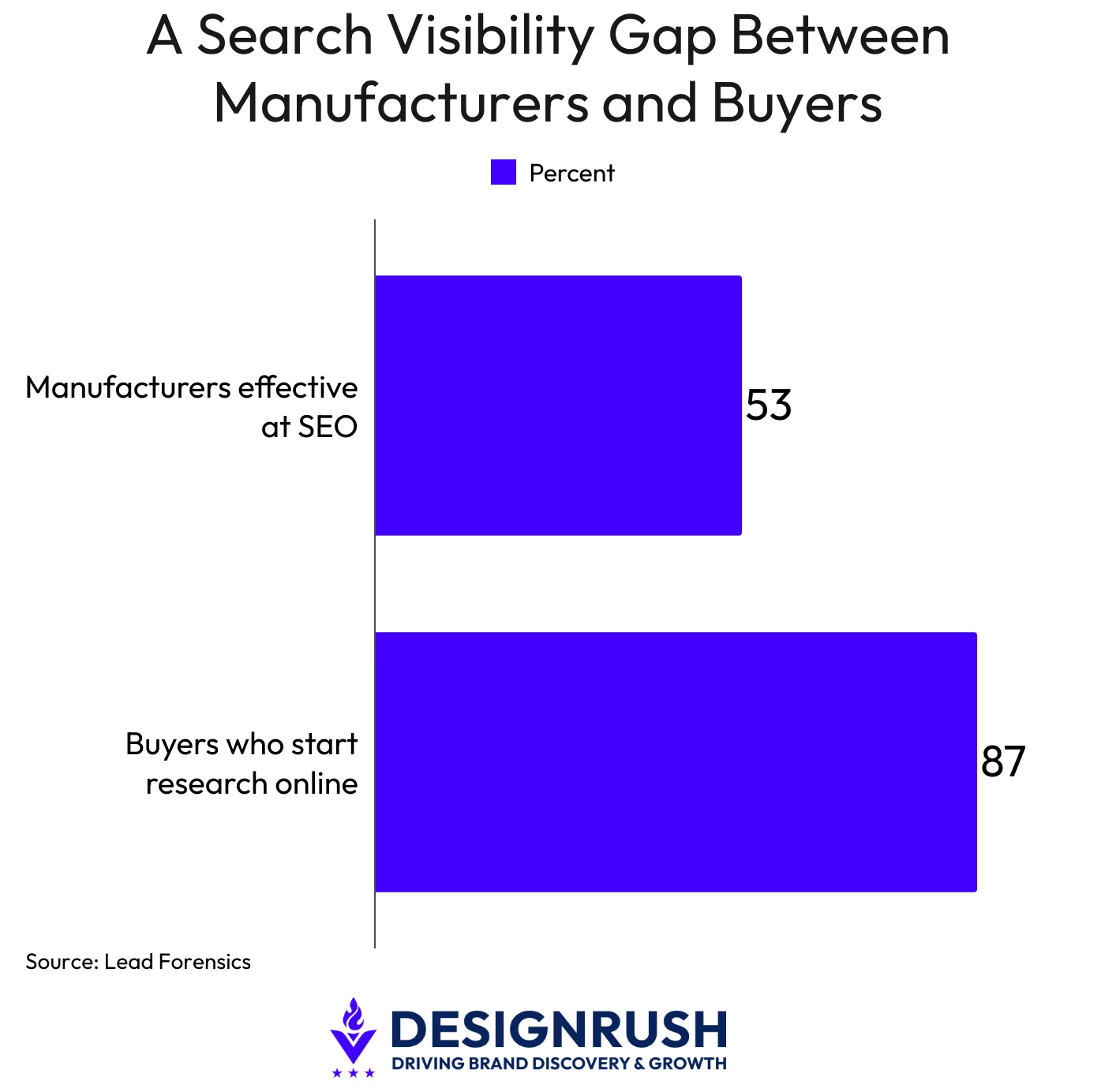
Only 52% of manufacturers consider themselves effective at SEO, according to a Lead Forensics roundup of 2026 manufacturing marketing data.
Meanwhile, 84% of industrial buyers say they use the internet as their starting point when looking for vendors. As a result, manufacturers face growing pressure to improve visibility.
 Yet Nathan Wheeler, founder and CEO of weCreate, says most still treat SEO like "a switch you turn on" instead of a process that gradually builds visibility.
In this DesignRush interview, he explains the misconception behind that, which queries produce RFQs, and how to read a competitor's visibility fast.

Who Is Nathan Wheeler?
Nathan Wheeler is Founder and CEO of weCreate, a digital marketing agency focused on helping manufacturers grow through search visibility and lead generation.
He has spoken on marketing and economic development for organizations including the U.S. Trade Commission, MNI University, and APEX Accelerator.
He also consults with corporate marketing teams on SEO and manufacturing lead generation.
The Misconception That Costs Manufacturers Revenue
What is the cost of getting SEO wrong?
For manufacturers, it begins with a basic misconception about what the work involves.
"I'll hear things like, 'Can you make sure my site is SEOed when you build it?'" Wheeler says.
That request assumes SEO ends at launch. SEO, per Wheeler, is the process of getting ranked higher in search results, in traditional Google and in LLMs, for the terms that bring in business.
Manufacturing has hundreds of keyword combinations for a single service. Covering that ground means working on-page and off-page at the same time.
On-page SEO means building pages, articles, and posts around keyword variations that map to what buyers search.
For instance, a core service page might cover "injection molding services." A first article might explain "How an AS9100 Certified Injection Molder Maintains Quality on Aerospace Projects."
And as the library grows, new content covers new markets, materials, certifications, and capabilities.
Off-page SEO, by contrast, demonstrates credibility to search engines and LLMs.
Wheeler measures that by the quality and quantity of sites linking back to it, whether those are industry associations, distributors, or trade publications.
"Much like on-page SEO, it's not a one and done game. Links and credibility need to be built over time, and it has to be done correctly. Bad links and bad citations do more harm than good," Wheeler says.
The Math Against Trade Shows
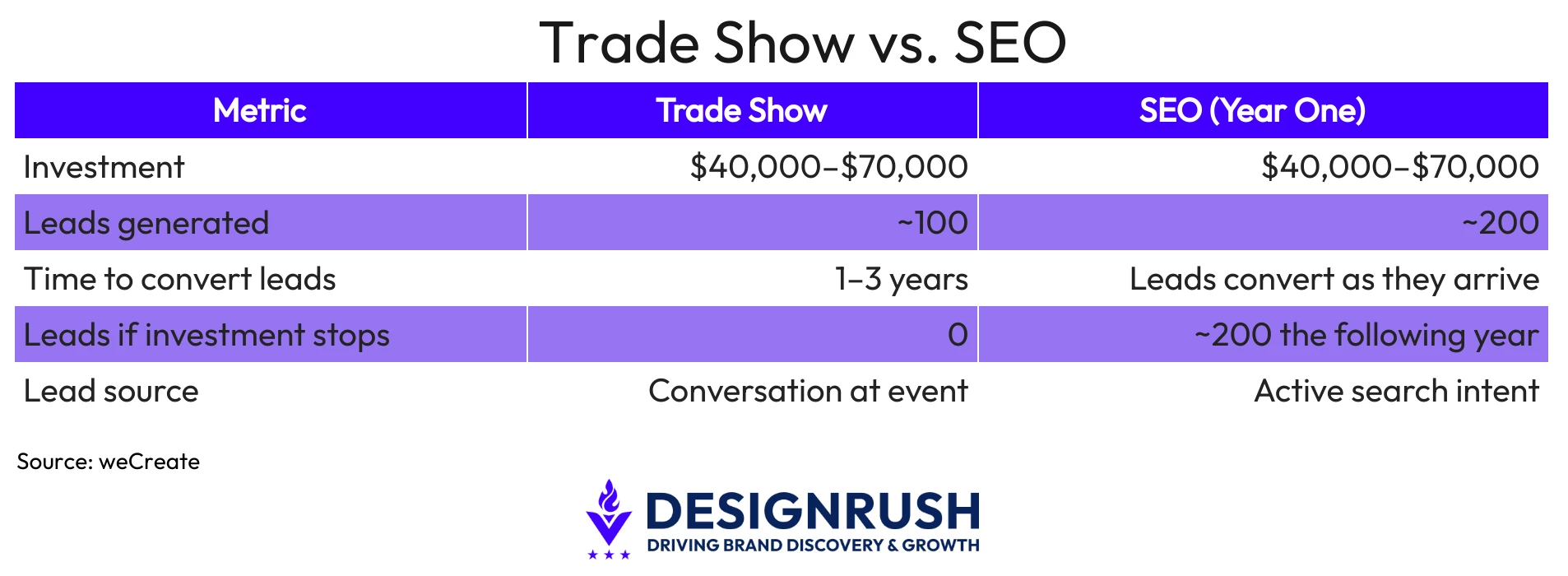
Exhibiting at a single trade show costs $40,000 to $70,000 after factoring in travel, booth space, marketing materials, and staff time.
That investment scans about 100 relevant leads into the trade show app. Converting them into customers takes one to three years. With luck, two become paying clients.
SEO runs on a similar budget for a year of work with a qualified agency.
"You end up with 200 leads that first year while things are still building, which means you'll see even more the second year. If you quit SEO, you still get those 200 leads the following year," Wheeler says.
 The leads themselves are different in kind, and that distinction explains why they close at such different rates.
Trade show contacts are people a company liked in conversation. SEO leads were already looking for what the company does before they ever made contact.
"These deals close faster and are more profitable because you weren't soliciting them, they were soliciting you," he adds.
Same spend. Two very different outcomes.
The pattern holds up industry-wide. SEO converts at 3.0% for manufacturing and distribution, nearly three times the 1.0% rate for PPC, according to First Page Sage.
For a company deciding where to put next year's budget, that conversion rate translates directly into which channel produces more paying customers for the same spend.
Not All Traffic Turns Into a Quote
A request for quote, or RFQ, only comes from one kind of search. Wheeler calls it transactional intent, and it looks nothing like the traffic that fills most analytics dashboards.
Transactional keywords are the ones a target customer would search when looking for a specific service.
"If you are a heavy fabrication company with lifting cranes and large-scale robotic welding, your customer might google 'Best fabricators in PA for large assemblies,'" he says.
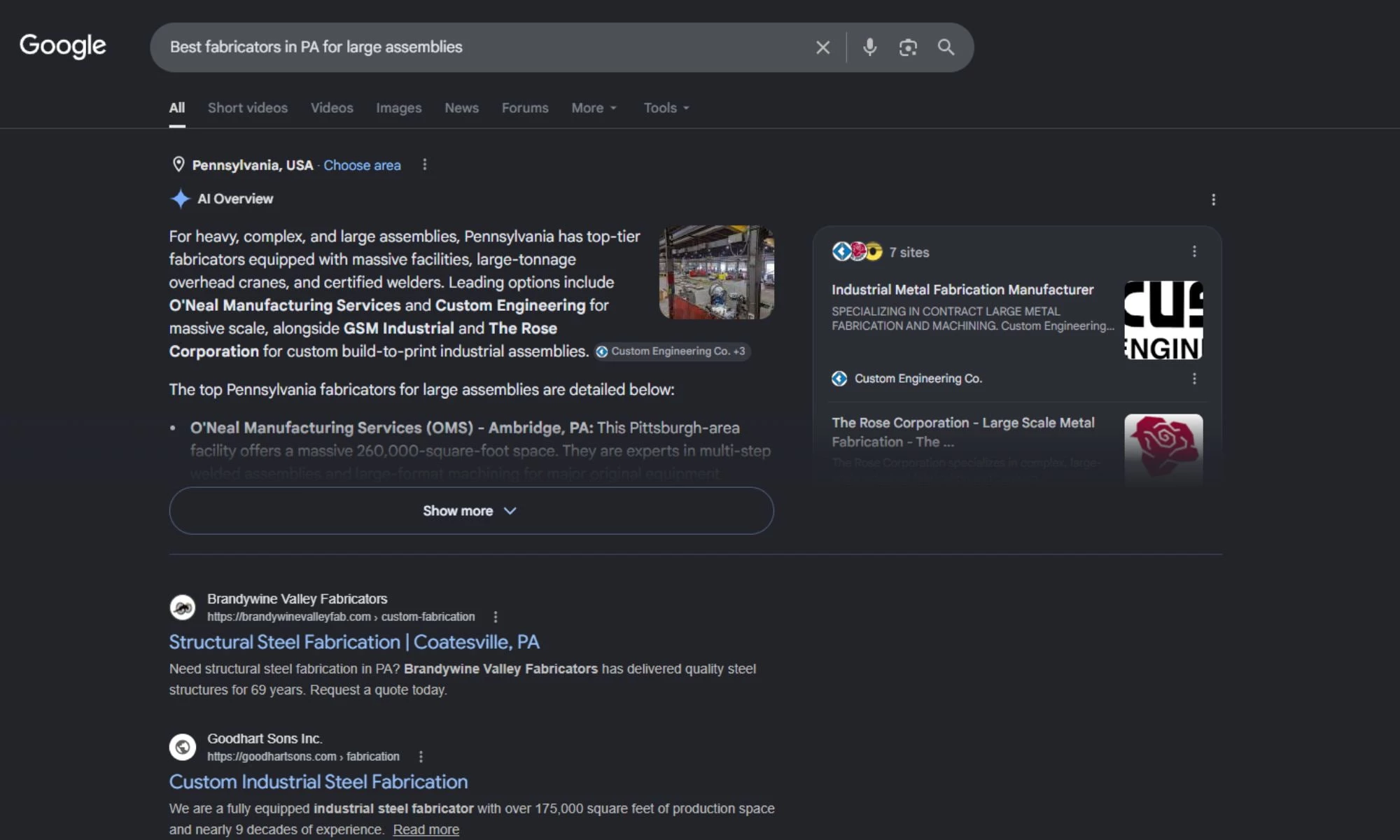
That query comes from someone who already knows what they need and is deciding who to hire.
Informational searches make up the rest of that traffic, and they come from a different kind of visitor entirely.
"Transactional keywords typically produce less search volume than informational ones, which pull in everyone else searching the topic," Wheeler explains.
Students researching the industry, competitors comparing methods, and casual browsers all fall into that wider pool.
An example might be "What's the efficiency gain in using robotic welding for large-scale fabrication projects."
That volume looks good in a monthly report, but it does not convert the same way.
"We like to put most of our focus on transactional keywords because those generate the best lead flow," Wheeler says.
"We do mix in non-transactional articles and titles to boost traffic, give other websites information to link to, and to rank for extremely competitive keywords."
What AI Search Is Changing for Manufacturers
AI search has not rewritten the rules of good SEO. It has raised the stakes for manufacturers who never followed them properly.
"If an SEO agency were doing things right from the start, there likely wouldn't be much of a change in strategy," Wheeler says.
That means explicit service details, content added over time, and credible links, the same foundation that was always required.
For manufacturers who built that foundation, the shift is manageable. For those who did not, the gaps are becoming more visible as traffic patterns change.
Google traffic is dropping while AI traffic grows.
"Because of this, we put more emphasis on published articles, better information on a client's website, and publishing content on third-party websites," weCreate’s CEO adds.
That approach targets exactly what most industrial sites still lack. As a result, manufacturers building it now are competing against very few others doing the same.
A Five-Second Read on Competitors
Two manufacturers can offer nearly identical capabilities and still land in very different places on a search results page. Wheeler says he can tell why in about five seconds.
He starts with the homepage. First, he checks whether the SEO title uses keywords or just repeats the company name.
Then he looks at the page itself. Does the page explain what the company does, or does it leave visitors guessing?
That single check on page depth predicts lead flow more reliably than most companies expect.
The homepage only tells half the story. Wheeler also runs a company's off-page SEO score against its competitors using dedicated software.
What he measures is how much credibility the site has earned through links from other sites.
"If the company I'm evaluating has a 2 and the competitor has a 15, then they're not going to compete on valuable search terms," he says.
That distance in off-page authority is what separates a company buyers find from one that stays invisible no matter how good its homepage looks.
And for most manufacturers, closing that distance costs less than their already-approved trade show budget.