
Insurance Claim Denials: Key Findings
- 15% of claims fail on first submission, and SwiftCare Billing shows how tighter workflows can prevent revenue loss before it starts.
- Its 98% clean-claim rate proves that QA, documentation, and scope alignment are levers for speed and reliability.
- Medical practices with complex operations can apply these same methods to protect margins and ensure payment integrity.
Nearly 15% of insurance claims get denied on the first try, according to the American Hospital Association’s (AHA) 2025 Environmental Scan.
Providers spend around $19.7 billion a year reworking those denials, and more than half of the time, the claims are paid anyway, Premier’s 2024 survey found.
That’s a lot of wasted time, effort, and overhead.
One major culprit? Coding.
Coding-related denials climbed 126% after the 2023 updates to Evaluation and Management (E/M) documentation were released.
According to ICD10monitor, this surge proved how even minor workflow missteps can slow payments and disrupt business operations.
When delivery and documentation don’t match, payments stall and margins shrink. That’s true whether you’re billing insurers.
SwiftCare Billing, a U.S. medical billing provider that supports 150+ specialties and reports a 98% clean-claim acceptance rate, points to three compliance gaps practices often overlook:
- E/M code misalignment
- Skipping routine internal claim audits
- Incomplete medical documentation
For many practices, the fix starts with the basics: reviewing E/M coding, running internal audits, and tightening documentation.
Editor's Note: This is a sponsored article created in partnership with SwiftCare Billing.
What These Gaps Really Cost
If you’ve dealt with billing debacles, you know how fast small errors compound, leading to major confusion, delays, and lost revenue.
Unsurprisingly, the same is true of denied or mis-coded claims.
These cracks in your process can become immensely troublesome, especially as they create entirely avoidable admin work, while slowing cash flow.
“Small process errors are where companies lose time and money without realizing it,” said Ghazanfar Bashir, CEO of SwiftCare Billing.
“Operations stay predictable and revenue keeps moving when documentation is consistent, workflows are reviewed, and audits happen on the regular.”
Let’s break down the three trouble spots and how to fix them.
Risk 1: E/M Code Misalignment
E/M misalignment has always caused denials, but the 2023 coding update made the problem worse.
Denials related to coding jumped 126% as providers struggled to meet the new documentation standards, according to MDaudit’s 2024 Benchmark Report.
For example, an established-patient office visit (CPT 99214) billed without sufficient documentation or with the wrong place-of-service or modifier could be denied.
Errors like these, using the wrong CPT code or pairing it incorrectly, occur in about 12% of claims and often contribute to payment delays
In short, proper care was delivered, but the paperwork didn’t match. Talk about a mess.
Here’s how one clinic cut A/R from 60 to 18 days while boosting first-pass claim approvals:
When deliverables don’t match the plan, errors pile up, approvals slow, and revenue suffers.
Providers can avoid these breakdowns with clear documentation standards, regular audits, and scope-to-submission alignment that keeps claims clean. Its 98% clean-claim rate proves the model works.
How can companies stay ahead? Review your current coding practices against the 2023 CPT E/M descriptors. Focus on high-volume or complex visits, and ensure documentation fully supports each code.
Regular checks and training help keep claims accurate and payments on track.
Risk 2: Skipping Routine Internal Claim Audits
Skipping regular audits is like sending out invoices without a second look. Some might go through, but others come back with problems you didn’t catch.
Safe to say, this is not a good look.
Internal audits give practices a detailed look at where errors might be hiding, which is why internal audits are integral to catching issues early.
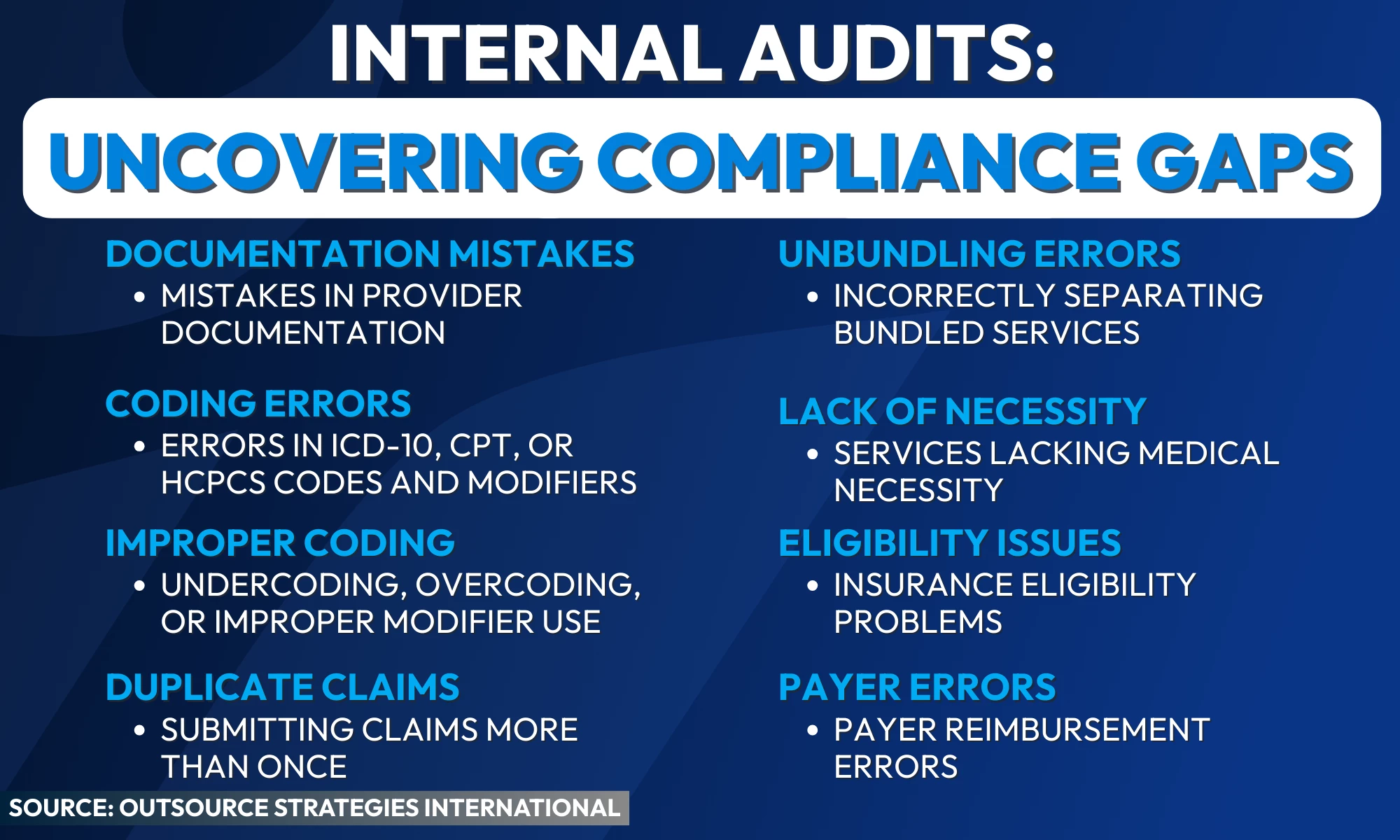
According to U.S.-based revenue cycle management provider Outsource Strategies International (OSI), these audits review documentation, coding, and billing processes to catch compliance gaps before claims are submitted.
Common issues these audits uncover include:
- Mistakes in provider documentation
- Errors in ICD-10, CPT, or HCPCS codes and modifiers
- Undercoding, overcoding, or improper modifier use
- Duplicate claims
- Unbundling services incorrectly
- Services lacking medical necessity
- Insurance eligibility problems
- Payer reimbursement errors
- Non-compliance with payer rules
The takeaway? Regular audits help find small mistakes early, keep processes simple, and stop slowdowns before they start.
See how accurate coding and audits prevent denials, reduce rework, and protect revenue:
The next step is to establish an audit routine that includes coding, documentation, and claim submissions.
Pair internal staff reviews with periodic third-party audits for stronger oversight.
Then track recurring issues to fix weak points and speed up payments.
Risk 3: Incomplete Medical Documentation
Some claims get denied not because of bad care, but because the paperwork doesn’t tell the full story.
Common culprits include:
- Missing treatment notes
- Vague progress updates
- Incomplete patient histories
These lead to reimbursement delays or outright rejections.
Thorough documentation is essential for coordinating work and ensuring accurate outcomes.
Why? Because teams with weak records usually end up dealing with:
- Constant follow-ups
- Workflow friction
- Delayed or reduced payments
This is how proper documentation prevents resubmissions, speeds payments, and reduces admin work:
What to do next? Treat documentation like part of the product.
Set clear standards for what gets recorded, such as patient info, clinical details, treatment plans, and authorizations.
Then make it stick.
How? Use smart templates, audit often, and train your team to build clean records as they go.
And there you have it.
Smoother audits, faster claims, and payments that don’t need chasing. Once your processes are documented and standardized, other operations (from approvals to project delivery) run more predictably.
Lock Down Your Billing Process
Operational errors don’t have to drain your revenue.
Top medical billing firms say the same thing: get E/M coding right, keep up with audits, and make sure documentation is complete. That’s what keeps billing smooth and reliable.
The focus stays on high-risk areas, clear standards, and consistent oversight.
Using HIPAA-compliant billing keeps patient data safe and everyday operations running smoothly:
This approach catches mistakes early and keeps claims moving, so the team has more time for patient care.
It works in any complicated workflow, but in healthcare, mistakes can be costly.
Practices that close these compliance gaps see approvals come through faster, audits run more smoothly, and revenue stays steady
Closing the Gaps in Healthcare Billing
Breakdowns happen. But they can be fixed by tightening documentation, simplifying processes, and aligning care with claims.
That’s what gets approvals moving, audits running cleaner, and revenue steadier.
And if those steps still don’t clear the backlog? Bring in a billing partner like SwiftCare.