
The era when AI agents were considered emerging technology has passed. By now, businesses have realized how much AI can help automate workflow processes and make decisions.
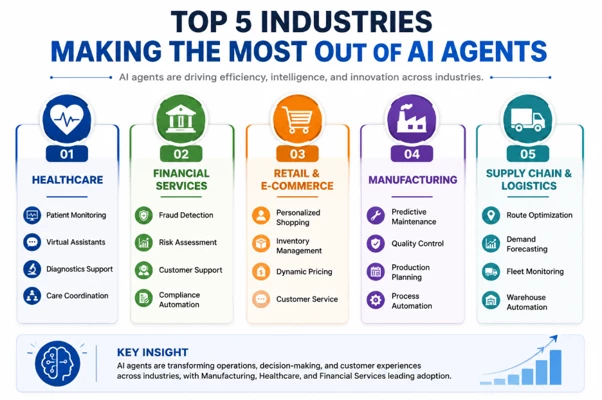
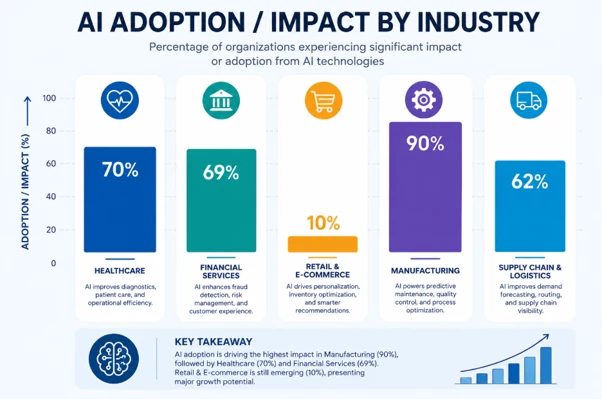
Though agentic AI is gaining momentum across various industries, early adoption for workflow automation has been strongest in healthcare, manufacturing, supply chain, retail, and fintech companies.
With the growing demand for AI agents, businesses have begun working with specialized AI agent development companies to develop large-scale solutions that.
Industries Driving the Adoption of AI Agents
People want real-time communication and prompt responses.
Regardless of whether they need information, compare options, or just want to buy something, every moment counts.
This is the reason why enterprises turn to an AI agent development company.
With their ability to understand context, process requests, and provide responses almost instantaneously, AI agents enable organizations to achieve quicker and customized interactions without the need for any human input.
Even though there are plenty of industries that have started using AI agents in their workflow, some of them are reaping the benefits faster and more effectively than others.
Because of their focus on data and efficiency, they make excellent candidates for agentic AI development.
These include:
1. Healthcare
Hospitals and medical institutions are collaborating with companies for AI Agent development for healthcare to improve the process of patient interaction, document management, and administrative operations.
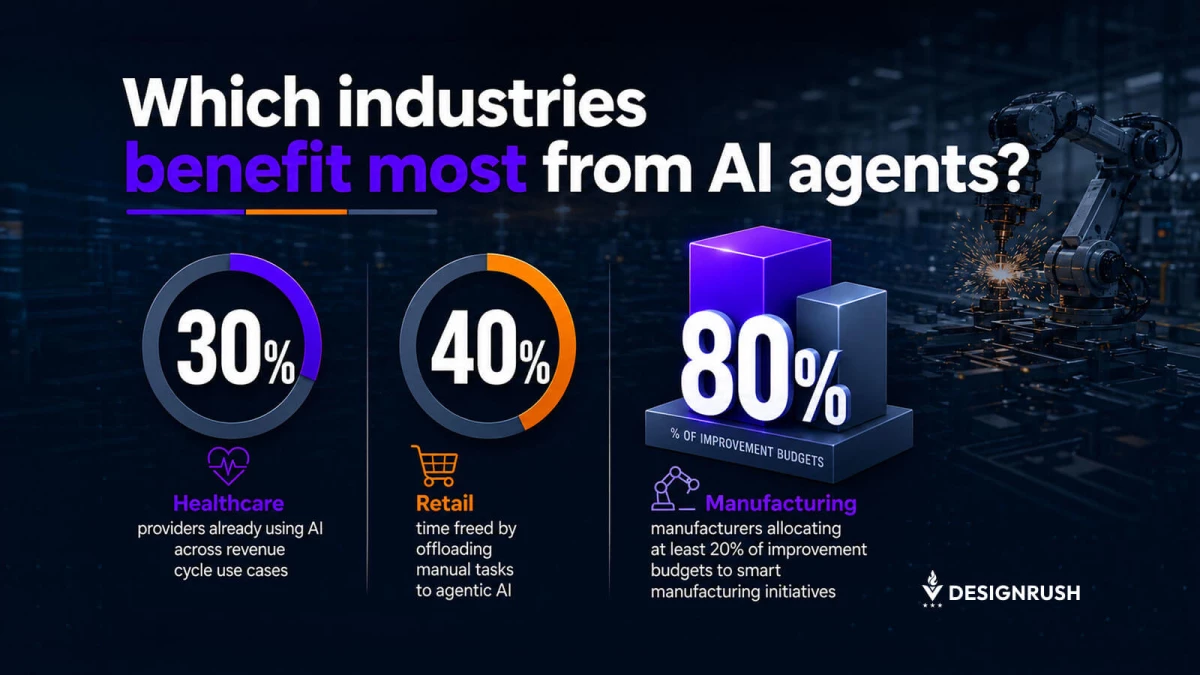
In 2025, McKinsey found that more than 30% of providers were already using AI and automation across seven revenue cycle use cases.
The study also pointed to potential cost-to-collect reductions of 30 to 60%, along with faster cash collection and less time spent on administrative work, giving staff more space for patient care.
2. Fintech
McKinsey also found that fintech companies are using AI agents in their systems to spot fraud cases, ensure regulatory compliance, manage risk, and provide customer services, increasing investigation handling by 15 to 20%.
3. Retail & E-Commerce
The use of AI agents in retail companies aims to personalize experiences for customers and handle inventories.
Retail brands adopt AI agent solutions for their business operations like automating order fulfillment systems.
Up to 40% of retail merchants’ time could be freed by offloading manual tasks to agentic AI, McKinsey estimates.
4. Manufacturing
According to Deloitte’s 2025 Smart Manufacturing and Operations Survey, 80% of manufacturers plan to allocate at least 20% of their improvement budgets to smart manufacturing initiatives.
The manufacturing industry uses AI agentic workflow systems to automate manufacturing process optimization, including production planning, maintenance prediction, and quality control.
5. Supply Chain & Logistics
Logistics and supply chain management companies are benefiting from route optimization, demand forecasting, shipping tracking, and real-time inventory management through AI agents.
Several factors are driving the development of AI agents:
- Burst of Enterprise Data
- Businesses produce vast amounts of structured and unstructured data each day. AI agents assist in analyzing data and turning it into useful information.
- The need for Intelligent Automation
- These businesses want more than basic automation from their systems.
- Growing Customer Demands
- Consumers have higher expectations when it comes to customer experience and services.
- High Operational Complexity
- AI agents can help simplify operations in complex industries such as healthcare and fintech.
- Emerging Generative AI Technologies
- Rapid progress in generative AI and AI infrastructure has enabled the development of agentic AI systems.
- Pressure for Efficient Work and Lower Costs
AI agents can help organizations improve efficiency, reduce costs, and support business growth.
What Makes AI Agent Adoption Difficult for Businesses
Though adopting AI agents offers an array of benefits for organizations, firms have to overcome various problems in order for the adoption process to be successful.
Data Issues
The availability of huge volumes of correct and available data is required by AI agents for their operation. Otherwise, the quality of analysis conducted and the quality of decisions made would be affected by a lack of proper data.
Incorporating AI in the Current Infrastructure
Many businesses lack the infrastructure needed to support AI agents.
As a result, the integration process becomes rather complicated.
Security and Compliance
Since AI agents frequently deal with sensitive business and personal data, organizations should comply with various regulatory policies regarding data.
Moreover, strong security mechanisms are required for the protection of such information.
Human Monitoring and Governance
Although the use of AI agents does not require any form of human intervention, oversight and governance are critical.
Simply put, companies need clear rules and oversight for AI-driven decisions.
Change Management and Employee Adoption of AI
Implementing AI agents requires more than new technology. It follows a structured set of steps:
6 Steps Towards Successful Integration of AI Agents Within Business Processes
Successful integration of AI agents requires something other than simply embracing innovative technologies.
What is required is a systematic way of integrating AI efforts with business objectives and growth strategies.
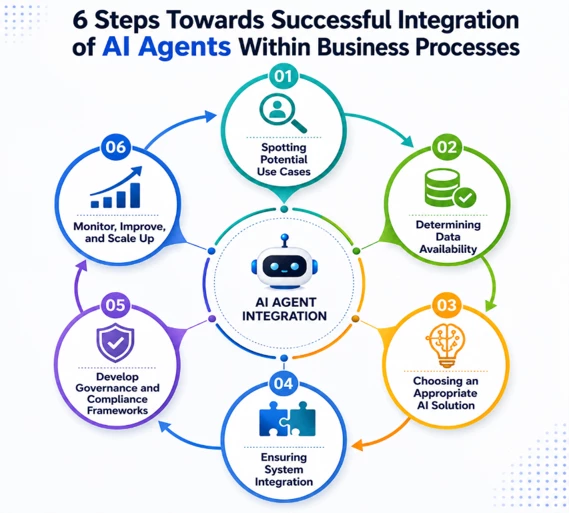
1. Spotting Potential Use Cases
Firstly, it is crucial to look into those areas where AI agents can be implemented to bring tangible benefits.
The emphasis should be placed on those workflows that involve streamlining tedious operations using AI agents.
2. Determining Data Availability
AI agents are dependent on quality data for their efficient performance. Companies should conduct analysis concerning data availability and its suitability before implementing AI.
3. Choosing an Appropriate AI Solution
This stage may imply either building customized AI agents or implementing off-the-shelf solutions that fit business needs well. Here, companies should define integration aspects.
4. Ensuring System Integration
The use of AI agents must be seamlessly embedded into organizational systems to make them effective.
5. Develop Governance and Compliance Frameworks
Organizations must devise policies on data security, compliance, monitoring, and human supervision.
Good policymaking will contribute to reducing the risks involved in the use of AI.
6. Monitor, Improve, and Scale Up
The use of AI should be treated as a continuous process that requires constant monitoring and improvement in order to effectively integrate AI agents within various business processes.
The Future of AI Agentic Adoption Across Industries
With the continuous development of technology, AI agents will play an integral part of the operational processes of organizations.
Businesses are currently moving from automation towards more sophisticated agentic systems.
By 2033, the AI agents market is expected to reach $182.97 billion at a CAGR of 49.6%, according to Grand View Research.
Therefore, companies from various sectors are becoming more interested in developing software using artificial intelligence.
In the future, the use of artificial intelligence agents is expected to evolve from handling specific tasks to handling entire work processes, and companies that build AI-powered app solutions effectively to compete will be better positioned within the digital environment.