
Disney Generative AI Strategy: Key Findings
- AI governance must be embedded from the start, treating control as a system architecture layer and not a compliance afterthought.
- Rights management is now a technical function, requiring AI outputs to be constrained by brand-safe, legally approved assets.
- Observability is key to sustainable AI adoption, enabling real-time oversight, accountability, and continuous refinement across teams.
Walking into a Disney creative session today, you’d still sense the same blend of imagination that has defined the company for decades.
But behind the scenes, something else is evolving too; a quiet revolution in how powerful generative AI is being integrated into the fabric of work and consumer experience.
“Disney isn’t just experimenting with AI tools, but embedding them into everyday workflows and product features,” says Malay Parekh, CEO of Unico Connect, a leading global software development company.
“Disney’s integration of AI gives us a rare behind-the-curtain look at how a large organization navigates the thrilling promise and sobering risks of the technology.”
Parekh says what stands out isn’t just that Disney is using AI. It’s mainly about how they’re doing it.
Their approach is deliberate, with careful intention, guardrails, and a keen eye on rights, governance, and controlled creative output.
As a firm that has delivered nearly 300 custom digital products, Unico Connect applies the same principles in its client work.
The company combines fast iteration, governance-first design, and deep IP awareness to help enterprises scale AI responsibly.
Editor's Note: This is a sponsored article created in partnership with Unico Connect.
Embedding AI into Operations Without Losing Control
Many organizations fall into a common trap: adopting AI where it’s flashy and visible, such as in marketing, customer service, or design prototypes.
But they often keep it at arm’s length from the core of how people actually do their jobs.
Disney’s model flips that.
By integrating AI into the tools employees already use, the company is not only boosting productivity but also ensuring the technology is visible and manageable.
That’s significant because Disney’s intellectual property, including its characters, narratives, and brand elements, can’t be casually generated or remixed.
It carries legal rights, emotional value, and cultural weight that demand careful handling.
“Disney’s approach acknowledges that the most valuable AI systems are not the ones that can generate the most, but the ones that generate responsibly,” says Parekh.
“And in Disney’s world, that means creative possibilities bounded by brand and legal constraints, rather than boundless experimentation.”
What the AI Adoption Data Really Tells Us
To understand Disney’s strategy, it helps to take a step back and analyze the broader enterprise landscape.
These data points show that while businesses are adopting AI at scale, governance often remains inconsistent or underdeveloped:
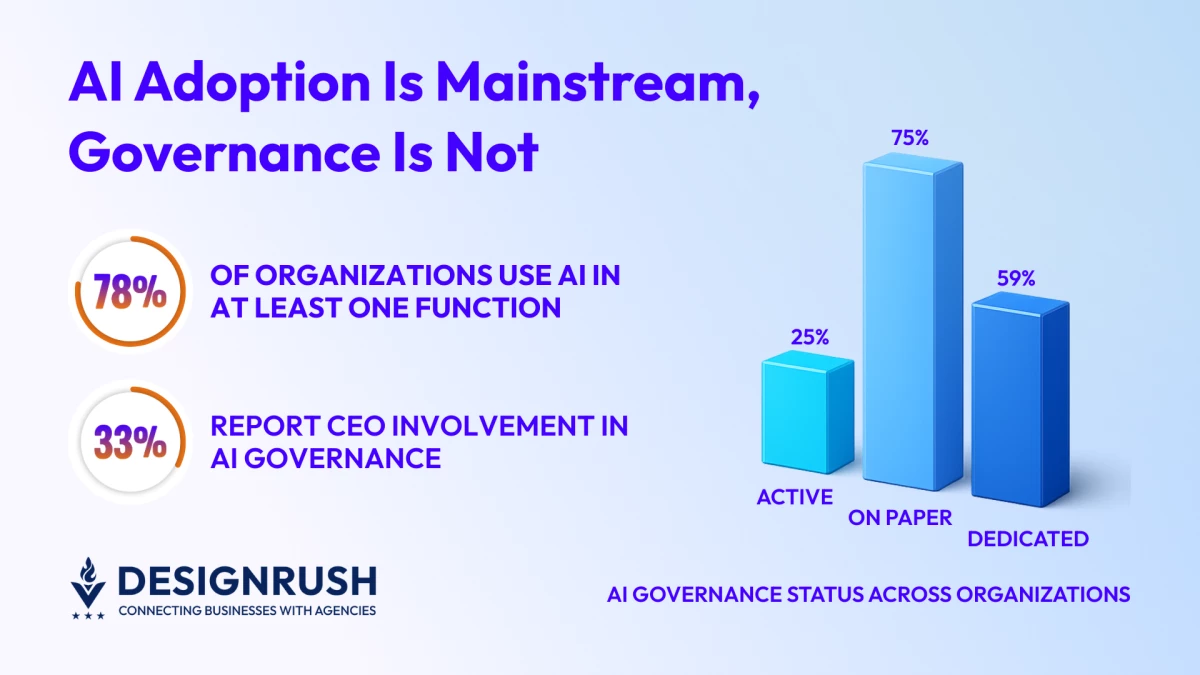
- 78% of organizations use AI in at least one business function, showing that adoption has reached mainstream scale across industries.
- 25% of organizations have fully implemented AI governance programs, revealing a significant gap between use and structured oversight.
- 75% of organizations report having AI usage policies on paper, but only a fraction translates these into mature governance frameworks.
- 59% of organizations have established dedicated AI governance roles, indicating that centralized oversight is becoming more common.
- Despite this, only 33% of enterprises report CEO involvement in AI governance, showing that leadership ownership is still uneven but emerging as a trend.
These figures reveal a core theme.
While AI integration is widespread, comprehensive governance, particularly rights management, compliance roles, and executive accountability, often trails adoption.
Engineering Guardrails into Everyday AI
Disney’s strategy, Parekh notes, offers a clear path forward for tech leaders and developers:
1. Governance First, Experimentation Second
Rather than retrofitting compliance after the fact, Disney appears to treat governance as an architectural requirement; a layer as foundational as security or data privacy.
This ensures creative tools scale with control, not uncontrolled sprawl or legal exposure.
2. Rights Management Isn’t Optional
When generative AI can produce outputs that resemble proprietary content, rights management becomes a technical requirement, and not a legal afterthought.
Disney’s controlled variation strategy, where it constrains what AI can generate to safe, approved assets, protects both brand and audience trust.
3. Observability Enables Improvement
Embedding AI into workflows where humans operate day to day creates visibility across teams.
That visibility allows organizations to monitor usage patterns, assess risks, and refine governance in real time; a far cry from shadow AI use that slips under the radar.
A Playbook for Developers and CTOs Alike
While Disney’s scale and IP complexity are unique, the principles can be used across the board:
- Start with use cases that matter: Build AI into the workflows where it will be used daily, and not just where it looks exciting.
- Turn governance into a system requirement: Define how outputs are controlled, monitored, and audited before you launch.
- Make rights work part of engineering: Integrate constraints into pipelines rather than retro-fitting legal reviews later.
“These steps turn AI from a set of experimental tools into a strategic, manageable capability that can grow with the organization’s needs,” says Parekh.
Navigating the AI Adoption Crossroads
Most companies today are somewhere in the awkward middle; keen to adopt generative AI but unsure how to control it.
The statistics prove that while adoption is widespread, governance is certainly falling by the wayside.
Disney’s model pushes the industry to reconsider what success looks like.
It’s not about how fast AI is deployed, but how thoughtfully it’s shaped to remain useful, safe, and aligned with human intent
At its core, this isn’t a story about technology. It’s an organizational story about trust, accountability, and the intersection of innovation with ethics.
“While Disney’s careful integration of generative AI may sound cautious, it actually primes the company for sustainable impact and provides others with a template for doing the same,” says Parekh.
Where the Magic of Disney Meets Strategic Discipline
Disney’s strategy reminds us that technology needs structure.
Generative AI has the potential to amplify productivity and creativity.
But without governance, rights safeguards, and controlled output, its risks can spiral faster than leaders anticipate.
What Disney offers isn’t a futuristic fantasy. It's a grounded, real-world example of how large organizations can multiply value from AI responsibly.
“In a future racing toward automation and augmentation, the question isn’t whether you adopt AI.
“It’s whether you build it in a way that amplifies human potential without eroding trust, rights, or control. And that’s the playbook worth writing,” says Parekh.